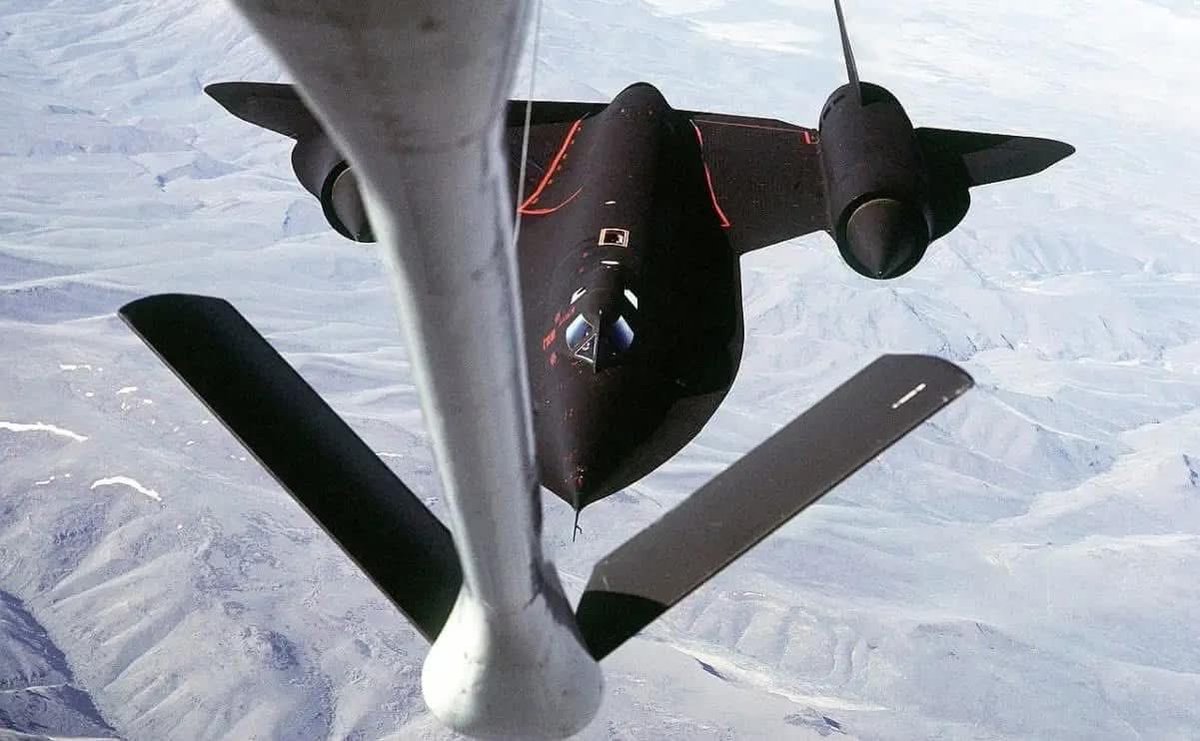
Why did the SR 71 have to refuel immediately after takeoff? it is not because the SR 71 leaks so much that is a false rumor. Please pass this article around so the truth gets out.
I found the answer in an interview with Rich Graham. It was so the SR-71 could accelerate past Mach 2.6
Many people believe we refueled after takeoff because the aircraft leaked fuel so profusely that we needed to fuel up quickly.” That is NOT TRUE. It was so the airplane would not blow up 🔥
Col. Richard H. Graham, a former Blackbird pilot. “We had to refuel right after takeoff for only one reason, and it wasn’t because we leaked JP-7 fuel on the ground. Yes, the plane does leak fuel, but not enough to require refueling after takeoff. “The aircraft had three liquid nitrogen Dewar flasks containing 260 liters of liquid nitrogen located in the nose wheel well.
The only way to ensure a 100 percent inert atmosphere in each fuel tank was to refuel the plane in flight, full of JP-7, allowing ambient air in each fuel tank to vent overboard. Once fully fueled, gaseous nitrogen would now dominate the space above each fuel tank as JP-7 burned off. The nitrogen gas pressurized each fuel tank to 1.5 psi above ambient pressure and inerted the space above the heated fuel to prevent autogenous ignition.
This is why we refueled after takeoff. Then we could safely accelerate beyond Mach 2.6.”
There was an exception, it was called a Rocket Ride. 🚀
“From takeoff to landing, the total mission time was fifty-seven minutes, and we named it the ‘Rocket Ride.’
This mission was very demanding because everything happened so quickly: departure, acceleration and climb, cruise, and descent for landing. Mentally, you had to stay well ahead of the plane on this mission compared to others.”As Graham explains, the demilitarized zone (DMZ) between North and South Korea is 160 miles long and only 2.5 miles wide; it is the most heavily militarized area in the world. The Rocket Ride missions aimed to monitor tunnels and military facilities on the north side of the DMZ that North Korea had dug over many years in preparation for future hostilities with South Korea.
Rocket ride required a yo-yo, which was a maintenance nightmare; however, it could be done by manually inerting the fuel with nitrogen.
Graham flew the first Rocket Ride with Don Emmons as Reconnaissance System Officer (RSO, the Blackbird back seater). According to Graham “Our mission was planned to fly down the middle of the DMZ, imaging directly under the SR-71 and North Korea about fifty-seven miles.” The route of flight took them directly from Okinawa, northward over the Korean Straits, into the Sea of Japan, to make a northeast-to-southwest pass through the DMZ, then exit into the Yellow Sea and return to Okinawa.
Posted by Linda Sheffield