The RWA decade is here. But putting assets onchain is only the beginning.
In a recent @Cointelegraph Chain Reaction conversation, @redstone_defi co-founder Marcin Kaźmierczak shared his view on what comes next for crypto infrastructure in 2026, and the bigger picture is much more interesting than another RWA narrative.
@MarcinRedStone sees RWAs as a long-term process, not a single market cycle. The buzzword was already here in 2025, but the real work is still ahead: putting assets onchain, adding new functionality, and making sure the resulting markets can operate healthily without major friction.
“The RWA decade is here!”
That long-term view leads to a more important question: what is actually holding institutional adoption back?
For Marcin, one of the biggest answers is legal clarity.
“Many institutions have been stalling until there’s more legal clarity.”
Institutions may be interested in tokenized assets, but interest does not automatically become deployment. Clear rules and conditions can determine whether large players are willing to move from watching the sector to putting meaningful capital into it.
That makes the CLARITY Act an important part of the conversation. Cointelegraph frames greater regulatory clarity as a potential catalyst for the next wave of institutional RWA adoption.
But regulation is only one piece of the infrastructure puzzle.
Marcin's own 2026 agenda highlights three areas worth watching:
1. NEW MARKETS
Pre-IPO markets for companies such as Anthropic and OpenAI, with Entropy, show how onchain infrastructure can create markets around assets that do not have the same conventional public-market structure.
2. RWA REDEMPTIONS
Tokenization cannot simply stop at issuance. Once an asset is onchain, users need ways to actually use it and eventually exit. RedStone Settle puts redemptions directly into the infrastructure conversation.
3. INFRASTRUCTURE CONSOLIDATION
As the ecosystem matures, Marcin expects infrastructure providers to consolidate. The next phase may be less about having more providers and more about building rails that can reliably support real financial activity.
There is also a notable institutional signal. During the discussion, Marcin referenced BlackRock as a RedStone client, reinforcing that these infrastructure conversations are already reaching major financial institutions.
Still, his framing is not that institutional adoption has already arrived at full scale.
The interesting part is the pace.
The conversation touches on how quickly RWA adoption could move and whether the market is approaching a “proper acceleration phase.” That distinction matters. The infrastructure may be getting built now, while the larger acceleration could come later as regulation, products and market mechanics catch up.
So the RWA lifecycle is becoming much bigger than:
TOKENIZE → DONE
It looks more like:
LEGAL CLARITY → TOKENIZE → ADD FUNCTIONALITY → BUILD HEALTHY MARKETS → ENABLE REDEMPTIONS → SCALE
And that may be the real takeaway from Marcin's interview.
The next RWA cycle won't be won simply by putting more assets onchain.
It will be won by making those assets actually work once they get there.
Based on Cointelegraph Chain Reaction with Marcin Kaźmierczak, 3 Sep 2026.
DeFi needs more than yield. It needs to understand the risk behind it.
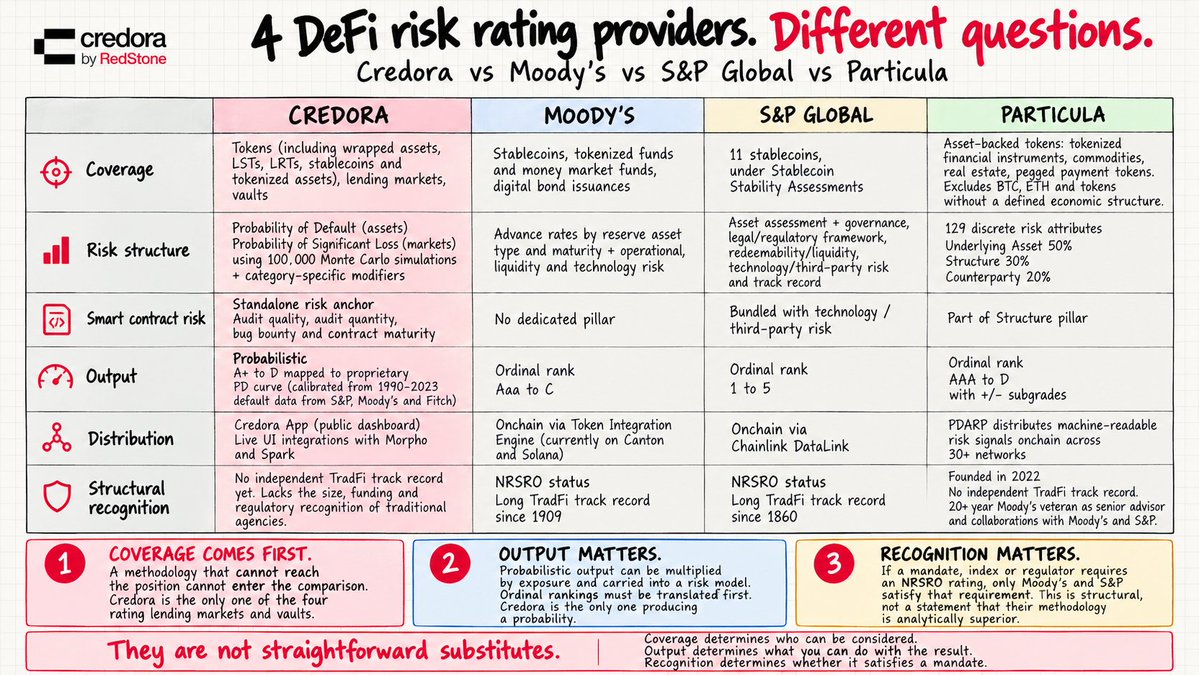
I spent some time going through Credora's latest comparison of four major DeFi risk rating platforms, Credora, Moody’s, S&P Global, and Particula, and one thing stood out pretty quickly: this isn't really about deciding which provider is “better.” Credora's full comparison
First filter: coverage.
Credora reaches across tokens, including wrapped assets, LSTs, LRTs, stablecoins and tokenized assets, but also lending markets and vaults. A methodology cannot assess a position it was never designed to reach.
Moody’s focuses on stablecoins, tokenized funds, money market funds and digital bonds. S&P’s assessments cover 11 stablecoins, while Particula focuses on asset-backed tokens with a defined economic structure.
Then comes the bigger difference: what the rating actually tells you.
Credora is the only one of the four producing a probabilistic output. Assets are assessed through Probability of Default, while markets use Probability of Significant Loss based on 100,000 Monte Carlo simulations. Those probabilities are mapped to the A+ to D scale using historical default data from Moody’s, S&P and Fitch.
That makes the output more than just a rank. A probability can be connected to exposure and carried into a risk model.
Smart contract risk is another area where Credora takes a different approach. It treats smart contract security as a standalone risk anchor, looking at audit quality, audit quantity, bug bounties and contract maturity.
Moody’s and S&P have something Credora cannot build overnight: decades of institutional history and NRSRO recognition. If an index, regulator or institutional mandate requires an NRSRO rating, that structural recognition matters. Methodology alone cannot replace it.
Particula brings a different strength, with 129 individual risk attributes across underlying asset, structure and counterparty pillars.
So the takeaway is simple.
These four providers are not straightforward substitutes.
Coverage determines who can assess the position. Output determines what you can do with the result. Structural recognition determines whether the rating satisfies a specific institutional requirement.
That is what makes Credora interesting. It is building a risk framework around the way DeFi actually works, with probabilistic ratings, deeper smart contract coverage, and distribution where capital is being allocated.
As institutional capital moves onchain, a number for yield is not enough.
The real question is: what is the probability behind it?
@Maddere7@CredoraNetwork Fair point. Traditional default data won’t map 1:1 to every DeFi edge case. That’s where the DeFi-specific modifiers matter. The real test is how it holds up through a full credit cycle.