Met a guy yesterday at my office.
Age: 29.
Portfolio: 3 lacs
Monthly Income: 80k
Monthly Sip: 20k
Stocks: Hdfc Bank, Hdfc Life, Kotak, Tcs, Bajaj Finance, Icici Lombard, Pidilite & Reliance.
Buy 1 share of each company every month.
Goal: To accumulate 500 shares of each company.
energy, water conservation, animal husbandry, & empowerment of women;
ITC ranked 1st globally amongst peers (comprising companies with a market cap between US$38bn and US$51bn), & overall 3rd globally on ESG performance in the Food Products industry.
End of Thread🧵
25/25
Management has noted that it will go asset-light for hotels, where the focus would now be on managed properties
Increased focus on improving the ESG scorecard:
In past 2 decades it has put in place a series of sustainability initiatives around carbon emissions, renewable
24/25
Dividend yield looks attractive:
The large pile of cash and liquid investments at ITC’s disposal (US$4.6bn as of March 2020, c.16% of market cap) means the dividend payout can be ramped up further.
Strategic changes to capital allocation address some concerns:
23/25
According to the Global Adult Tobacco Survey India 2016-17, while 42% of adult Indian males consume tobacco only 7% of them smoke cigarettes (compared to 14% who smoke bidis and 30% who use smokeless tobacco);
22/25
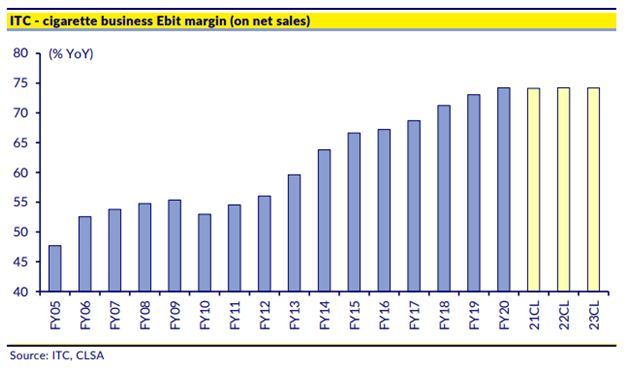
been rewarded with improvements in margin profile.
Hefty contribution to exchequer:
Payout in terms of taxes has been high given the high taxation structure for cigarettes
With steady increases in indirect tax, the company’s indirect payout expanded to c.41% of gross revenue.
create steady free cash flow;
ITC has said that while legal industry volume declined 20% over FY11-FY20, illegal volume grew 36%. EBIT margin looks like it may have reached its limit:
The management approach of completely passing on the effect of any tax increase has
20/25
A focus on value-accretive segments:
ITC’s food business is concentrated in categories with limited added value;
Cigarettes- A cash cow:
Despite multiple headwinds, ITC’s cigarette business has maintained profit growth momentum which in turn has helped
19/25
strong margin expansion in the Atta business;
The decision to focus on foods was strategically sound, given the wide penetration of categories with a large unorganized share, limited competition in the organized space, and Consumers trading up as the economy grew.
18/25
Interestingly, Atta is perceived by some to be a low margin business, it is now a high-single-digit margin business (with 9% Ebit margin);
Improving scale, rising premium compared to peers, less need for promotions, and increasing captive production should help drive
17/25
reducing transaction, handling, and transportation costs; ITC currently sources two-thirds of its agri-requirements directly from Farmers and the rest from the open market.
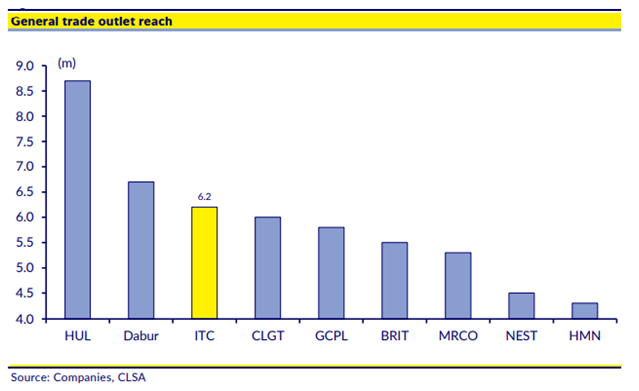
Key reasons for ITC pursuing acquisitions could be to address gaps in its portfolio & distribution;
16/25
product hygiene, safety, and quality. In 2018, ITC commissioned its largest integrated food manufacturing and logistics facility with ‘Wheat-mandi’, with an investment of Rs15bn in Kapurthala, Punjab; This ICML is still in the ramp-up phase, with direct buying from farmers
15/25
ITC has added 9 integrated consumer goods manufacturing and logistics (ICML) facilities and is in process of setting up two more;
To provide structural advantages including ensuring product freshness, Improving market responsiveness, and providing a heightened focus on
14/25
foods and beverages, ITC has been aggressive over the last couple of decades in setting up capacity across this vertical;
Since FY02, ITC’s FMCG business has invested Rs78bn in CAPEX with cumulative EBITDA losses of Rs10bn;
The business turned profit positive from FY13;
13/25
Foods & Beverages categories offer an opportunity to create scale but have relatively low margin profiles (10-20%, versus around 25-30% for home & personal care).
ITC has made significant front-end investments in capacity:
Seeing the potential opportunity from Organized
12/25
4million farmers;
ITC sources about two-thirds of its procurement through e-Choupal;
ITC’s agri-business capabilities play an important role in securing supplies for its packaged food business, too;
11/25
The agri-business provides strong back-end support (42% of internal sales for FY20);
Its “e-choupal” initiative (a digital endeavor for direct procurement from farmers) has widened its coverage, linking 35,000 villages through about 6,100 e-Choupal, servicing about
10/25
The Savlon brand, acquired in FY15, has seen a CAGR of 50%, Nimyle, acquired a couple of years ago, saw 100% CAGR.
Agri-business- a strategic fit & competitive advantage:
ITC has a broad agri-business with a non-leaf tobacco share of 86% compared to 62% a decade ago
9/25
noodles, juices, and personal care.
ITC is one of the most diversified FMCG businesses in India;
With strategic CAPEX now in place, no need for any expansionary CAPEX for the organic business over the next five years;
8/25
In the last decade, revenue contribution from FMCG expanded from 20% in FY10 to 28% in FY20; Similarly, EBITDA contribution expanded from (-6%) in FY10 to +7% in FY20;
Between FY08 - FY20, revenue from the FMCG segment saw a CAGR of 15%, new categories developed included
7/25