As Taiwan’s 2026 local elections approach, campaign events are drawing attention both on the streets and online.
The 2022 Taiwan Communication Survey asked about political and public-affairs activities during the roughly three weeks leading up to the local elections.
Political gatherings and campaign rallies were the most common activities both online and in person, with 19% of respondents watching them online and 7.1% attending in person.
Overall, online participation was more common in six of the seven paired categories.
Still, 63.5% selected none of the listed activities.
Explore the data: https://t.co/jPibZSa3Ez
#TaiwanElection #PoliticalParticipation #Taiwan
How does parental involvement matter during the preschool years?
Using longitudinal data from Kids in Taiwan (KIT), Liu et al. (2025) found that parental involvement at ages 3 and 4 consistently predicted children’s executive function one year later.
📄 Published in the International Journal of Behavioral Development (@SAGEJournals): https://t.co/messv2afXF
📊 Explore KIT: https://t.co/DIg7zsHHmo
#ChildDevelopment #Parenting #LongitudinalData
Jensen Huang’s affair has made headlines worldwide. Public attention has centered on semiconductor stocks and suspected Chinese espionage, while the affair itself has drawn little condemnation.
Compared with women, society seems more forgiving of men in sex scandals, especially successful men. Do people in Taiwan see it the same way?
Past waves of the #TaiwanSocialChangeSurvey asked respondents whether it is acceptable for a married person to have extramarital sex, with separate questions about married men and married women.
After subtracting one answer from the other, most respondents do not find extramarital sex more acceptable for one spouse than the other, but a double standard does exist.
Although the share is small and has declined over time, respondents who are stricter on married women have consistently outnumbered those who are stricter on married men.
-
Explore more Data about Taiwan?
https://t.co/OnhoQw2x5d
-
#Taiwan #SexualFidelity #TSCS #Marriage #JensenHuang #Nvidia
Student-led protests in France have expanded from school conditions to living costs and public services. For some, taking to the streets is a way to defend their rights—even at personal risk.
How common is such action in Taiwan?
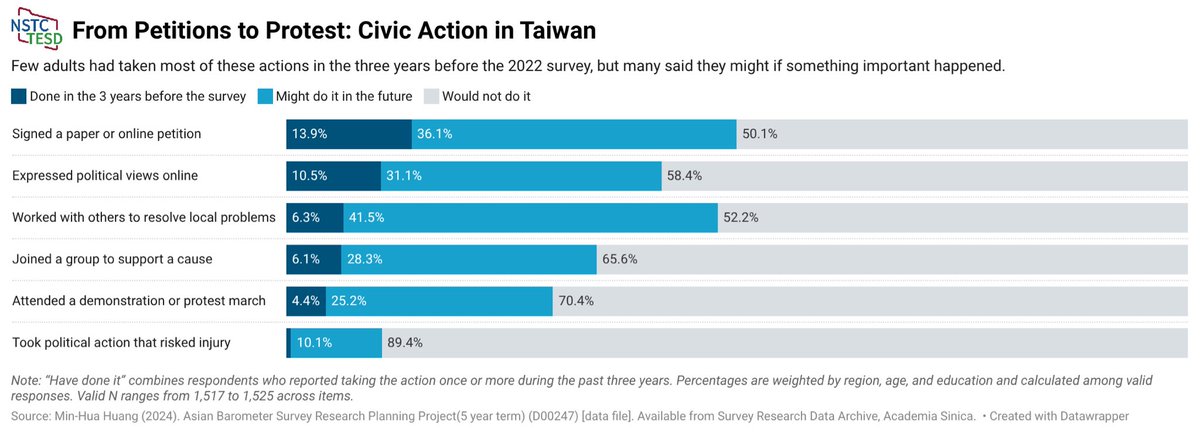
According to the 2022 Asian Barometer Survey, in the three years preceding the survey, 4.4% of respondents had joined a demonstration or protest march, while just 0.5% had taken action for a political cause despite risks to their safety.
By comparison, signing a paper or online petition was the most common of the six forms of civic action covered by the survey, at 13.9%.
Yet past participation tells only part of the story.
Another 25.2% said they might join a demonstration if something important happened, and 10.1% might take action despite the risks to their personal safety.
Explore more Asian Barometer Survey data: https://t.co/d8ALShpRIR
#FranceProtests #StudentProtests #Taiwan #AsianBarometer
Is success written in the stars?
Across five waves of the #AsianBarometerSurvey in Taiwan (2001–2022), more than 70% of respondents disagreed that “wealth and poverty, success and failure are all determined by fate,” while roughly a quarter to nearly 30% agreed, a share that has edged up slightly over the past decade.
Books and magazines are a familiar part of many children’s home lives.
Data from Kids in Taiwan (KIT), a national longitudinal study of child development and care, show a clear pattern:
First-grade children with more frequent opportunities to read at home also scored higher on an IRT-based language ability scale, where higher values indicate higher estimated ability.
The estimated median language ability score was −0.12 among children who rarely had these opportunities, compared with 1.08 among those who had them very often.
The distributions still overlapped across groups, showing considerable variation in children’s language ability.
Explore more KIT data on child development and family life: https://t.co/DIg7zsH9wQ
#ChildDevelopment #Reading #TaiwanResearch
🛒 How much do Taiwanese people spend online each month?
According to the 2024 #TaiwanCommunicationSurvey, more than half (53.9%) of the respondents have spent money online. Whether on shopping, in-game purchases, or music and video downloads.
Among these online shoppers, the average monthly spending is about NT$3,880, the median is NT$2,000, and the mode is NT$1,000.
While most people spend between NT$1,000 and NT$5,000 a month, some spend far more, up to NT$100,000 a month.
-
Explore more data on media use and daily life in Taiwan:
🔗 https://t.co/JlgWtBu1WN
#TCS #TaiwanCommunicationSurvey #TaiwanSocialData #OnlineSpending #DigitalConsumption
Taipei police recently raided Commander D, an LGBTQ+ bar in the city’s Wanhua district, taking 51 people in for questioning and arresting the bar’s owner.
The raid sparked protests and scrutiny of police conduct, leading us to revisit a question asked in the 2010 Taiwan Law and Social Change Survey: What should police prioritize when enforcing the law?
Among 1,473 valid respondents, 56.9% chose flexibility and consideration of circumstances.
Another 38.3% selected compliance with legal procedures, while just 4.8% put mission completion first.
At the time, flexibility—not legal procedure or mission completion—was the most common answer.
But what about today?
Explore more Taiwan Law and Social Change Survey data:
🔗https://t.co/nVbWMCLTlF
#Taiwan #LGBTQ #Policing
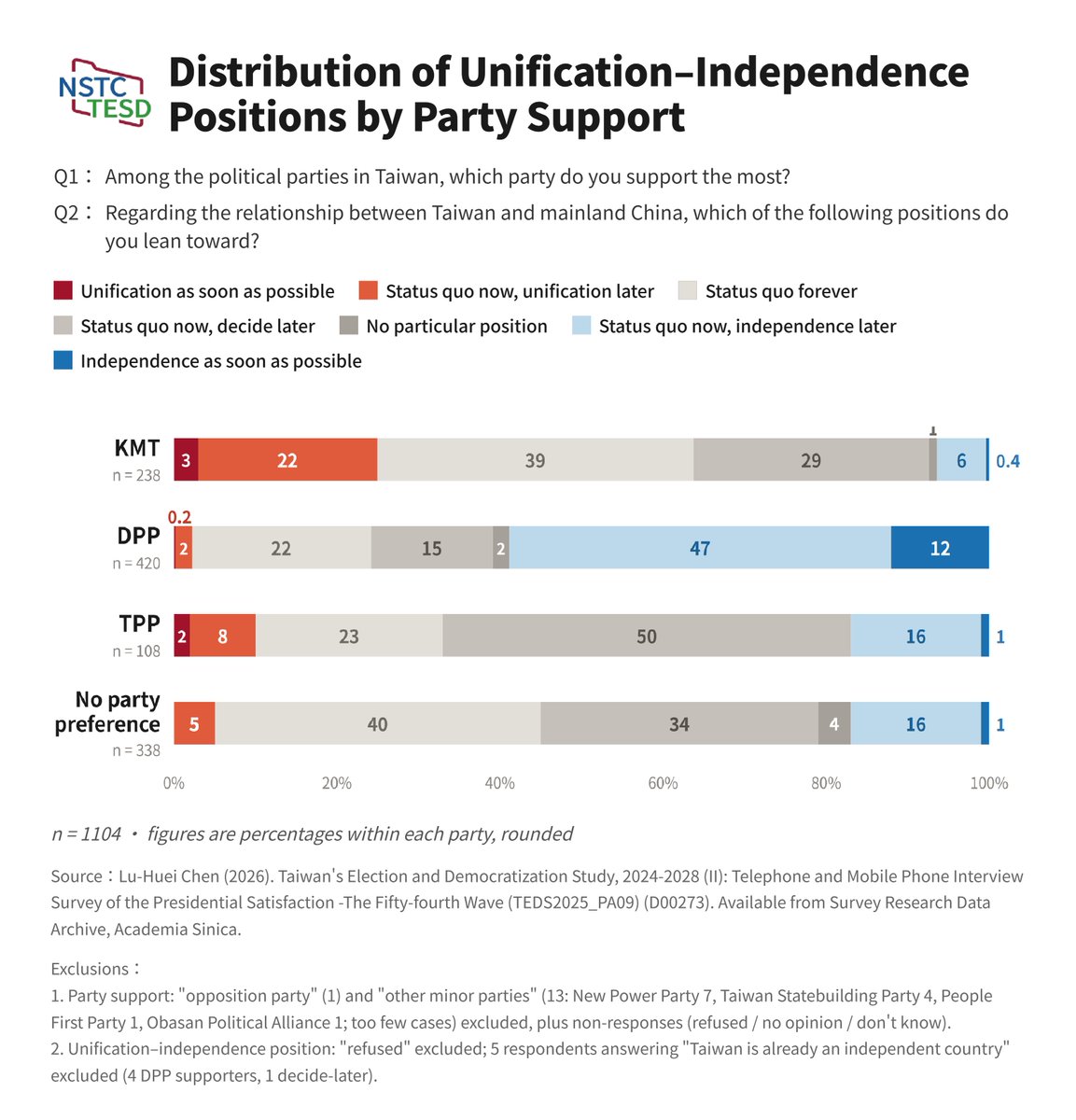
In Taiwan, party support is almost a mirror of where people stand on unification (with the People's Republic of China) vs. independence (as a separate Taiwan).
Polling data from the #TaiwansElectionandDemocratizationStudy (TEDS) 2025 shows:
🔵 Among Kuomintang (KMT) supporters, about 25% lean toward unification, the highest share of any party, while almost none support independence. However, around 70% overall prefer maintaining the status quo.
🟢 Democratic Progressive Party (DPP) supporters lean toward independence, and more clearly so. 47% want to "maintain the status quo and move toward independence later," and 12% say Taiwan should "become independent as soon as possible." The share wanting to "maintain the status quo" is the lowest among all parties.
�� Taiwan People's Party (TPP) supporters fall on both sides, with the largest group (50%) choosing to "maintain the status quo and decide on independence or unification depending on the situation."
🟤 Voters with no party preference show a distribution similar to TPP supporters on the unification–independence question, but with more wanting to "maintain the status quo forever" and more holding no particular stance.
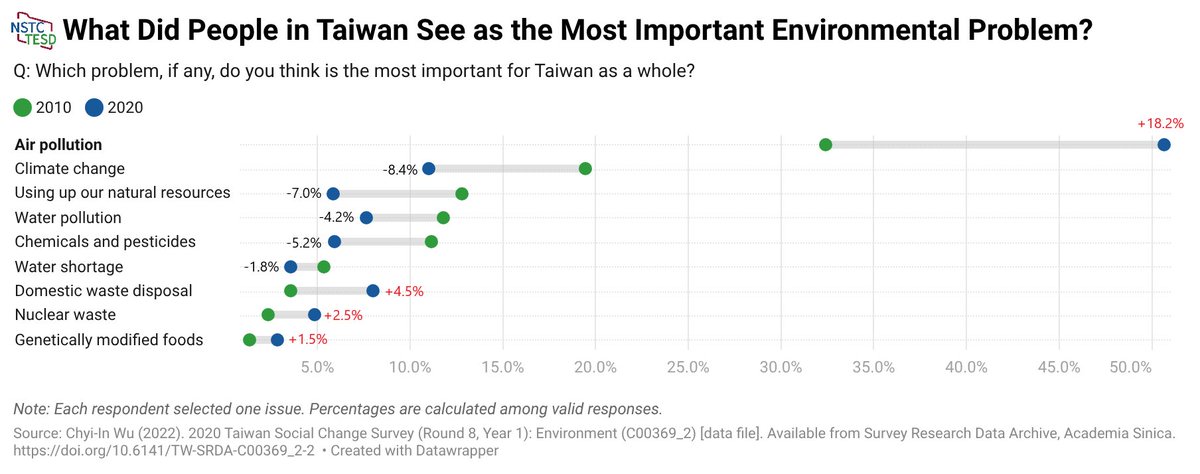
Taiwan’s environmental priorities became more concentrated between 2010 and 2020.
Air pollution recorded the largest increase at +18.2 pp, while domestic waste also gained share (+4.5 pp).
Climate change (−8.4 pp), natural resource depletion (−7.0 pp), and chemicals and pesticides (−5.2 pp) moved in the opposite direction.
Overall, responses in 2020 were much more heavily concentrated on air pollution.
Explore more long-term survey data on Taiwan’s changing society with TSCS: https://t.co/OnhoQw2x5d
#TaiwanResearch #EnvironmentalData
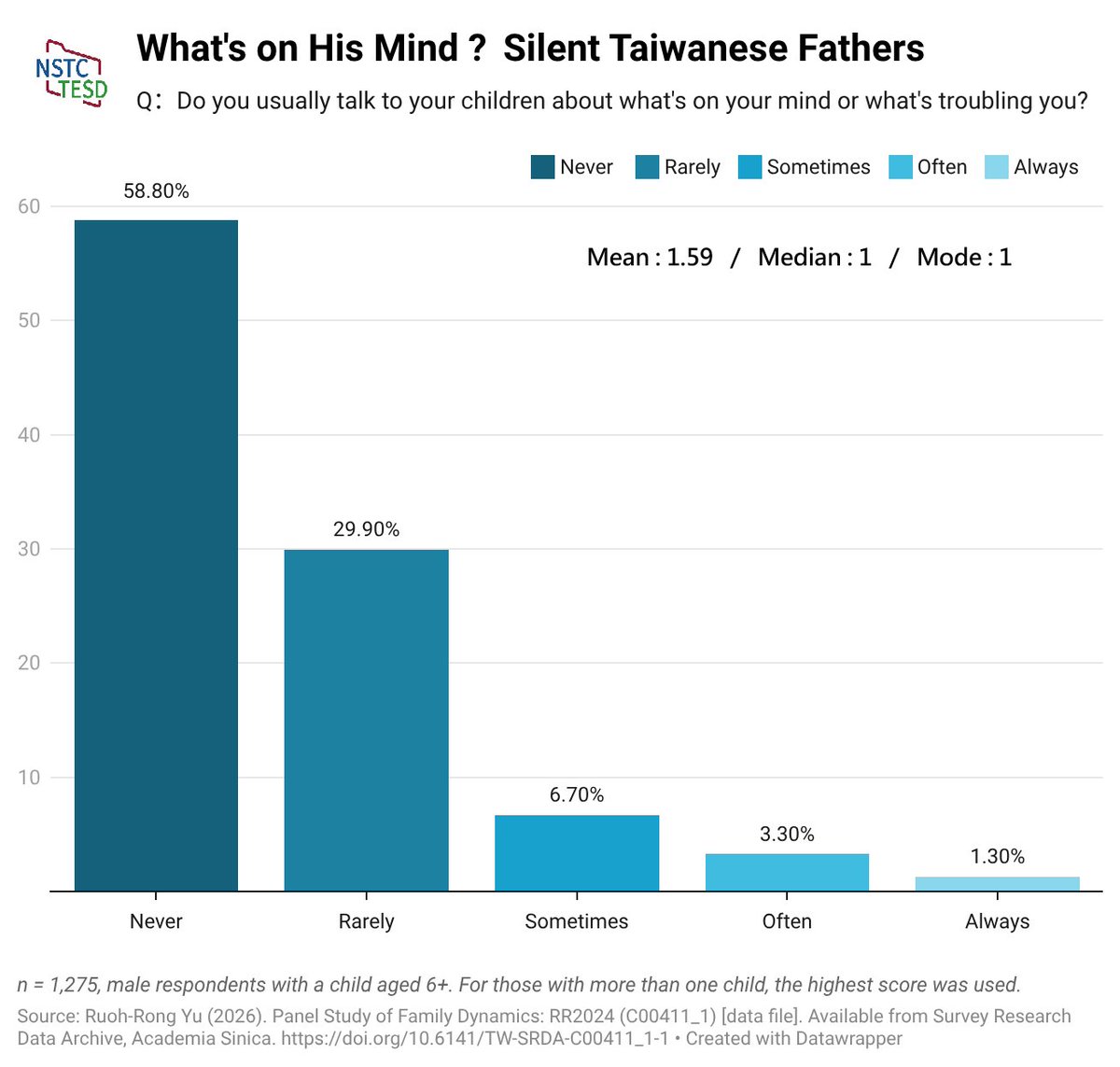
What's on his mind ? Have you ever heard your father talk about his feelings?
Recent survey data from #PanelStudyofFamilyDynamics found that among all male respondents who had children above 6 years old , 58.80% had "never" confided their worries or troubles to their children. Both the median and the mode were 1, the mean was 1.59. Overall, Taiwanese fathers tend to keep their stress and worries to themselves in front of their children.
-
Searching for more data about Taiwan?
Click here: https://t.co/Qw92XMeS0y
#Fathers #PSFD
Does the sense of relative deprivation from an unfair income distribution weigh most heavily on those who earn the least?
Data from the 2022 #AsianBarometerSurvey shows that over 60% of people in Taiwan see the country's income distribution as unfair. Yet among the lowest-income households (monthly income under NT$39,000), only 53% called it unfair. Compared with roughly 61% to 69% across the higher-income groups.
The lowest-income households were, in fact, the least likely to feel that income distribution is unfair.
-
Explore more data on public attitudes and social life in Taiwan:
https://t.co/WqXc75ODs5
#AsianBarometerSurvey #TaiwanSocialData #IncomeDistribution #RelativeDeprivation
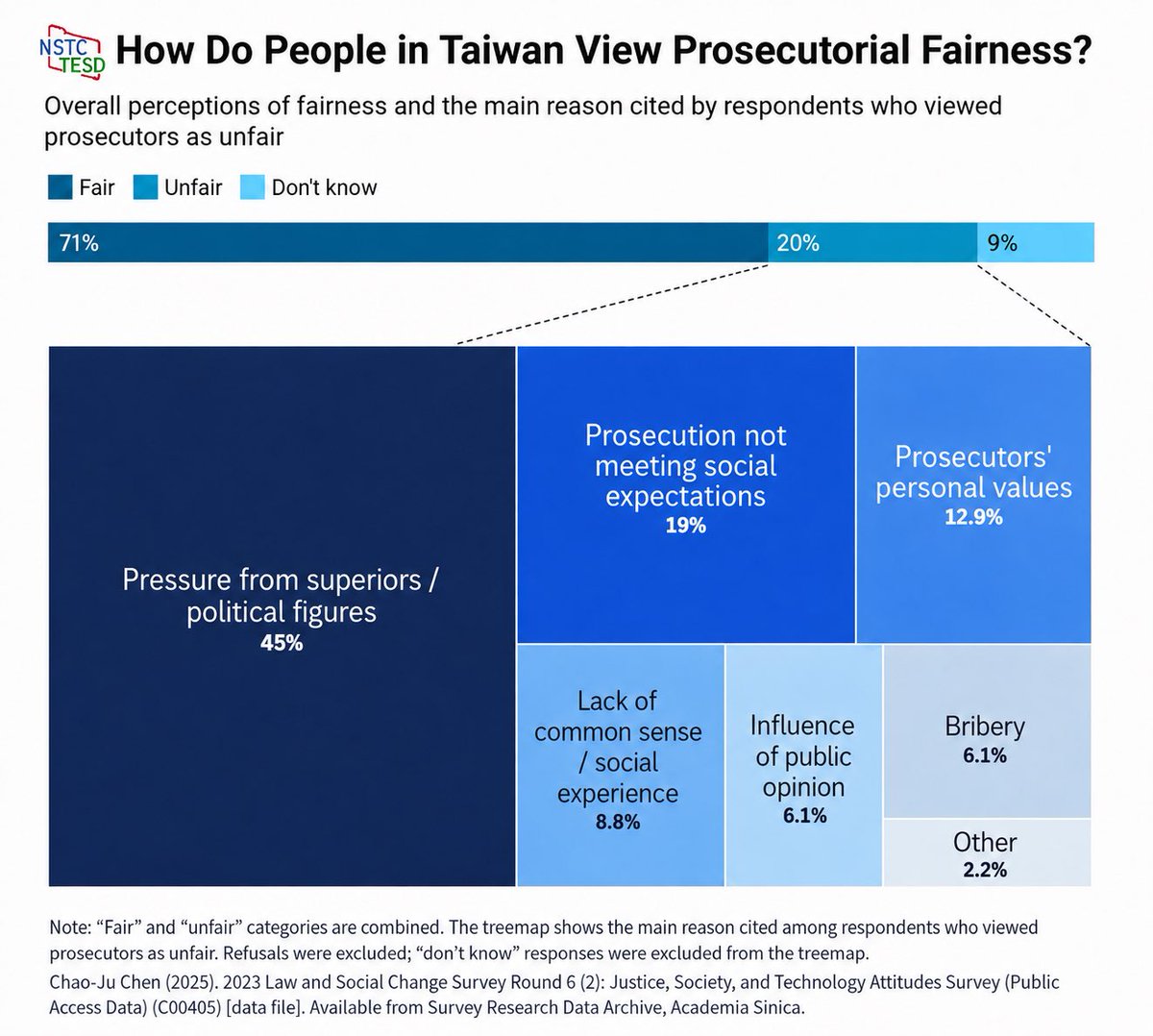
South Korea’s recent prosecution reform has renewed debate over how prosecutorial powers should be divided and overseen.
As the country moves to separate investigation from prosecution, survey data offer a view of how people in Taiwan perceive prosecutorial fairness.
In 2023, 71% viewed prosecutors as fair, while 20% viewed them as unfair. Among those who perceived unfairness and gave a reason, the most commonly cited reason was pressure from superiors or political figures (45%).
Explore more data on judicial trust and legal attitudes in Taiwan: https://t.co/nVbWMCLTlF
#SouthKorea #ProsecutionReform #TaiwanResearch
Are Taiwan's local languages disappearing?
Data from the Asian Barometer Survey shows that the share of households speaking mostly or only a local language at home has fallen from nearly 40% to around 20% since 2001, while the share speaking the official language rose by about 10 percentage points.
But mixing the official language with local languages is still part of most families' everyday life. Accounting for around half of the population, a share that has also crept up slightly.
-
Searching for more data about Taiwan?
Click here: https://t.co/WqXc75ODs5
-
#HomeLanguages #LocalLanguages #OfficialLanguage
Double Seventh Festival, often compared to Valentine’s Day, celebrates love and romance. But for some, conversations about love also come with questions from family: Are you dating anyone? When are you getting married?
In Taiwan, data from the 2024 Panel Study of Family Dynamics (PSFD) show that never-married respondents aged 35–39 reported the highest rates of parental urging around dating or marriage.
Among this age group, 33.2% had been urged to find a partner or start dating, 28.5% to get married, and 8.5% had a blind date arranged by their parents.
But the pattern did not simply increase with age. Reported rates were lower among respondents aged 40 and above.
Explore more data on relationships and family life in Taiwan with PSFD: https://t.co/Qw92XMeS0y
#DoubleSeventhFestival #TaiwanResearch #FamilyResearch