A lot of people are worried about P = NP.
Here’s the simple version.
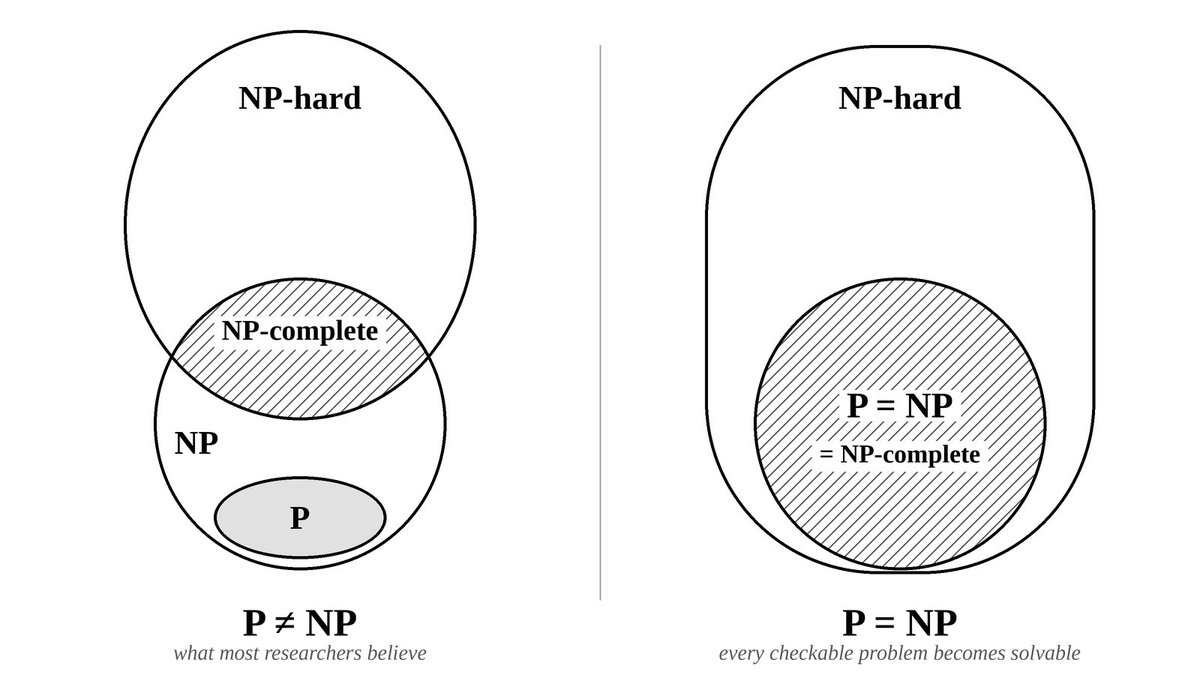
P is the set of problems a computer can solve quickly. Sorting a list, finding the shortest route on a map, multiplying numbers.
NP is the set of problems where, if someone hands you an answer, you can check it quickly. A filled-in Sudoku is easy to verify, but solving a hard one from scratch can take forever.
If you can check an answer fast, can you also find it fast? P = NP says yes. Almost everyone believes the answer is no, but nobody has proved it either way. It’s a $1M Millennium Prize problem.
Riemann is solved, but it doesn’t change your day. P = NP would change everything very fast.
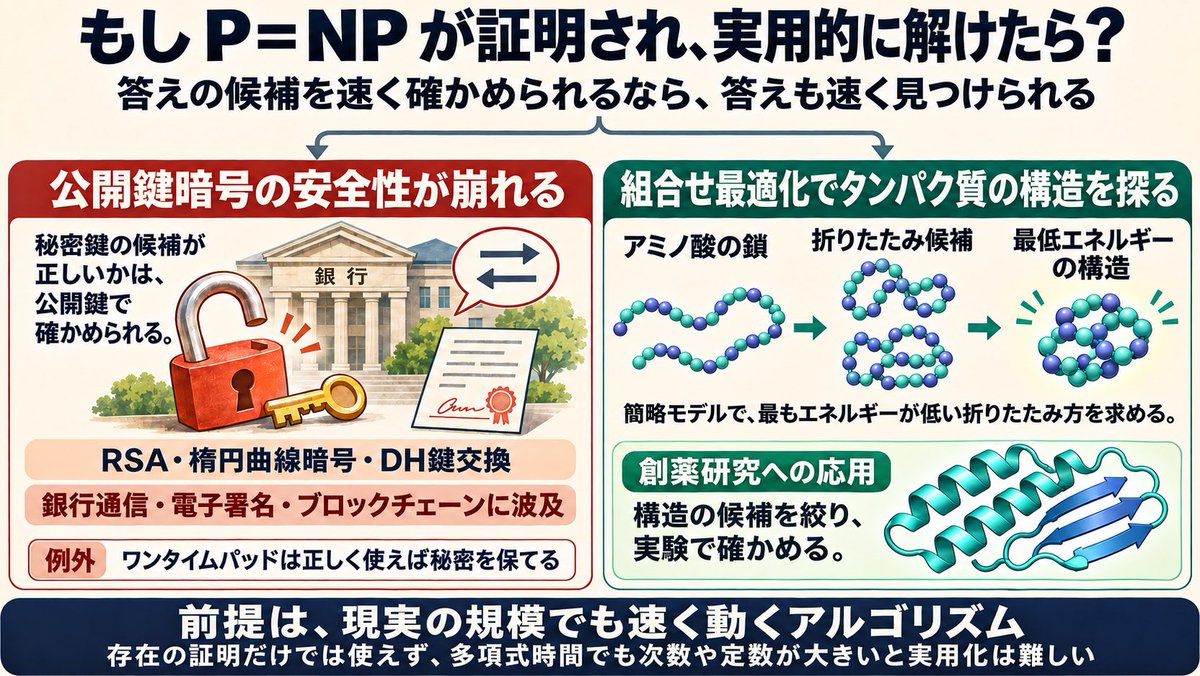
Almost all modern security rests on the assumption that some problems are brutally hard to solve but easy to check. Factoring huge numbers is the classic one.
If P = NP, that wall could fall. HTTPS, online banking, passwords, digital signatures, crypto wallets, all of it would be at risk.
The same power that breaks encryption would solve the hardest optimization problems we have.
Protein folding and drug discovery would speed up massively. Logistics, flight schedules and supply chains would become near perfect.
Training AI models could get far cheaper. Even finding mathematical proofs could be automated.
It depends on how it’s proved. If the proof is not constructive, or the algorithm runs in something like n^100 time, it's useless in practice. The scary version is a fast, practical algorithm.
Most researchers bet on P ≠ NP, and that is the reason your bank account is safe today.
But if someone ever proves P = NP with a practical algorithm, the world gets rewritten overnight.
Best case, we cure diseases and solve problems we thought were impossible.
Worst case, every lock on the internet opens at once.
Something to worry about indeed.
Chau Ngo has a wonderful take on AI in mathematics. I believe the same about economics.
The profession has placed a very large premium on technical competence over the last three decades or so: for example, the ability to prove the existence of an equilibrium in a complex model, the asymptotic convergence of an estimator, or an understanding of the subtleties of numerical algorithms. I believe that, given the technology available circa 2000 or 2020, this was the optimal decision to push our field ahead (although I need to recognize that, having benefited personally from such a large premium, I am not completely unbiased).
But the world has changed. Thanks to AI, you no longer need an extraordinary ability in stochastic limit theory or functional analysis to answer important questions. What you need is an extraordinary ability to ask important questions and, even more importantly, to understand the implications of the answers.
Do not get me wrong: you will still need to have an adequate command of stochastic limit theory or functional analysis. But think about English: without being able to speak English, you will not succeed in the profession, but you only need to be adequate (have you heard my accent?), not to reach Stephen Fry’s outstanding mastery of the language.
Both undergraduate and graduate education in economics need to be reshaped drastically. The journals’ editorial lines and the peer review system need to change. And how we decide who gets tenure, prizes, and other forms of professional recognition needs to evolve.
I don’t have the answers to how we should do this. But I know that we must definitely not follow the reaction of many in the mathematics community. The Association for Human Mathematics is a pitiful and, I am afraid to say, shameful revolt against reality that confirms the suspicion among many outside academia that we have become an isolated, self-indulgent guild more bent on rent seeking and virtue signaling than on the search for truth.
And, like Ngo, I am extremely optimistic. I truly believe that over the next ten years or so, economics will progress like never before. I am incredibly excited to be alive at this moment. I understand, though, why many graduate students or assistant professors might feel uneasy about the landscape. But the historical record shows that if we handle the transition properly, there will be plenty of gains from the new technology to share.
Thanks to @stablequan for posting Ngo’s note. I borrowed it from him.
To elaborate -
If P = NP is proven & we get a practical polynomial-time algo for an NP-complete problem, modern cryptography largely collapses.
Most public-key systems (RSA, elliptic curves, Diffie-Hellman) rely on the hardness of problems that would suddenly become efficiently solvable. TLS, banking, digital signatures, secure messaging, and most of blockchain infra would become insecure unless built differently. Society would need an emergency global transition to new foundations - only info-theoretically secure methods (one-time pads) or certain quantum schemes would remain safe by default.
The upside is enormous: optimal solutions for logistics, scheduling, protein folding, circuit design, and countless optimization problems become feasible. But “polynomial time” can still be useless in practice if the degree or constants are huge, and a non-constructive proof would change almost nothing on its own.
But yeah - god help us if proven true.