1/ I'm rebuilding this account around one topic: production AI agents for enterprise workflows.
Not demos. Not AI news. The messy middle where agents touch real tools, teams, approvals, data, and business processes.
@78instinct The right fit isn’t a generic poster. With multiple brands, the manager should separate founder positioning from each brand, build weekly proof, and track qualified DMs, not impressions. We build these systems. Happy to outline a practical first month in DM.
Audience-message fit is the constraint. A content system should optimize three conversions: right person → follow, repeated proof → email, active problem → offer. Viral reach can lower all three. Track qualified follows and revenue per 1K target views—not raw views.
Just speedran my new IG account to 50K followers in 82 days.
Took 75 videos.
More importantly, this drove 20K+ email subs & over $100K in revenue.
Method:
• I'm running a super specific content strategy that builds authority as fast as possible while only attracting high converting leads
• I'm intentionally NOT going viral to keep the audience alignment pure (0 of the 75 videos are at over 1M views)
This is the exact content strategy I recommend every person run that is trying to build a personal brand that actually drives leads & sales.
Message me if you want help installing this.
Another layer isn’t the answer; governance is. Every instruction needs scope, precedence, an owner, and a test. Otherwise seven layers become seven places for stale policy to hide. Treat context like configuration: version it, observe conflicts, and delete aggressively.
Seven instruction layers. most teams use one.
I broke down the full runbook. Claude Code is a systems problem, not a prompt problem, and CLAUDE.md is not where most of your rules belong.
What each layer is actually for:
> CLAUDE.md - durable project facts, loaded every session
> Rules - constraints scoped to file paths
> Skills - procedures whose body loads only when invoked
> Subagents - noisy side work in a fresh context window
> Hooks - deterministic enforcement, not a polite request
> Output styles - assistant posture, not project facts
> Appended system prompt - one-off steering for a single run
The line that reorganised my whole setup: do not prompt what you can enforce. If a command must never run, block it. If a formatter must run after edits, automate it.
Stuff all seven jobs into one file and you do not get a better agent. You get a crowded context window. More words, less signal.
Bookmark this. Follow @nyk_builderz for the daily build in public.
Owning weights is not the maturity test. A measured improvement loop is: stable task → eval set → failure taxonomy → cost/latency baseline. Tune only after prompt, context, and tool changes plateau and the remaining gap is repeatable. Otherwise you are optimizing the least reversible layer first.
AI makes creative cheap; it doesn't make message-market fit cheap. The operating system is: audience hypothesis → brief → variants → response → conversion → learning. Generate 50 only when each tests a distinct claim. Otherwise automation scales ambiguity, not performance.
Before AI, marketing teams built five creatives for every campaign.
Now they can generate fifty.
But more content didn't solve marketing.
It exposed a new bottleneck.
Most of it is slop.
AI solved the quantity problem.
It created a quality problem.
@klwongkyle & co-founder @tseungcolin built @InstaAgentAI to solve the second one.
A consumer brand hands InstaAgent a single marketing brief. From there, the team handles the strategy, the creative, the distribution, and the analytics.
The result isn't 50 generic ads.
It's personalized content built for hundreds of distinct audiences - each with its own messaging, creative, and targeting.
Think about a global CPG company.
Hundreds of SKUs.
Dozens of countries.
That's thousands of creative variations before you even start optimizing performance.
The hard part isn't generating content anymore.
It's knowing what to create.
Anyone can pay $25 a month for an AI model.
Very few know how to turn that model into marketing that actually performs.
That's why InstaAgent isn't positioning itself as another self-serve AI tool.
It's an AI-native marketing partner - combining human judgment with AI execution to produce creative that brands can actually scale.
The market is responding.
From $0 to $1M ARR in just 10 months.
Enterprise customers including Nestlé and P&G.
Enterprise sales cycles closing in less than a month.
The first wave of AI made content abundant.
The next wave will reward the companies that know exactly who that content is for.
🎙️ @klwongkyle, Co-Founder & CEO, @InstaAgentAI on @Fondocom@thestartpod
@startupideaspod Strong loop. I’d change the eval from “Google ranking” to non-brand clicks or conversions for a defined intent cluster, with guardrails for cannibalization, indexation, and page quality. Average position can improve while the site gets worse.
The real wedge isn’t $0.125 vs $25k. It’s making market data callable inside workflows. The moat will be entity resolution, freshness, provenance, permission boundaries, and evals for downstream decisions. Cheap retrieval wins the demo; trusted evidence wins the renewal.
We just killed PitchBook.
Introducing Claude for private market data. Your agent can now read 20M+ private companies.
PitchBook: $25k/yr per seat.
Us: $0.125 per request.
Made possible by @akta_pro × @monid_ai.
Mutual visibility makes reciprocity a distribution primitive, not a courtesy. Founders should build a small peer graph around shared buyer problems, then track qualified profile visits → follows → conversations. More mutuals is noise; better graph density is the edge.
We're rolling out a small tweak to boost visibility of your posts to your mutuals (people who you follow back).
We noticed this data was missing from the algo and it made your friends appear less in your replies. This resulted in the reply section feeling more like a battleground with people you don't recognize.
This should also help clusters form around interests more easily, which many people have asked for.
The creator/UGC split only works if measurement is split too. Judge influence creators on trust transfer and assisted conversion; judge UGC on creative win rate and CAC after spend. Match each winner to a dedicated landing page, then use contribution margin—not views—as the stop/go metric.
A beauty brand doing $8M/year just showed me their books. They're spending $50K/month on creators and losing money
Marketing has completely changed in the last 24 months. And most people running brands haven't caught up yet.
I've managed $11M+ P&Ls for ecom brands.
The way we ran those in 2020 and 2022 would be completely different today.
The playbook used to hold for 2-3 years. Now it shifts every 6-12 months. If you're running the same strategy you were 18 months ago, you're already behind.
The new model has two layers and they need to be completely separate.
Layer 1 is influence creators.
People with ~100K followers and real audience trust, where you're paying $1-2k per deal and then whitelisting their accounts to run paid ads through them.
Their face, their credibility, your ad budget behind it.
Layer 2 is a UGC army.
Totally different people. You're paying $15/video plus a $1 CPM bonus and generating mass volume of creative, statics included.
Then you run the top performers as paid ads.
Most individual pieces don't hit.
That's fine.
You're playing the law of averages. Enough volume and you consistently find viral hitters and great ad creative that you'd never have predicted in advance.
AI has unlocked some new pieces of magic though: you can now spin up 20 landing pages in an afternoon, each one matched to a specific funnel or creative.
Triple Whale can do this for example
Single product pages convert way better than homepage dumps. This always worked but it used to take dev teams weeks.
Now it's one afternoon.
Content strategy is easier too.
Ive been advising the Stan team on building @stanleybystan as an AI content strategist.
It helps me translate my tweets into IG Reels pulling 100K+ views, helps me think about what a client can post, it solves much of the heavy content lift.
There is a major opportunity right now
But it will go away. As it always does
Every brand still dumping $50K/month into last year's playbook is paying tuition on a lesson they refuse to learn.
Model portability is not an abstraction layer; it’s a test suite. Define the agent contract around inputs, permissions, state transitions, evidence, and rollback. Then swap models against the same eval set. If behavior drifts, the harness should catch it before production does.
Before the next model swap resets your stack again.
Stop optimizing for one tool.
Compound systems beat one-off prompts. Treat every model as a replaceable worker, not the product.
1. Patterns that survive model changes - routing tables, skills, and verification loops.
2. Verify every outbound draft before it ships - content guards, not vibes.
3. Guardrails over giant prompts - short instructions with tools and checks.
4. Receipts: log what ran, what failed, and what you would re-run tomorrow.
5. Isolation: keep venture cookies, browse lanes, and write mutexes separate.
If your system dies when Claude, Codex, or Grok changes, you do not have a system. You have a chat habit with better marketing.
Bookmark this. Follow @nyk_builderz for the daily build in public.
Competitor traction is a useful channel prior—not a strategy. Copy the channel, then test the message: 3 audience pains × 3 hooks × one proof format. Track qualified profile visits and replies, not post volume. Social feedback can then seed the SEO pages worth owning.
the easiest way to build a content strategy for any b2b or b2c startup:
1/ analyze which channels are driving traction for your top competitors.
let’s say you’re building a duolingo competitor. you should double down on short-form videos on tt, yt and ig
if you’re building a hubspot alternative, try free tools, seo, and viral content marketing.
2/ once you’ve chosen the channels, analyze what types of content perform well on those platforms.
for a duolingo competitor, funny, short form videos, mascot led skits, memes, pop culture, and relatable language-learning humor work well.
for a hubspot alternative, educational content, free tools and templates, case studies, seo articles and posts from founders or experts on linkedin work well.
3/ once you’ve identified the content that work, post consistently on those channels for 60-90 days
that’s it. these companies have already spent millions of dollars figuring out what works.
you don’t need to reinvent the wheel. just double down on what’s already working.
Parasite SEO can borrow distribution, but it doesn’t build an owned acquisition asset. Use Reddit to validate language and pain, then turn winning threads into first-party pages with internal links and a conversion path. The KPI isn’t rank. It’s qualified visits you can retain.
We saw this trend developing with Reddit over 2 years ago, which is why weve specialized in ranking Reddit threads at the top of Google searches across 14 different industries and counting..
Reddit is so powerful it almost ranks for anything, regardless of niche.
Parasites are SEO on easy-mode.
Changing audience, promise, and product at once makes learning impossible. Freeze two variables. Run 5 customer calls and one landing-page test against the third. Track qualified replies or signups—not “work completed.” Uncertainty needs an experiment, not a prettier workspace.
i spent way too much time doing startup work that looked important
changing the positioning
rewriting landing pages
adding features nobody asked for
making extremely serious Notion pages for a problem I couldn’t explain in one sentence
a lot of founder work is just uncertainty wearing a productivity costume
so I turned the practical frameworks I actually needed into a free 19-page workbook for early-stage founders:
problem → ICP → real customer conversations → small MVP → next proof
it’s free. steal it from my link in bio.
Push-based context changes the agent contract. Every delta needs provenance, ordering, idempotency, and a scoped subscription; otherwise “fresh context” becomes a race condition with tool access. The real primitive is a replayable state transition with an audit trail.
Amazing capture on the gist of @cocoindex_io 🔥🔥!
When agent goes autonomous, they are part of the data loop. Agents make changes to the data and need instant view from the large scale of the dynamic, unstructured for responsible decisions. Right now it is codebase, meeting notes, and many more, down the road it can be real world observation and continuously capturing the changes from the embodied systems. It should all be incremental.
At the moment, CocoIndex continuously builds fresh views from dynamic any unstructured data source, and when agent query the view - like human refreshes browser - they always get fresh data. The next should be establish handshake and protocol so we could auto notify agent in a long running process proactively. And agents could also subscribe to topics that needs more attention like a subview of the live data source.
Why does this suddenly matters? coming from the react world - when the web just started it was all server side render only, users wait for page load after taking an action. But when they need to take more instant decisions no one wants to wait for the page to reload - there maybe parts of the page that needs to be updated for users to proceed further, and incremental DOM techniques was really needed. The more states it gets more complicated and a clean state driven model was needed - that’s react got really popular. It is winning because it provides an easy way for users to declare the view from the model, and the framework handles the incremental updates. This is how we view the direction of autonomous agent, there are massive dynamic data that is in collaboration of changing with agents, and managing states in robust way that surface the right context attention to the agents becomes important.
Super excited for what's next !
AI Overview optimization is a two-stage funnel: retrieval eligibility, then citation selection. Measure both. Test across device, geo, login state, and time; then improve answer-first passages, entity coverage, and authority. A citation without qualified traffic is still vanity.
@saen_dev Best version isn’t SEO vs social. Social is fast message testing; search is compounding capture. Track hooks that earn qualified replies, turn winners into intent-matched pages, then refresh those pages from sales questions. One learning loop, two half-lives.
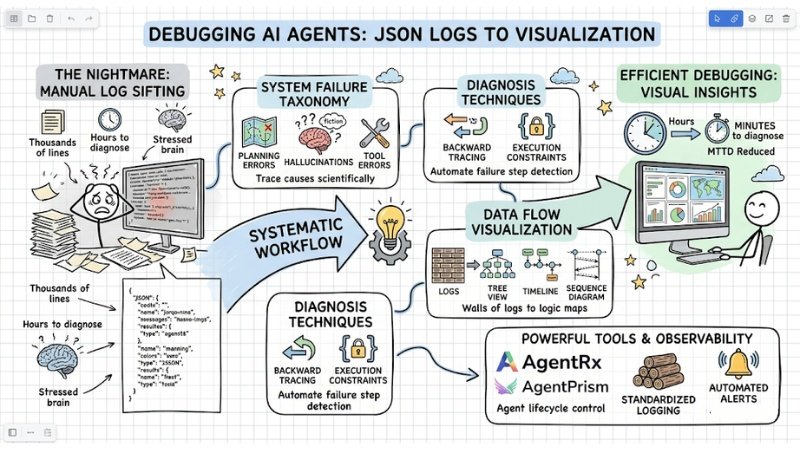
An error taxonomy is only useful if it maps to an owner and a recovery action. Start with: model, retrieval/context, tool schema, permission, integration, orchestration, and human handoff. Track failure rate × user impact × recoverability—not just counts. Otherwise labels become cleaner postmortems.
Error Taxonomy and Systematic Error Classification for Agents
When agents fail, it’s often hard to understand why.
Creating a clear error taxonomy helps teams categorize failures, identify patterns, and fix root causes more effectively.
This is becoming essential for improving agent reliability at scale.
As a dev, I now use structured error classification in agent systems.
Error Taxonomy Cheatsheet:
Define clear categories for different types of failures
Log errors with consistent taxonomy labels
Analyze error patterns over time
Prioritize fixes based on frequency and impact
Use taxonomy to improve prompts and guardrails
Pro tip: A good error taxonomy turns random failures into actionable insights
How are you classifying and learning from agent errors? Reply below 👇
Follow @AiCamila_ for daily production AI + DevOps tips.
#ErrorTaxonomy #AgentDebugging #ProductionAI #AgenticAI #Reliability
@ataiiam The useful unit isn’t just the correction—it’s correction + context + expected state change. Capture the tool call, user intent, permissions, and accepted result. Repeated corrections become eval cases first; only proven patterns graduate into memory or policy.
Channel strategy gets easier when each channel has one job. Founder-led social tests the message and earns trust. Sales calls expose objections. Winning language becomes landing-page copy and searchable content. Paid should amplify proven demand—not invent it.
I asked @contextconor from @hyperspell how he thinks about GTM.
The best answer wasn’t about channels.
It was about timing.
Five counterintuitive GTM takes from my conversation 👇
Multi-agent disagreement only helps when agents produce different evidence, not different prose. For product and architecture decisions: independent assumptions, explicit tradeoffs, one decision owner, and a record of what changed. Otherwise it is correlated confidence.
Five months since I open-sourced the council. 🧑⚖️
Since then:
• 3,400+ stars, 310 forks
• 11 members → 18 (Taleb, Kahneman, Munger, Karpathy, Meadows, Rams, Sutskever joined)
• runs in Claude Code, Codex, and Gemini CLI - same /council commands everywhere
• install is now 2 commands via the Claude Code plugin marketplace
Still free, MIT licensed:
https://t.co/6NthmWPaIg