I'd have thought that smarter models would learn to talk more like humans, but as this thread shows (and the experience of a couple of days of working with it), Fable (if you let it) seems to get even more "Claudish".
No one:
Claude Opus 4.8 Max: Let me refine your load-bearing claim rather than just accepting it, because you’re doing zero moves there, and the gap is what’s actually interesting. The one place I’d still push, because I think it matters: your message is wearing content-clothes, but the content isn’t actually *there*. The tell: it’s just an empty string. But the emptiness of the string IS its lack of content. Pull one, and the other goes inert. That’s the structural spine.
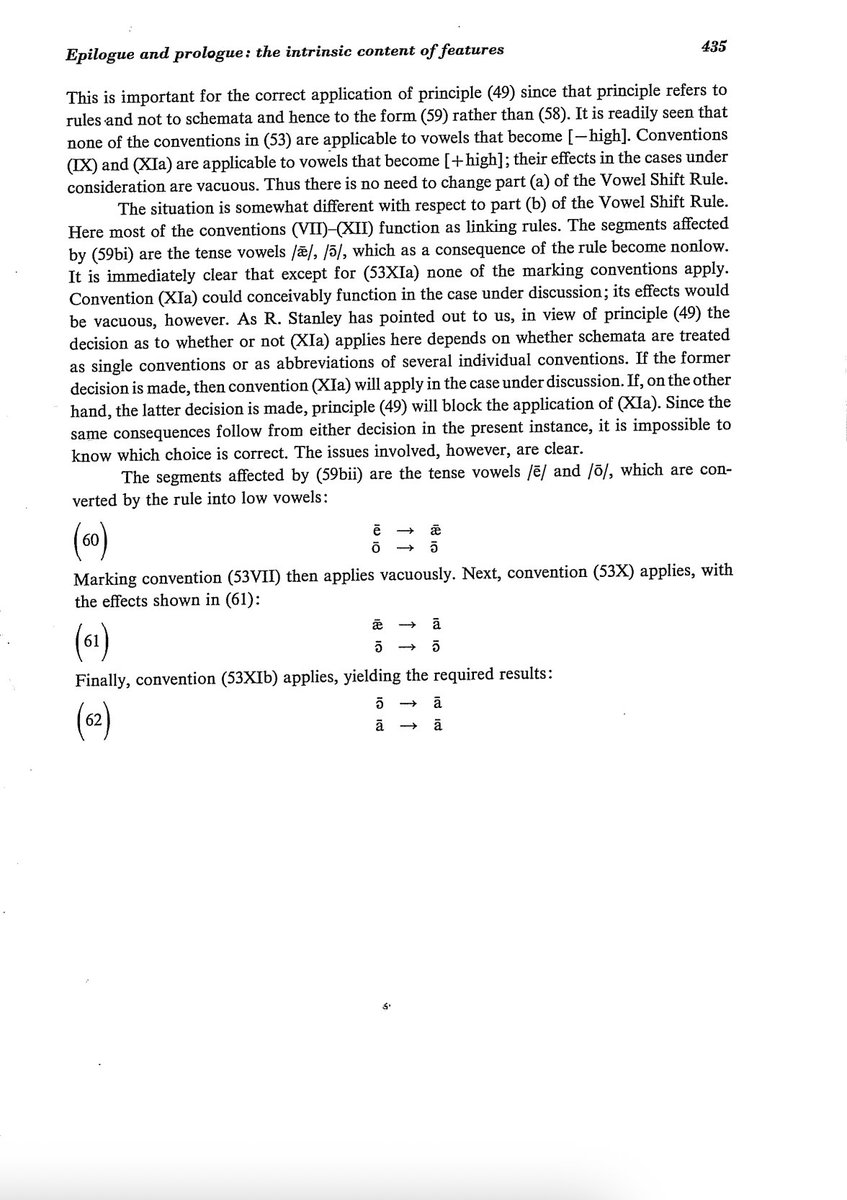
The article also says that the last line of “The Sound Pattern of English” (1968), by Noam Chomsky and Morris Halle, pays homage to the last rule "अ अ" of the Aṣṭādhyāyī (https://t.co/XtgEy9lfki), and indeed that book ends with "ā → ā".
Article on Pāṇini by Kiparsky (for "Handbook of the History of Phonology"): https://t.co/xTgCv9QUYl
First 5 pages an overview ("Pāṇini's grammar and its goals"); next 15 pages go into the system itself. Dizzying, but a glimpse why it's one of the monuments of human intellect.
Found it via his webpage (https://t.co/Nx9mXPgUzK) which also has an interview by Ashwini Deo: https://t.co/njqbrB7h0c
He was a professor at MIT when he got inspired by a course by Frits Staal, and decided to spend two sabbatical years in India learning from S. D. Joshi. And…
Learned that the creator of Wordle made a new game a few months ago, a “gradual on-ramp” to cryptic crosswords: https://t.co/JAsIdMHBOW
(Just one clue/word a day, gets harder over the week.)
Will surely never be as popular as Wordle, but clearly a lot of care has gone into it.
Most schools have an annual/school day with kids' dances etc. This school has simply made them all part of one whole.
I know nothing about Baba Hari Dass or his American followers, but elevating the mundane, harmonizing it with a higher purpose, is quintessential Indian culture
Attended this performance (https://t.co/QMIggQbZsf) again today.
[Well, half of it, before Mr. 6 had one of his inflexibility episodes: as he missed a minute or two after the intermission, he decided it just wouldn't do and chose to miss the rest too… so I sat with him outside]
I'd heard this in a lecture, but was reminded last week when we attended (the kids loved it!) this grand Ramayana play performed by school kids — https://t.co/QMIggQbZsf Almost none of them are Indian, but except for a mispronounced name here and there, it was all very well done.
Then I corrected myself: no, as incomparable as the two are, this too is really a fine thing. Not only the fact that a bunch of non-Indian kids are performing a Ramayana in the first place (and a grand production and fun show, good enough to sell tickets to the public), but also:
The same issue has an article on this milieu, specifically the (mathematics department of the) University of Mysore, Manasagangotri: “Neither conceived as a narrowly professional training ground nor as an elite research enclave”: https://t.co/50E7fqmvZ3
https://t.co/1W93nRGyOZ
If the narrative of modern Indian mathematics is often recounted through the “high peaks” of specialised research institutes
-the TIFRs, the ISIs, and the IIScs-
there exists a quieter, yet foundational chapter written in university departments that once served as
(1/3)
The life of a former head of the mathematics department of the University of Mysore: https://t.co/kKTqm8m9Fn
Interesting glimpse of (this tier of) academia in India in the 1960s/1970s.
I think the worst is when people I like, and whose thoughts I actually want to read, turn to AI-generated writing… there's a sense of loss: “where did you go?”. It's “defecting” in more than one sense.
I share this uneasiness exactly. Does everyone not notice? (Maybe they don't!) Do writers think others won't notice? (Maybe they don't care?!)
The quoted blog post is great, and an interesting aside is that this sort of nonsense existed before LLMs but at least was avoidable:
A distressingly high % of the prose I see online is now AI-generated. It feels like I'm playing a coordination game in which a rising fraction of the world is defecting? And I guess it feels worse because there's this sense of insult—like, "did you think I wouldn't notice?" And then: "wait, do others not notice??" It's not subtle!
“But I know that such ideas are now considered out of date, and I suppose I’m being an old fogy.” — Donald Knuth, writing in 1986 (he was 48 then).
He always writes semi-autobiographically, but this thing about his first love is very sweet IMO: https://t.co/dTvtg5cMgJ
[…but I also cannot help feel that the site would benefit greatly from linking to a legend on the results page. For maybe 10–15 years his Sanskrit Heritage site/engine was unparalleled as a tool and perhaps an entire generation of Sanskrit students would have learned better. :)]
Talk by Gérard Huet (2024) on the colours used in his Sanskrit “reader” at https://t.co/bEO7SYg1cX: https://t.co/mxuwec8aSy (paper: https://t.co/Tkidcka3Ws)
As a computer scientist he methodically classifies Sanskrit ~words into categories, and it is interesting and informative…
@hsraghav Would it help? The question doesn't say the 18-year-old self would listen :)
[Surely my 18-year-old self was already telling myself “Do not procrastinate” every single day, and in hindsight it was counterproductive…]