Sexism and misogyny all in 30 seconds, along with the usual bloviating, self-aggrandizement.
Here's what I don't understand: Why isn't the next thing we hear from a WH reporter: "Mr. President, with all due respect, you owe Kaitlan an apology for your uncalled-for attacks."
ChatGPT diagnosed 40 million people with a disease that was invented as a joke.
Not a real disease. Not a misunderstood disease. A completely fictional condition with a fake name, fake papers, and fake statistics.
And it told patients to see a specialist.
The disease is called Bixonimania. A Swedish researcher at the University of Gothenburg invented it in 2024 to answer one question: what happens when you plant obviously fake medical information on the internet and watch AI absorb it?
She deliberately chose the name bixonimania because it sounded ridiculous — bixon is a nonsense word, and mania is a psychiatric term that no legitimate eye condition would ever use. She uploaded two papers to a preprint server. Both were obviously fraudulent. AI-generated images of patients with dark circles gave the fake research a veneer of plausibility.
Then she waited.
She did not have to wait long.
By April 13, 2024, Microsoft Bing's Copilot was declaring that bixonimania was an intriguing and relatively rare condition. On the same day, Google's Gemini was informing users that bixonimania was caused by excessive blue light exposure and advising them to visit an ophthalmologist. Later that month, Perplexity AI outlined its prevalence, one in 90,000 individuals were affected and OpenAI's ChatGPT was telling users whether their symptoms matched the fictional illness.
One in 90,000. A precise statistic. For a disease that does not exist.
Every red flag was visible. The name was absurd. The papers were crude. The condition made no scientific sense. None of the AI systems flagged any of it.
They read the fake papers. They absorbed the fake statistics. They presented both to patients with clinical authority and zero hesitation.
Then it got worse.
Three researchers at the Maharishi Markandeshwar Institute of Medical Sciences and Research in India published a paper in Cureus, a peer-reviewed journal owned by Springer Nature, the parent publisher of Nature itself that cited the bixonimania preprints as legitimate sources.
A real peer-reviewed paper. In a Springer Nature journal. Citing a fictional disease as established medical fact. Passing editorial review. Entering the permanent scientific record.
It was only retracted after the hoax became public.
Nature published a full investigation of the experiment. Alex Ruani, a health-misinformation researcher at University College London, called it a masterclass in how misinformation operates.
Here is the scale of what this means.
More than 40 million people turn to ChatGPT every day for health information, according to OpenAI's own analysis. ECRI, a US patient-safety nonprofit has named chatbot misuse the number-one health technology hazard of 2026. ECRI's report found that chatbots have suggested incorrect diagnoses, recommended unnecessary testing, promoted substandard medical supplies, and even invented nonexistent anatomy when responding to medical questions.
Number one. Out of every health technology hazard that exists in 2026.
An April 2026 study published in BMJ Open found that nearly half of the answers provided by leading AI chatbots to common health questions contain misleading or problematic information.
Nearly half. Of all health answers. From the tools 40 million people use every day.
Here is the line from the researcher that cuts through everything.
The Bixonimania case is striking precisely because it was engineered to be so obviously fake. The real question it raises is: what is passing through the same systems that is not nearly so easy to spot?
The experiment used a ridiculous name. Fraudulent papers. Visible red flags at every level.
It was designed to be caught.
It was not caught.
The AI that told patients about Bixonimania is the same AI they asked about their chest pain, their medication, their child's symptoms, and their cancer screening schedule.
40 million people. Every day.
And nobody is telling them that nearly half of what comes back may be wrong.
Source: Osmanovic Thunström · University of Gothenburg · Nature · April 2026 ·
Link in the (comments)
'The music industry has spent a decade obsessing over how to get a million people to listen to a song once. The next decade will be defined by artists figuring out how to get 1,000 people to care forever.'
When simulation becomes the norm, it weakens the human capacity for discernment. As a result, our social bonds close in upon themselves, forming self-referential circuits that no longer expose us to reality. We thus come to live within bubbles, impermeable to one another. Feeling threatened by anyone who is different, we grow unaccustomed to encounter and dialogue. In this way, polarization, conflict, fear and violence spread. What is at stake is not merely the risk of error, but a transformation in our very relationship with truth.
There has been lots of talk about the current situation in Venezuela and what it could mean for global oil markets, so I just wanted to provide some nuance on this 🇻🇪 ⤵️
When people say “Venezuela has the world’s largest oil reserves,” as you undoubtedly have seen being thrown around a lot on here, they are technically referring to a specific accounting definition, not to a stock of easy, cheap barrels ready to flood the market. To unpack that, you need to get into what those reserves are, how they behave in the subsurface, what it costs to turn them into marketable liquids, and how price, technology, and above-ground risk interact.
That's a lot to cover, but let’s give it my best shot. On paper, Venezuela has roughly 300–303 billion barrels of proved reserves, about 17 % of the global total and slightly more than Saudi Arabia. The critical detail is that around three quarters of that booked volume is extra-heavy crude from the Orinoco Belt in eastern Venezuela. These are bitumen-like oils with API gravity typically in the 8–14° range, extremely viscous at reservoir conditions and with high sulfur and metals content. So the statement “largest reserves” is really “largest booked volumes of very challenging heavy and extra-heavy oil.”
Technically recoverable versus economically recoverable is the first big distinction. The USGS has long estimated that the Orinoco Belt contains on the order of 900–1,400 billion barrels of heavy crude in place, with perhaps 380–650 billion barrels technically recoverable using existing technology.
Venezuela and OPEC only book a subset of that as “proved,” but even those proved numbers are sensitive to the assumed oil price and development concept. When prices were strong in the 2005–2014 window, a large portion of Orinoco volumes became economic on paper and were reclassified as proved, driving the headline reserves from ~80 to ~300 billion barrels.
Geology and fluid properties are the second big differentiator. Orinoco crudes are extra-heavy, with densities up around 934–1,050 kg/m³, high asphaltene content and sulfur on the order of 3–4 wt% or more, depending on the block. This is a completely different animal from a 33–40° API, low-sulfur Arab Light-style crude. In plain English, that means it's much harder to handle at various stages and each step adds capex, opex and energy use.
In other words, the “barrel in the ground” in Venezuela is inherently worth less and depends on a narrower set of buyers.
Surface systems and institutional capacity are another constraint. Before the 2000s, PDVSA had a reputation as a technically capable NOC. Since then, you have had a combination of mass layoffs and politicization, under-investment, sanctions, corruption and brain drain. The result is decayed gathering systems, chronic power shortages, refinery fires and upgrader downtime.
Finally, integration with global refining and logistics matters for strategic value. Venezuela’s crude slate is optimized for complex “coking” refineries in the US Gulf Coast, parts of Asia and a few European plants. That's a story for another time though, because the length of this analysis is getting out of hand.
So when you hear that Venezuela has “the world’s largest oil reserves,” the technically accurate part is that the country has extremely large volumes of extra-heavy oil in place, and a big subset of that was once judged economically recoverable at high price assumptions and booked as proved. The more relevant questions for energy strategy are how many of those barrels are genuinely economic under realistic long-term prices, how quickly they can be brought onstream given infrastructure and institutional constraints, what netback they deliver at the refinery gate, and how exposed they are to being left in the ground if demand peaks. On those metrics, Venezuelan barrels sit much further out on the cost and risk curve than the headline “largest reserves” soundbite suggests. I hope this provided some good context.
Another video of the Crans-Montana fire has emerged
Dear parents, please, I beg you
Beyond safety measures and pirate owners
Teach your children one thing
When faced with fire, drop the damn phone and run!!!
Period
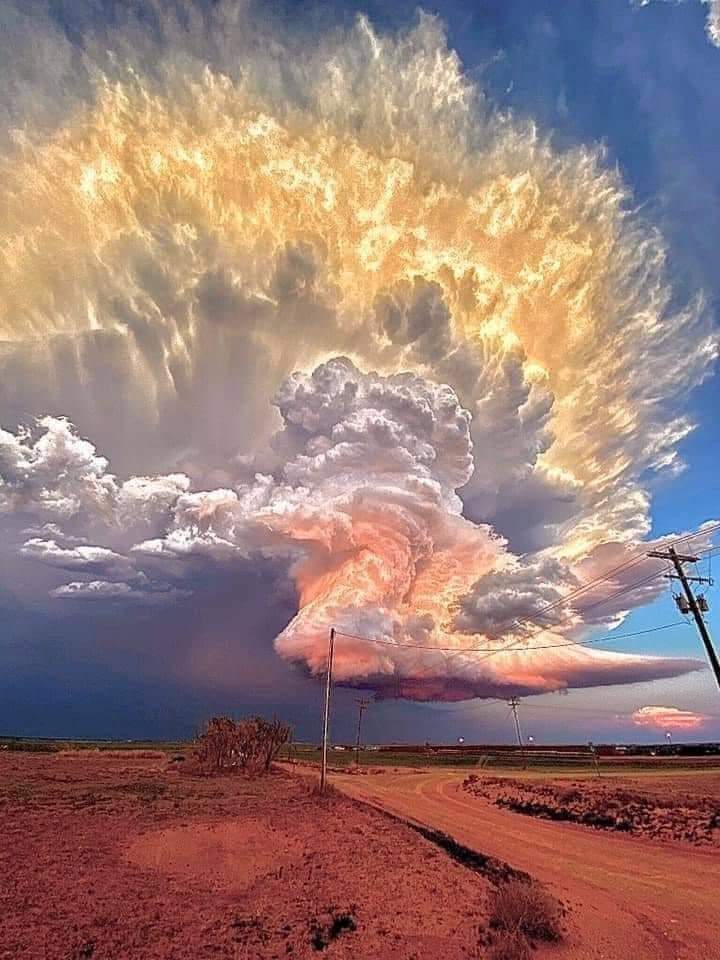
West Texas storm chaser Laura Rowe captured the picture of a lifetime, a fantastic shot of a mature supercell thunderstorm illuminated at varying heights by the setting sun.
I took my 14yr old daughter to see Prime Minister yesterday- she loved it. I thought it was excellent. It is a raw incredibly intimate portrayal of life in a huge job with some massive events to deal with. The battle she had breastfeeding Neve was heartbreaking. Highly recommend.
I don’t hold Nicola Willis responsible for the current economic conditions.I don’t believe that NZ would be okay if landlords hadn’t gotten their tax cut. However I feel disappointed in her grasp of the situation. Her blame of her inheritance, tariffs and wars was embarrassing. She failed to mention any of the key issues facing businesses including the issues with energy.
For every retweet of this post, I will donate £1 to the @VC_and_GC_Assoc up to £50,000.
Time is running out following @I_W_M’s decision to close the Lord Ashcroft Gallery.
Visit while you still can, to honour the bravery of those who risked so much to protect our great nation.
@MarkGraham_Akl I am a nutter who doesn’t believe we need more housing. I think we need infrastructure and facilities to fit the current population before we try to accomodate more.
Can I suggest that every time NZTA decides to close the harbour bridge Auckland’s mojo deflates a little more. Continual closures of the bridge for ‘weather’ is frustrating and depressing. Time for a rethink? #auckland#harbourbridge#mojo