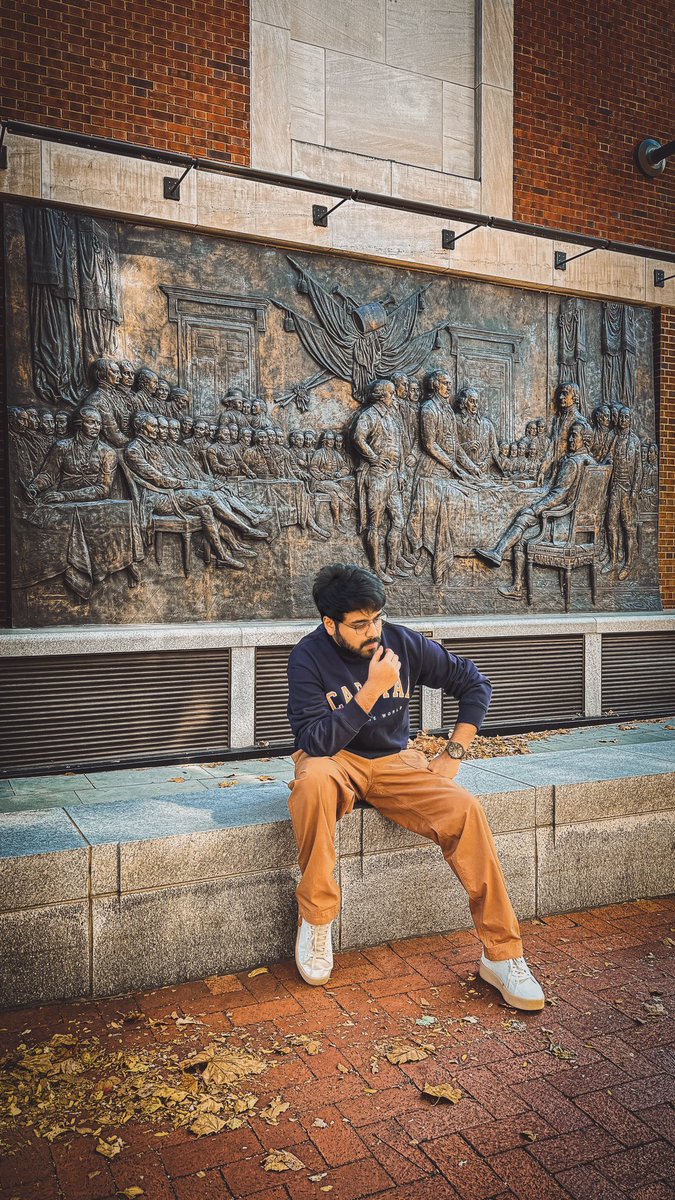
The great American experiment continues to stand as one of the most remarkable political experiments in human history, even after more than two centuries. I personally believe it has endured because it was crafted by an intellectually elite generation of statesmen.
Revolutions are often born from the frustration, anger, and anguish of ordinary citizens. Those emotions may be powerful enough to overthrow oppressors, but they are not sufficient to construct a constitutional republic capable of enduring for centuries. America’s greatest fortune was that, at its founding, it produced an intellectually elite generation of statesmen who transformed revolutionary energy into institutions deliberately designed to survive not merely their own generation, but generations yet to come. They understood both the nobility and the frailty of human nature, and therefore built a constitutional framework capable of restraining power, balancing ambition, and enduring the changing tides of history.
For the American experiment to survive the nineteenth century, it needed a leader like Abraham Lincoln. When the country was tearing itself apart, even while pursuing one of the greatest moral causes in American history, Lincoln refused to abandon the Constitution. Instead, he relied on its very principles to make his case and preserve the Union. By combining constitutional integrity with moral courage, he preserved the American experiment through its greatest crisis. I believe that is why many American historians refer to his presidency as America’s Second Foundin
Likewise, the twentieth century also demanded the same quality of statesmen. It found them in leaders like Franklin Roosevelt and Ronald Reagan. Though they represented fundamentally different political philosophies, both renewed the American experiment in response to the defining challenges of their respective eras. From what I have learned, every century seems to demand a generation of exceptional statesmen capable of preserving, renewing, and extending the experiment without abandoning its founding principles.
A political experiment can survive only when intellectually elite leaders emerge at critical moments to renew it.
So, on this Fourth of July, I believe that if the American experiment is not to fail in the twenty-first century, America must once again produce leaders worthy of the intellectual tradition established by its Founding Generation to carry the experiment forward. 🇺🇸
Three pages into reading this book, I’ve spent almost an hour conversing with AI, asking questions, writing notes, digging deeper into the subject, understanding the context behind every idea.
It’s a massive book, and if I finish it without stopping or losing focus & concentration, it’ll probably become on of the biggest book I’ve ever completed.
But when a book engages me this deeply, I kind of lose myself in it.
I was reading India of My Dreams, and I came across a line where Gandhi speaks about “de-Indianizing our education.”
It hit me, because I’ve often used the opposite idea i.e Indianization. We have this unique ability that whatever comes to our land, we make it our own. We Indianize food, we Indianize religions, we even Indianize ideologies like communism and socialism.
But reading that line I paused for a sec..
Because while we are so good at Indianizing what is foreign, we are quietly de-Indianizing what is our own… our languages, our cultural systems, our education… what not.
Maybe that’s the irony. I wouldn’t call it a balance, because we have far more to lose.
I am obsessed with and have been fascinated by the term ‘principled pragmatist’, and I was introduced to it by Talmage Boston in his book while he was referring to Thomas Jefferson, who is the OG Principled Pragmatist.
Happy to start this account on his birth anniversary.
No leader is as pragmatic and as principled as him, and no man is as morally flawed and yet as morally defining as him.
Whenever I read Gandhi, I’m struck by the purity of his thought and the naivety within it. But at the same time, he could see the better angels of our human nature. So he could walk the talk, live it, and prove it. Maybe, from his perspective, it wasn’t naive. Perhaps it appears so only because of our inability to be that pure, or because we have normalized selfishness and greed so deeply that anything higher now feels naive.