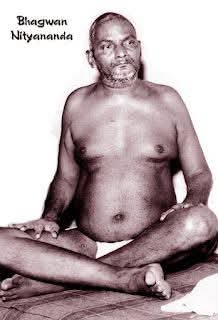
When Bhagawan Nityananda was moving around naked in Kanhangad, the police took Him to court saying this is against the law of government. "You are not even wearing a loincloth! Why? What is the reason?", questioned the Magistrate.
"I stay in the forest so I do not need any clothing", replied Bhagawan Nityananda.
"If that is so then why are you roaming in this place which is inhabited by civilised and refined people? This is against the law", warned the Magistrate.
"When I was in the forest I did not invite anyone to come to me. People came to me willingly. Also I did not come here voluntarily but your people have brought me here. If you feel wearing a loincloth is really necessary you may clothe me up", agreed Bhagawan Nityananda.
The Magistrate issued an order to clothe Nityananda Baba with a loincloth. When the police tried to tie the string to His waist it torn into pieces. Finally when the string could be tied successfully the loincloth was torn. Even after struggling for five hours Nityananda Baba could not be clothed with the loincloth.
A devotee came running and prostrated in front of Bhagawan Nityananda. Only when the devotee prayed to Him could Bhagawan be clothed with the loincloth.
~~
Avadhoota Bhagawan Nityananda, P69
#BhagavanNityananda #Ganeshpuri #Saints #spirituality #God #brahman #divinitywithin #vedanta #VedantaWisdom
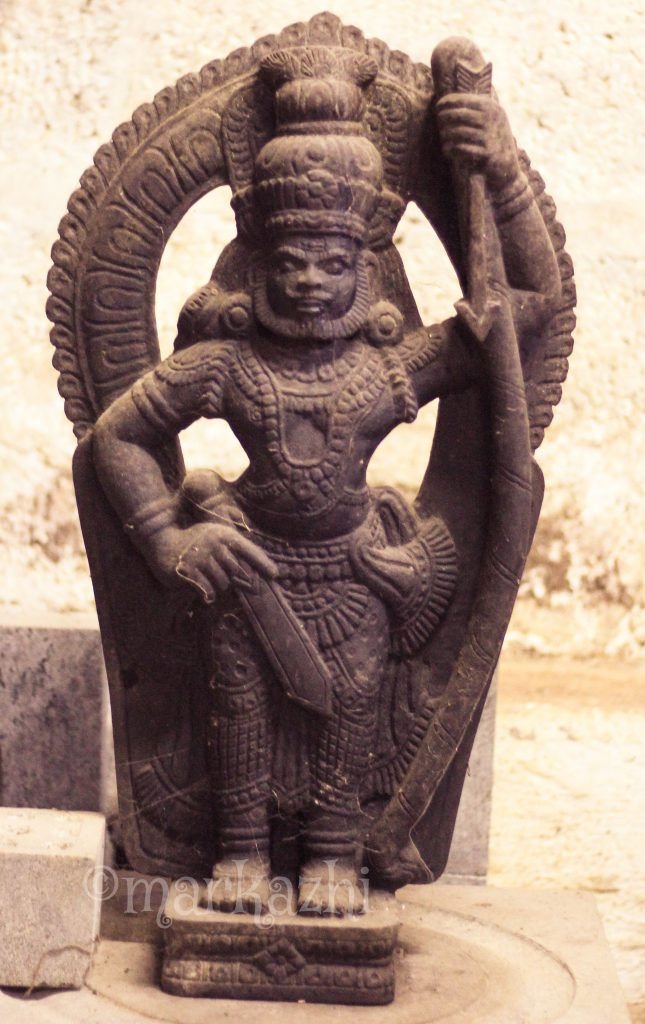
Vettaikkorumakan is a upaprathishta seen in Malabar Temples
He was born to Siva-Parvathi when they took the form of Kiratha to test Arjunan
He was a gifted archer and killed many a rakshasa. But his arrows were also a disturbance for Rishis
Vishnu intervened and 1/2
Onam is not a secular festival wearing Hindu clothing. From Sangam Tamil to Puranic scripture to Kerala's own temple inscriptions, Thiruvonam has been Bhakti at every stage, and Mahabali's surrender stands at its very heart. https://t.co/LlYfLU5a0T
We quit our jobs.
There were six of us — Shiv Nadar, Arjun Malhotra, Yogesh Vaidya, Subhash Arora, D.S. Puri and me.
It was 1976. Startups were not really a thing in India. Venture capital did not exist. Banks were not exactly lining up to lend money to six young men with an idea and no collateral.
And computers? Most people had barely heard of them.
But we believed the microprocessor was going to change the world.
So we took the plunge.
Between the six of us, we managed to put together ₹1.87 lakh. We borrowed, pooled our savings and, in one case, even sold a car.
Our first office was a small barsati in Golf Links, Delhi.
We called ourselves Microcomp. We wanted to build an Indian computer.
There was just one problem.
We didn’t have a manufacturing licence.
That eventually led us to UP Electronics Corporation. They had the licence. We had the technology. And that partnership gave birth to Hindustan Computers Limited — HCL.
But perhaps the most audacious part of the story was what happened next.
We started selling a computer that was still being designed.
We had a brochure and a mock-up of the machine. That was it.
Our sales teams went across India, knocking on doors and convincing businesses to buy into a technology they had never used before.
The first orders came from IIT Kharagpur and IIT Madras.
Then came the harder part — convincing businesses.
In Coimbatore, we were up against DCM DP, a much bigger and more established name. I still remember sitting in the reception area of Premier Mills while the DCM team made its pitch.
We went in second.
And we won.
That one order gave us five more. Then ten.
That was HCL in those early years: not having the biggest balance sheet, the biggest brand or the easiest path — but finding a way.
We were restless.
We looked for gaps. We hired people who had what we called a “cowboy” spirit. We believed that technology had to be made useful and accessible, not intimidating.
And we kept moving.
From building India’s early indigenous computers to taking our business to Singapore when HCL was just four years old. From a small room in Delhi to a global technology company.
When I look back at 50 years, I think about six people sitting together in 1976, wondering if this crazy idea could actually work.
I think about a barsati.
A brochure for a computer that did not yet exist.
And the courage to knock on the next door.
That, to me, is the real HCL story.
50 years later, the technology has changed beyond anything we could have imagined.
But the spirit remains the same:
Dream big. Take the risk. And above all, Just Aspire.
Happy 50th, HCL.
What a journey it has been.
#AjaiChowdhry #JustAspire #HCL #50yearsofHCL #Nostalgic #Founders
In kaliyugam/Rahukaalam, Dharma will be in sukshma(subtle) mode. Many don’t have the capacity to appreciate or even Notice.
4/4
#Caste_Reservations#Reservations#S_in_ESG
Brief Points on the Central Government Caste based Reservation in India:
Quota Percentages:
1. SC (Scheduled Castes): 15%
2. ST (Scheduled Tribes): 7.5%
3. OBC (Non-creamy layer only): 27%
4. EWS (castes not covered in the above 1 to 3 i.e. Upper/Forward castes): 10%
1/n
In the highly politically sensitive topic of Caste based Reservations, where nothing much could have been done earlier, this EWS quota happened only due to our Hon’ble PM. Entire weaker sections of our country, be it social or economical, have been taken care of.
3/n
Stumbled upon a very interesting fact yesterday.
Three great sons of India had gone to the Ramakrishna Math and Mission to take sanyas,the life of a monk. In all these cases the Math-Mission saw that these young boys were meant for a different kind of service to the nation
THE MISSION SHIFTS. THE COMPASS HOLDS.
This was never the plan. Initially, the plan was to climb just G2. But just before setting off for Pakistan, I ran the numbers on my 8000m summits. That’s when it hit me: if I tick off Broad Peak whilst I’m here , only one remains “Cho Oyu.” Then I become the FIRST person in history to climb all 14 eight-thousanders twice. Without oxygen.
This wasn’t planned. The Hattrick project was the focus because it carried a bigger mission. But opportunities don’t scream: they whisper to those already working in silence.
Here’s the secret I’ve carried through every expedition: I never competed with anyone else. My only battle was against the man I was yesterday. Every single day, pushing my own limits. Because the moment you look sideways: at what others are doing, saying, achieving: you drift off your compass. Your heading is YOURS. Guard it fiercely.
They criticized me when I climbed the 14 without O’s during Project Possible. If you haven’t seen what that took, watch 14 Peaks on Netflix. That film is the unfiltered truth. I was there doing multiple rescues of climbers left behind by other expeditions, raising the funds myself, leading from the front, fixing our own lines, dealing with the Shishapangma permit with China, being at hospitals for my mum’s operation and so much more. And now? Now I’m heading for the double without oxygen: triple in total. The noise hasn’t stopped. I just stopped listening.
To those who still doubt: I already climbed all 5 of Pakistan’s 8000ers in just 26 days. Leading. Guiding. Without oxygen. Breaking the records of those who broke mine with oxygen. The receipts are there.
Broad Peak, I ask for nothing but safe passage up and back down. I take zero mountains for granted. Not one. The moment my foot leaves basecamp, it’s 100%. Always has been. Always will be.
This one is dedicated to everyone who carried me here. Supporters. Critics. All of you. Without both sides, there is no fire. So thank you genuinely.
My purpose has never been about me. It’s about what I represent. It’s about showing YOU that your own mountains—whatever they are—are climbable.
#nimsdai #eliteexped #everest
🦔AI companies are bulk-buying rare books, scanning them through high-speed machines that cut the spines off, and shredding the originals. A service called ISBNdb facilitates orders of up to a million books and keeps buyers anonymous. Pre-2022 books are premium because they're free of AI-generated text. A federal judge ruled the practice is fair use because eliminating the original means only one copy exists at a time. Anthropic hired the former head of Google Books partnerships to obtain "all the books in the world."
My Take
This got to me. A bookseller told 404 Media that rare books with almost no surviving copies are being fed into this pipeline. Books that survived wars, fires, and centuries of handling are being shredded so an AI can learn to write a better marketing email.
ISBNdb's website literally says "'AI company destroys two million books' is not a headline that generates sympathy," and they still built an entire business around making it happen quietly. They offer NDAs as a feature. They coach clients to call it "digital preservation."
I've covered AI companies scraping the internet, torrenting libraries, and stealing music. This is worse because it's irreversible. You can re-upload a website. You can reprint a bestseller. You can't replace the last three copies of an 18th-century botanical text once someone shreds them for training data. And the judge said it's legal. So it's going to accelerate.
"We shred rare books and offer NDAs so nobody finds out" is a legitimate business model in 2026. What a timeline.
Hedgie🤗
Swiss farmers planted flowers between their crops and watched pest damage drop by over half. The UK is now running the same trial across 15 farms. The reason this works is embarrassingly simple.
A Swiss study on winter wheat found that fields with wildflower strips had 40 to 53% fewer leaf beetle pests than fields without. Crop damage dropped 61%.
The mechanism is simple. Wildflowers feed hoverflies, lacewings, parasitic wasps, ladybugs, and ground beetles. Those insects eat the aphids, beetle larvae, and caterpillars that farmers would otherwise spray for. A few meters of wildflowers hosts an unpaid pest control crew that would jump at the chance to whoop some aphid ass.
In apple orchards where no insecticides had been used for five years, plots with wildflower alleyways had 9.2% damaged fruit. Control plots without flowers had 32.5%.
The UK is now running a five-year trial across 15 farms placing 6-meter flower strips through the middle of fields, not just at the edges, because the beneficial insects can't reach the center of a large field otherwise.
This works the same way in a backyard vegetable garden as it does on a commercial farm. Plant native flowering species near your tomatoes, beans, and squash. The pests still show up, but the predators show up too.
Study doi: 20151369