Youth soccer (youth sports) is a competitive market with businesses selling a product that obviously customers are willing to pay for. I’d love if soccer was free to all. But who is going to pay for all this free soccer?
"Pulisic is fragile, that is not debatable... What would Erling Haaland look like against us? Gronk against a junior high. We need some size."
@colincowherd argues the USMNT needs bigger, stronger athletes to compete at the highest level
Regardless of where you stand on Balogun-Gate, the whole reaction to both sides highlights some very key differences in the American vs European mindset.
In the American mind, "getting it right" is the most important thing. Thats how justice is served, is by getting to the correct result based on the play on the field.
The European mind is different though. They have an instinct towards bureaucracy and are obsessed with process. The Process must be respected. Respecting process is more important than the specifics of what happened on the field.
And thats why you get this wild take thats fairly common where a Euro will say something like "He didnt deserve the red card, but once it was given it cannot be overturned!".
To the American mind, justice is served by getting the call right, regardless of process. To the European mind, justice is served by respecting process, regardless of the result.
Its a fascinating look into the psyche of both, and if I'm permitted a little armchair psychoanalysis of both groups, id say the reason lies in their history. The Europeans spent centuries as the peasant class of Europe, essentially being forced to accept whatever shit the aristocracy piled up on them. There was no "appeals" process, they took what they had too, because there was no other option. In this environment, a certain "acceptance of one's fate" or immunity to overt injustice likely seeped into the national psyches. No one had success by "fighting the power", the power imbalance was simply too great. What eventually saved them though, was process. Rules-based orders were the only thing that gave them a semblance of power vs the aristorcracies of their upper classes. And so they came to revere Process as the Ultimate Good and working OUTSIDE process as the Ultimate Evil.
The Americans, on the other hand, never developed their national psyche in the world of Kings and Aristocrats. Class was far less rigid in the new world, and risk-taking WAS highly rewarded there. "Fighting the power" to "do what was right" WAS greatly rewarded during the American Revolution when a few great men "fought the power" and were gifted with what would become the most powerful, prosperous country on Earth. And so a certain disdain against "process" took hold, a general feeling that "process" was only as good as long as it provided fair and just outcomes. As opposed to the European model, where "process " was the only thing that had given them anything close TO "fair and just outcomes".
So in that context, the massive gap between both sides makes sense
Or maybe this is all nonsense and its just anti-American, pro-Euro tribalism, who knows 🤷🏼♂️
American mentality: "I don't want it handed to me, I want to earn it. Send your best and let's compete."
European mentality: "Yes, the call was incorrect, but it worked to our advantage. I demand your best are kept benched for the sake of bureaucratic regulatory consistency."
The most interesting part of the red card saga isn't the ruling. It's how differently Americans and Europeans process the idea that they might have been wronged.
Europeans are fundamentally different from Americans in one particular way: they expect life to be aggravating and at times unfair. It's just a fact of moving through the world. I joke that in Europe, the customer is always wrong. You didn't read the fine print. The only pharmacy in town is closed every other Tuesday for three hours, and even if the times weren't posted, that's still your problem. Too bad if you want the bill, because the waiter's on his union-mandated half-hour smoke break, and you're just going to have to wait.
To quote the great Mark Knopfler: sometimes you're the windshield, sometimes you're the bug. There's something freeing in that. Things are less in your control, so there's less angst in managing your expectations.
In America, things couldn't be more different. We simply can't accept a wrong left unrighted.
The flight attendant sneezed handing you a drink on your one-hour flight? 15,000 frequent flyer miles. Didn't like your appetizer? A replacement is on the way, and the whole course comes off the bill. There's a reason our interstates are lined with trial lawyer billboards.
Europeans have turned complaining into a continental pastime with no expectation that the universe owes them a remedy for their grief. You gripe about the train being late, your friends nod solemnly and everyone goes back to their apéro. In America, we launch a full-blown investigation of the train system, sue the government (and its contractors) that allowed for the tardiness and hold a Congressional hearing on the state of national infrastructure.
So to an objective observer, the red card shouldn't have happened, and VAR was a travesty. To Americans, our star player shouldn't be unfairly banned from a match we couldn't afford to lose for a card he so obviously didn't deserve.
Who cares that FIFA used a little-used reversal to fix it. Who cares that other people are mad about it. We. Were. Wronged. It was unjust. It must be corrected. We would accept nothing less.
Europeans waxing poetic about the sanctity of the game are, of course, talking about a governing body whose last tournament host was decided via confirmed cash bribes — one that imposed dress codes on women, shrugged off widespread allegations of modern slavery and reconfigured the entire tournament calendar to suit the host country. Which is exactly the point. If you've made peace with all of that, at least enough to watch the tournament four years later, a probationary suspension isn't actually a scandal.
Maybe that's the real divide. Over millennia, Europeans have made peace with being the bug. Americans have never once considered it, and apparently, we're not about to start now.
This is why I cannot watch soccer. Somebody bumped into this tough SOB so they had to put a cast on his head. These dudes are softer than real boobies!
Banks aren’t worried because this is likely the worst storm of the asset cycle, these things will recover unless macro headwinds stay the way they are. In their hands
This isn’t a big deal if we eventually hit low interest rates and yields start recovering.
Primary dealers buy unsold treasuries at auctions because they have to, it’s only really a problem if rates continue to stay high, banks are forced into a scenario where they have to sell
The US has 1 option, after being so open about how close to collapse their economy is.
They know it, they’ve hinted at it - their choice whether they do it
Numbers on Christian Watson’s four-year contract extension:
It’s actually a $92.5 million extension. There are escalators that could bring it closer to the $110.5 million that was initially reported.
His APY of $23.135 in new $ puts him just inside the top 20 among WRs.
Not a problem now but becomes a huge problem if rates continue to persist at high levels preventing long rates from falling if investors demand a higher term premia
House Judiciary will hold a hearing next Wednesday on the SBA and has invited Roger Goodell to testify (he declined an invite for a similar hearing in the Senate), per a letter @YahooSports obtained.
While the hearing will focus on pro sports, college sports is certain to arise.
No matter how stupid the US govt is being, I guarantee the overwhelming majority of institutional investors park their money in US treasuries > corporate treasuries in case of a crash and that’s really the outcome that matters. Esp when it comes to triggering major CDS events
Tweeting nonsense again
For corporates we price CDS spreads as it not repaying its debts
For governments (esp US gov) CDS spreads represent the likelihood of a credit event. Could be as simple as debt ceiling accidents that keep happening
Not purely sov default
This is absolutely incredible.
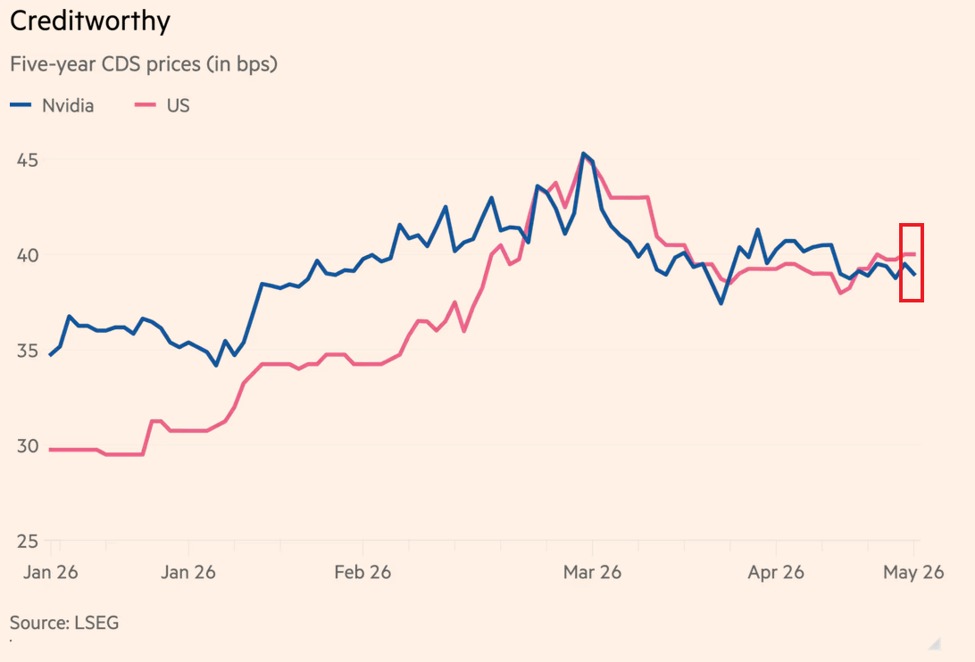
Investors now perceive Nvidia to be as creditworthy as the US government.
Nvidia's $NVDA, 5-year credit default swap (CDS) is trading at ~38 basis points, slightly below the US sovereign CDS, at 40 basis points.
In other words, markets consider the world's largest company to be less likely to default on its obligations than the US federal government.
This comes as in FY2026, Nvidia carried only ~$8.5 billion in total debt against ~$10.6 billion in cash and generated nearly $100 billion in free cash flow, giving it one of the strongest balance sheets of any company in the world.
Even if Nvidia's earnings dropped -90%, it would still rank among the 100 most profitable companies in the world.
Markets are treating Nvidia as one of the safest companies on the planet.