If Brendan Sorsby is forced to enter a supplemental draft, he will be a late 1st or early 2nd round pick, per @TonyPauline
“Presently Sorsby is graded higher than Arch Manning by several area scouts as we head towards the season.”
Standing here in the hallway assisting a citizen journalist who is currently in the ER in Manhattan, and @Hilton is threatening to toss $25,000 of my equipment into the dumpster if I don’t imminently abandon him
WTF?
No bueno.
I KNOW you don’t approve of this, @BillAckman
🚨 BREAKING: FBI has just RAIDED and ARRESTED the man who I caught on video threatening the lives of an ICE agent and his family outside ICE Newark
Nicholas Scelfo is facing FEDERAL FELONIES
THIS IS HOW IT’S DONE! 🔥
THANK YOU to @FBIDirectorKash and @DAGToddBlanche for PERSONALLY working with me on this.
You PROMISED you’d find him, and you delivered.
WELL DONE! 👏
ACTING AG BLANCHE: “FAFO.”
Voyager 1: The Titan IIIE That Launched Humanity’s Interstellar Envoy On September 5, 1977, a Titan IIIE rocket thundered off Space Launch Complex 41 at Cape Canaveral, carrying one of the most ambitious missions in human history. Voyager 1 was on its way — not just to explore the outer planets, but to eventually leave our Solar System entirely.The Titan IIIE, paired with its powerful high-energy Centaur upper stage, was chosen for its raw muscle. It had to deliver the spacecraft with enough velocity to escape Earth’s gravity and begin the long journey outward. Timing was everything. The launch took advantage of a rare planetary alignment that occurs only once every 175 years, allowing Voyager 1 to use Jupiter’s gravity as a slingshot toward Saturn, and then onward into the unknown.The launch itself was a spectacular success — a masterpiece of 1970s engineering. But the real treasure was tucked inside the payload fairing:Advanced cameras and scientific instruments
The now-legendary Golden Record — a time capsule containing sounds of Earth, music, greetings in 55 languages, and images of our world, designed as a message for any intelligent life that might one day find it.
Thanks to that powerful initial push from the Titan IIIE and clever gravity assists from Jupiter and Saturn, Voyager 1 became the fastest and farthest human-made object in existence. In 2012, it crossed the heliopause and entered interstellar space, where it continues to travel today — over 25 billion kilometers from Earth and still sending back precious data.More than four decades after that dramatic liftoff, Voyager 1 remains a silent but enduring ambassador of humanity, carrying our voices, our music, and our curiosity into the vast cosmic ocean.A single launch that sent a small machine on a journey that may outlast our civilization itself.
Voyager 1 and its twin, Voyager 2, are the only spacecraft to have operated beyond the heliosphere, which is the protective bubble of particles and magnetic fields created by the Sun. Voyager 1 crossed into the interstellar boundary in 2012, whereas Voyager 2, moving at a slower pace and in a different direction, reached that boundary in 2018. ✍️
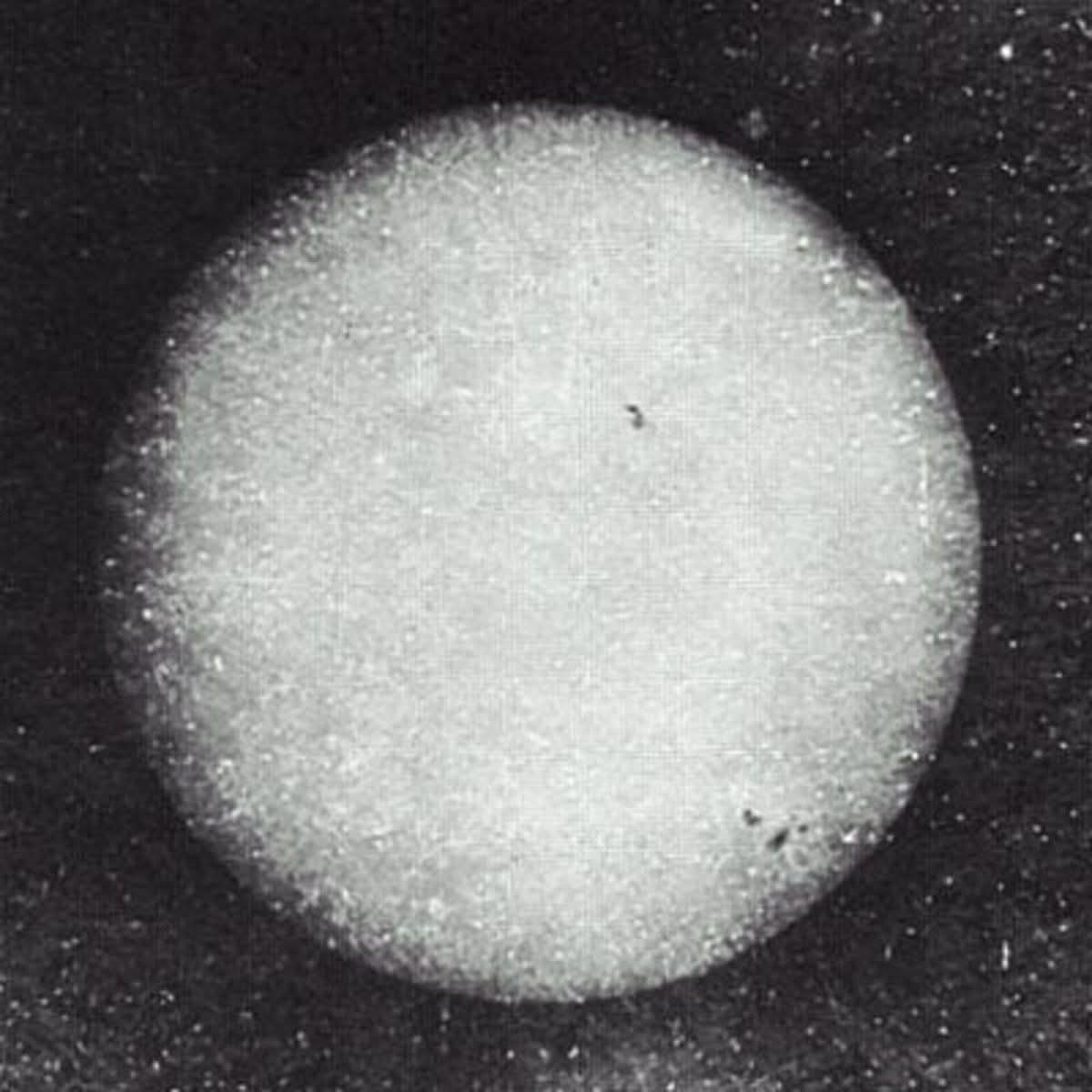
181 Years Ago Today:
The First Photograph of the SunOn April 2, 1845, French physicists Hippolyte Fizeau and Léon Foucault made history by capturing the very first successful photograph of our star — a groundbreaking daguerreotype that revealed actual sunspots on the Sun’s surface.This grainy but revolutionary image proved the Sun wasn’t just a featureless ball of light — it was a dynamic, complex world we could finally study in detail. It marked the birth of solar photography and helped launch modern astrophysics.
Credit: Hippolyte Fizeau & Léon Foucault (Public Domain)From this humble 19th-century plate to today’s stunning high-res images from SOHO, SDO, and Parker Solar Probe… what a journey! Happy 181st birthday to the first photo of the Sun!