Across a dozen brands I worked with as a fractional CMO, the biggest lever kept turning out to be the same thing.
Ad creative.
As fCMO at Clean Juice, Snap Fitness, Tarry's Apparel and more, performance ad creative for Meta, YouTube and TikTok became the most requested part of my work.
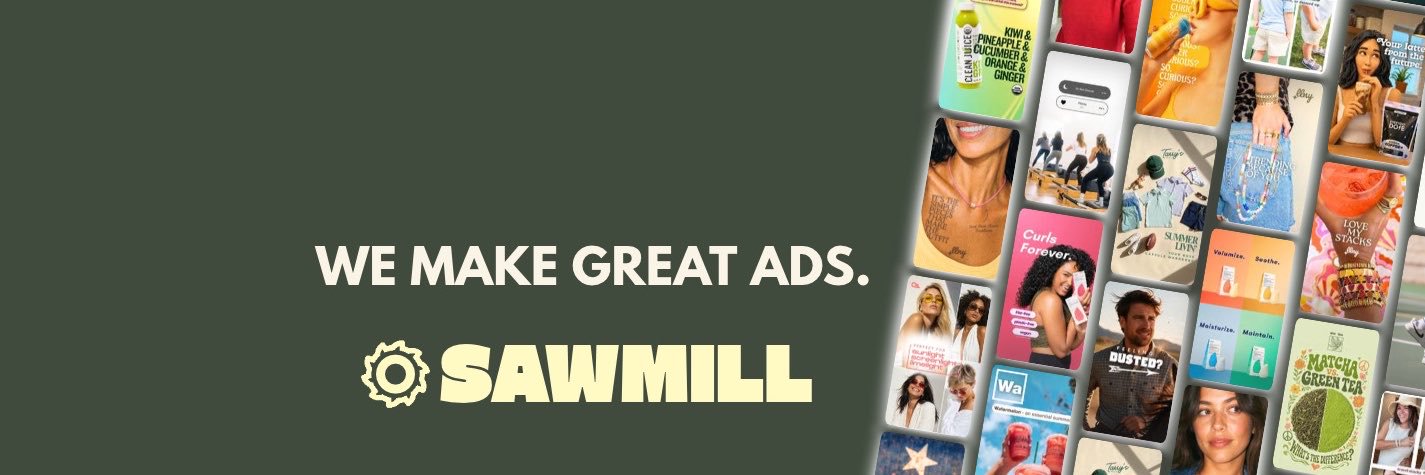
So this week I'm launching SAWMILL ⚙️.
One focus: making great ads.
Plenty of agencies offer ad creative. Few do only that.
And hundreds of AI tools now make ads cheap to produce. The results are a different story.
Great performance ads come from great creative strategy:
WHY your audience buys from you.
WHO they are, in real detail.
WHAT you make, from UGC to long-form animation to statics that pop.
HOW it all becomes one plan that tests, learns and doubles down on winners.
That's the gap SAWMILL fills.
Experienced designers, editors and strategists, using the best AI tools.
@TaylorHoliday totally. meant that as long as that ratio isn't getting worse. I'd take a $120 nCAC if the 12mo LTV was $700 over a $55 nCAC where the the 12moLTV is only $200.
I have learned a massive arbitrage when it comes to compensation:
There are a lot of different ways that you can pay someone. The most obvious method is salary and bonuses. In our modern world, our salary gets processed digitally and deposited directly into our bank account. Although it is helpful to the employee, it is intangible. They will never physically see the money, and it is hard for them to tie that money to a specific future purchase.
Basically, this make salary and bonuses table steaks for compensation. We need to be looking for other concrete ways to financially compensate employees. Some examples include:
Buying their lunch
A gift card to their favorite store
Providing a laptop that can be used for work & personal
A budget for decorating their office
I've found that these forms of compensation deliver MUCH higher happiness per dollar spent. If I pay $10 for an employee's lunch, that is much more concrete than their digital bank deposit being $7 higher after taxes.
Compensating people in ways other than salary requires creativity and thinking outside the box, but it is worth the effort. And the ultimate skill is learning to compensate people in ways that don't cost money. Some examples:
+Publicly recognizing a team member for excellence.
+Writing thank you notes.
+Investing time in the personal development of people who you manage/lead.
+Creating an environment where employees are empowered to make decisions.
+Cultivating a culture that people will enjoy being immersed in for 40 hours a week.
You should strive to pay your employees well, but a paycheck is the most basic form of compensation. Business gets much easier when you master the many other ways of rewarding your employees.
.@stevenborrelli on the pricing experiment that flipped their unit economics:
"Our AOV dipped to $140. But then our CAC dipped from like $120 to $55."
"To get the same revenue, we did have to acquire more customers. But the new customer count—in August of this year, we acquired half of the total '25 cohort in one month."
"It's almost like a weird thing where the customer getting more value is what lowered the CAC."
GrokBot is the best. Muse is the worst from all these, imo.
🚩 Important note for anyone seriously paying attention to posts like these: you need to build a memory system outside of the agent, regardless of which one you’re using.
📁A folder system of MD files to store all your notes, insights, data and project info you generate with your agent.
I use Obsidian, but you can use other tools.
🧠 The point is to build your own “AI brain” that is independent of any agent harness, so if you need to switch, you can easily port over and get up and running in a new agent system within hours.
Otherwise you risk a) losing information over time due to every agent’s memory limits, or b) being forced to stick with one agent since that’s all you’ve ever used, and paying more when they inevitably raise prices
If you’ve used a personal AI assistant (@bot, @Muse, dots from @OpenAI, @Claudeai Duet, @Instinct, etc), which was your favorite and why? What are the biggest differences?
Agreed on GrokBot. Also agreed on “Muse is a toy” 😂
Important note for anyone seriously paying attention to posts like these: you need to build a memory system outside of the agent, regardless of which one you’re using.
A folder system of MD files to store all your notes, insights, data and project info you generate with your agent.
I use Obsidian, but you can use other tools.
The point is to build your own “AI brain” that is independent of any agent harness, so if you need to switch, you can easily port over and get up and running in a new agent system within hours.
Otherwise you risk a) losing information over time due to every agent’s memory limits, or b) being forced to stick with one agent since that’s all you’ve ever used, and paying more when they inevitably raise prices