After much thought and reading, I have come to the conclusion that this is the most important distinction in the world.
Socialism = arguing about how to divide the pie.
Capitalism = baking as much pie as possible.
Elements of both are necessary for balance but when you get to a situation where the socialist mindset is dominant (Europe), all the pie-bakers start leaving or stop baking.
That's really stupid. If localities don't support the effort, it's going to be more of a heavy hand from a powerful federal government and possibly military.
BREAKING: With a 13-0 vote, the LA City Council adopted a "sanctuary city" ordinance today to prohibit the use of city resources and staff for federal immigration enforcement efforts.
https://t.co/WLXYLRvnFW
@kcalnews That's really stupid. If localities don't support the effort, it's going to be more of a heavy hand from a powerful federal government and possibly military.
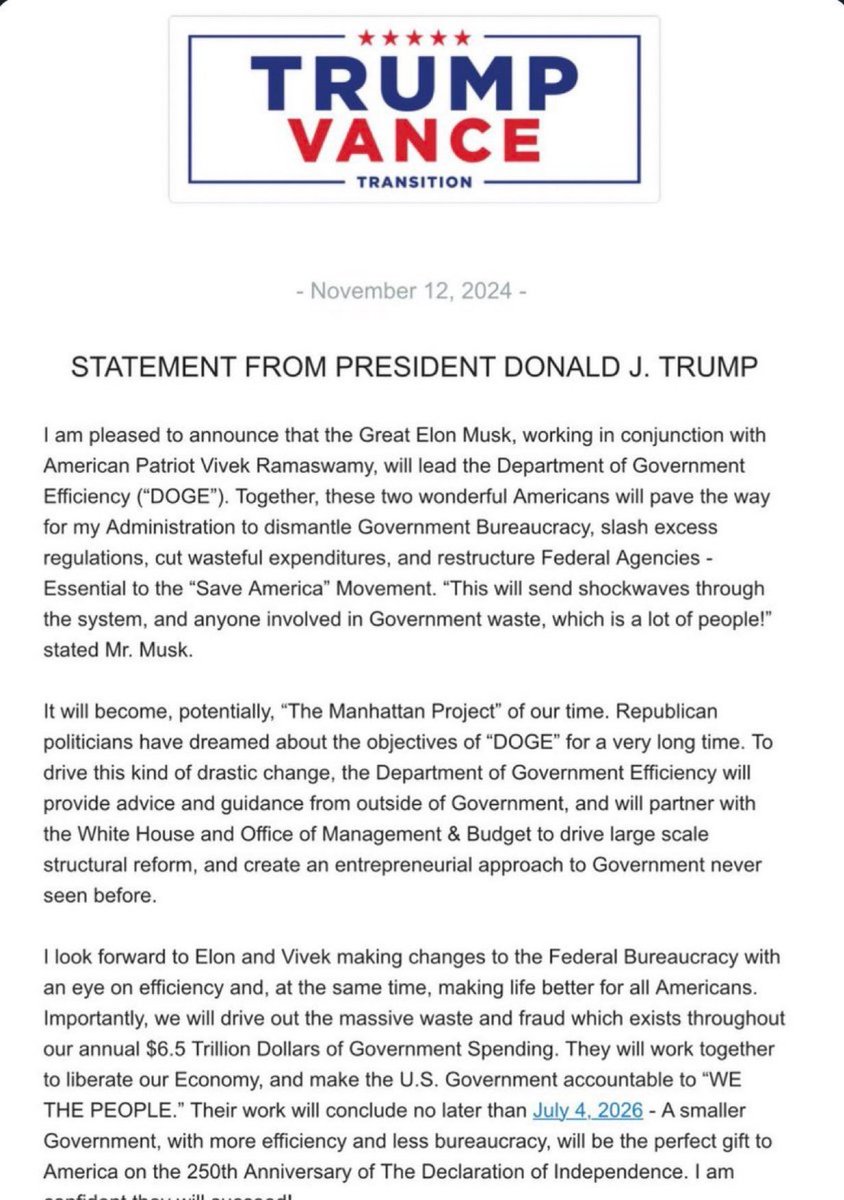
What should reassure every Tesla investor:
"provide advice and guidance from OUTSIDE of Government"
"limited to 21 months, up to July 4, 2026".
Dream Scenario. Thank you @elonmusk and @VivekGRamaswamy
Here’s a key point about our mission at DOGE: eliminating bureaucratic regulations isn’t a mere policy preference. It’s a legal *mandate* from the U.S. Supreme Court:
- West Virginia v. EPA (2022) held that agencies cannot decide major questions of economic or political significance without "clear congressional authorization." This applies to *thousands* of rules that never passed Congress.
- In Loper Bright v. Raimondo (2024), the Court ended Chevron deference, which means agencies can't foist their own interpretations of the law onto the American people. Over 18,000 federal cases cited the Chevron doctrine, often to uphold regulations, many of which are now null & void.
- In SEC v. Jarkesy (2024), SCOTUS restricted the use of "administrative law judges" by agencies. The same agency that wrote the rules shouldn't be able to prosecute citizens in “courts” that it controls.
- In Corner Post v. Board of Governors (2024), the Court held that new businesses can challenge old regulations, greatly expanding the statute of limitations & opening many more rules up for scrutiny. So we shouldn't just look at rules passed in the last 4 years, but over the past 4 decades (or more).
DOGE is ready help the U.S. government conform to the U.S. Constitution once again. @elonmusk and I are ready to serve. 🇺🇸
Elon Musk, 11 years ago: Having too many laws and regulations is not good for society.
“The natural bias of regulations is to last forever. You have to actively delete a regulation or a law, the way things are set up in most laws. Some laws have sunset provisions.
And the problem with that is you get vested interests who like that law. And there's an inertia around it.
And so, over time, the body of laws and regulations grows and grows and grows. It is something that I think is not ultimately good for society.
So, in fact, I think it would generally be a good idea to have it such that it's hard to establish a rule and easy to remove one.”
Montana Job Summit, 2013
The world is suffering slow strangulation by overregulation. Every year, the noose tightens a little more.
We finally have a mandate to delete the mountain of choking regulations that do not serve the greater good.
@VRSTEPHENS8 @MattWil21494922@AaronUSMC75@SaulAlejandr00 Actually there are many more "homeless" than just veterans - by far. I live in NorCal, so I know. Mentally ill, junkies AND people who just don't give a shit about life are most of the people I see on the streets.
@MaireCazz@CIS_org I loved the idea of NEPA. Of course we need to consider the environmental impacts. But it is both too weak (as you said, no mandate) and too strong, getting in the way of important projects for one tiny species. It's created a massive beaurocracy.