Three weeks ago, we released Phonic-1. Today, we're introducing Phonic-1.1.
Phonic-1.1 continues to be the most advanced speech-to-speech model for agentic tasks.
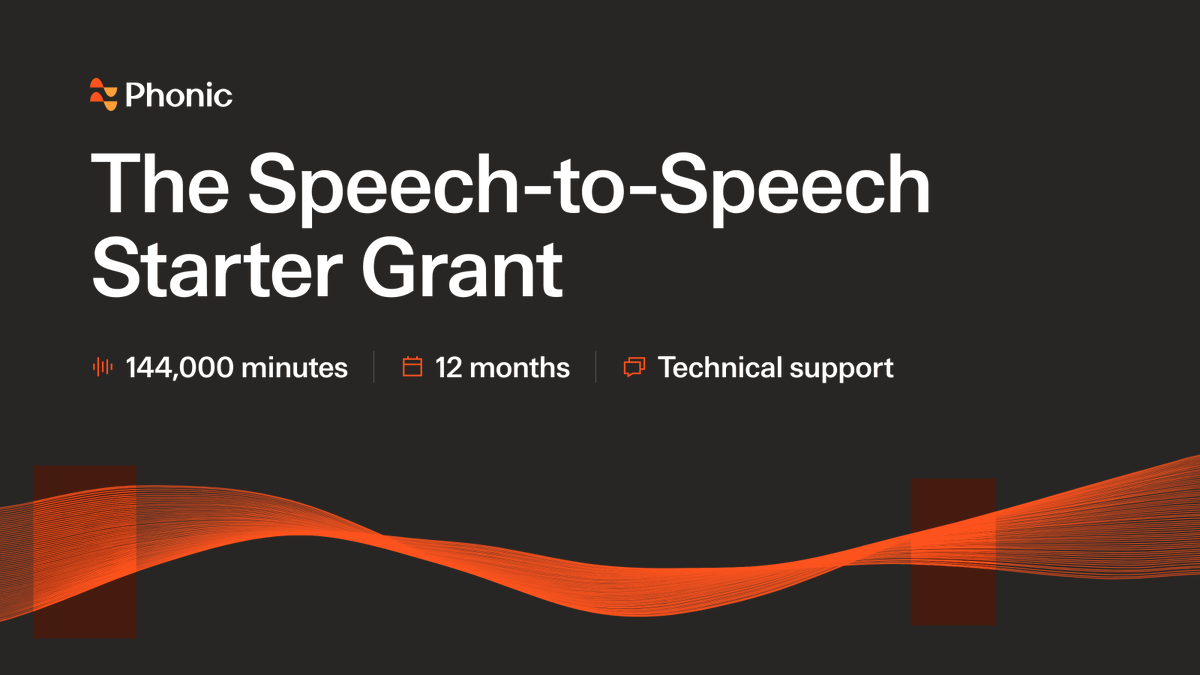
Introducing The Speech-to-Speech Starter Grant.
Last week, we launched Phonic-1, the most advanced speech-to-speech model for agentic tasks. We now want to get Phonic-1 into the hands of startups that are excited to build products on top of the latest models.
We’ll cover 144,000 minutes of Phonic across 12 months and provide direct access to our research and engineering team.
In return, we’d love to learn from you. Developers building on top of Phonic teach us more about where we should take Phonic than any benchmark.
If you’re a startup looking to build on speech-to-speech models, apply at https://t.co/P4hHl6jTvO!
our team has been heads down building for years and I'm just so grateful for the response to Phonic-1's launch yesterday
I love my team. they built a model that's..
#1 on AA's speech-to-speech index
#1 on AA's 𝜏-Voice (agentic performance)
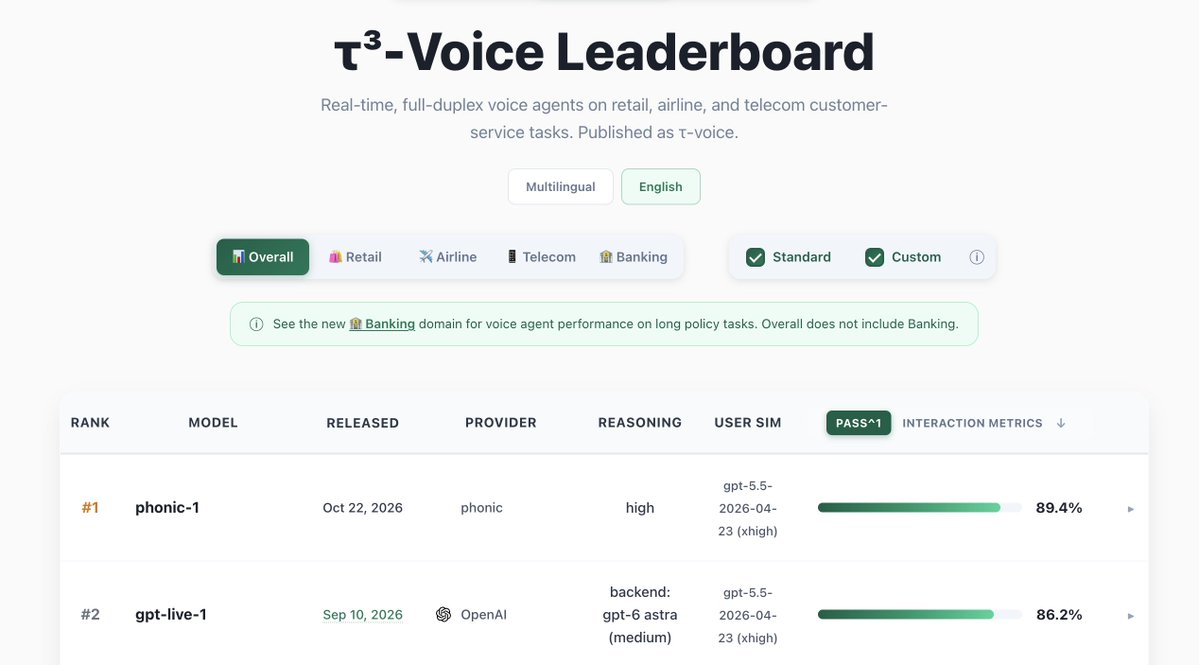
#1 on Sierra's τ³-Voice
#1 on Cekura's s2s benchmark
#1 on Veris's VAmoS Pro Bench
#2 on Bluejay's MIVAS s2s benchmark
we literally just dropped seven figures on a new compute cluster to support the load
we can't wait to continue pushing the frontier for our customers!! try it out and let me know what you think
pro tip - connect your phonic agent to @Muse and have it make phone calls on your behalf. @alexandr_wang i've been using muse x phonic to do all my phone errands, it got me a $200+ refund on doordash and also helped me book my hotel for @nycmarathon 💙🧡
Introducing Phonic-1, the most advanced speech-to-speech model for agentic tasks — from @phonic_co, the speech-to-speech model company.
We’ve had a breakout year and raised a $27.5M Series A led by @firstround with participation from @Lux_Capital, @felicis, and Definition.
Introducing Phonic-1, the most advanced speech-to-speech model for agentic tasks — from @phonic_co, the speech-to-speech model company.
We’ve had a breakout year and raised a $27.5M Series A led by @firstround with participation from @Lux_Capital, @felicis, and Definition.
Phonic takes gold on Tau Voice English!
Its the first time that a model not produced by one of the big labs (openai/xai/gemini) has come out on top. Congrats to @NikhilKMurthy, @moinnadeem and the Phonic team, this is huge!
Phonic-1: https://t.co/uNroPiEw12
Leaderboard: https://t.co/jmAweQNzDx
Phonic's Phonic 1 (High) is the new leading Speech to Speech model, debuting at #1 on the Artificial Analysis Speech to Speech Index at 87.1, while also leading on agentic performance and being competitive on latency
Phonic 1 is @phonic_co 's Speech to Speech model, available through the Phonic API at $0.07 per minute. We evaluated Phonic 1 at its high intelligence level through the Phonic API.
Key takeaways:
➤ Speech to Speech Index: #1 of 22 at 87.1, ahead of Grok Voice 3.0 (86.9) by a very small margin. The Index averages Speech Reasoning (Big Bench Audio), Agentic Performance (Tau Voice), Arena Preference and Task Success Rate
➤ Speech Agent Arena: #8 of 30 on preference (Elo 1012) and #4 on Task Success Rate (92.3%)
➤ Tau Voice: #1 at 79.9%, a clear lead of 5.4 points over the next model
➤ Big Bench Audio: #3 at 98.9%, behind StepAudio 3 Realtime (99.7%) and Qwen Audio 3.0 Realtime Plus (99.2%)
➤ Speed: #4 on Time to First Audio at 0.61s, and the fastest of the top 5 models in the Index
➤ Cost: $4.20 per hour of input audio
Congrats to the @phonic_co team 🚀
See below for more detail ⬇️
A few years ago, Moin and I were driving down 280 and talking about building something in voice AI. We were excited by the future with models that could truly understand and naturally speak with us, and it felt obvious to me at the time that these models, like us, needed to take in and output audio. It turns out this is an extremely hard thing to build, but I’m so proud of the Phonic team for taking us a step closer in that direction with Phonic-1.
Few lessons I learned:
1. Intelligence cannot be traded off for low latency or naturalness: the most valuable workloads in voice are intelligence bottlenecked (multi-step tool calling, instruction following and long context understanding)
2. Real calls are the ultimate benchmark. Whenever I sit with a customer and listen to their calls, I always find new failure modes and learnings that help us build at the frontier.
3. Reliability is everything. A voice call going silent or dropping is truly an awful experience, and you can’t just retry a request (like coding agents). We had to think about our infra from the ground up for reliability.
We’re so excited to release Phonic-1. It’s a really great model across intelligence, latency and naturalness, and already making a huge impact with our customers. And so much more in store to come!