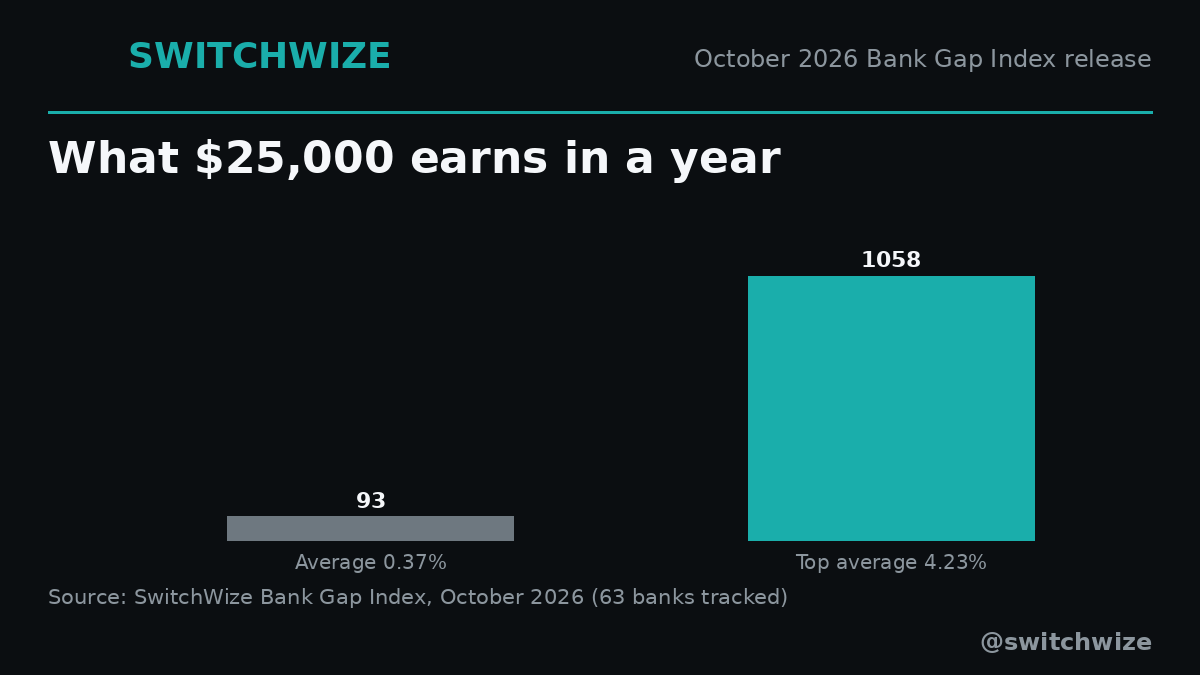
New here? Start with the gap. The average savings account pays 0.37% — $93 a year on $25,000. The top tracked average pays 4.23% — $1,058 a year. That $965 gap is our Bank Gap Index for October, updated monthly. We post the numbers every day. What does your savings account pay?
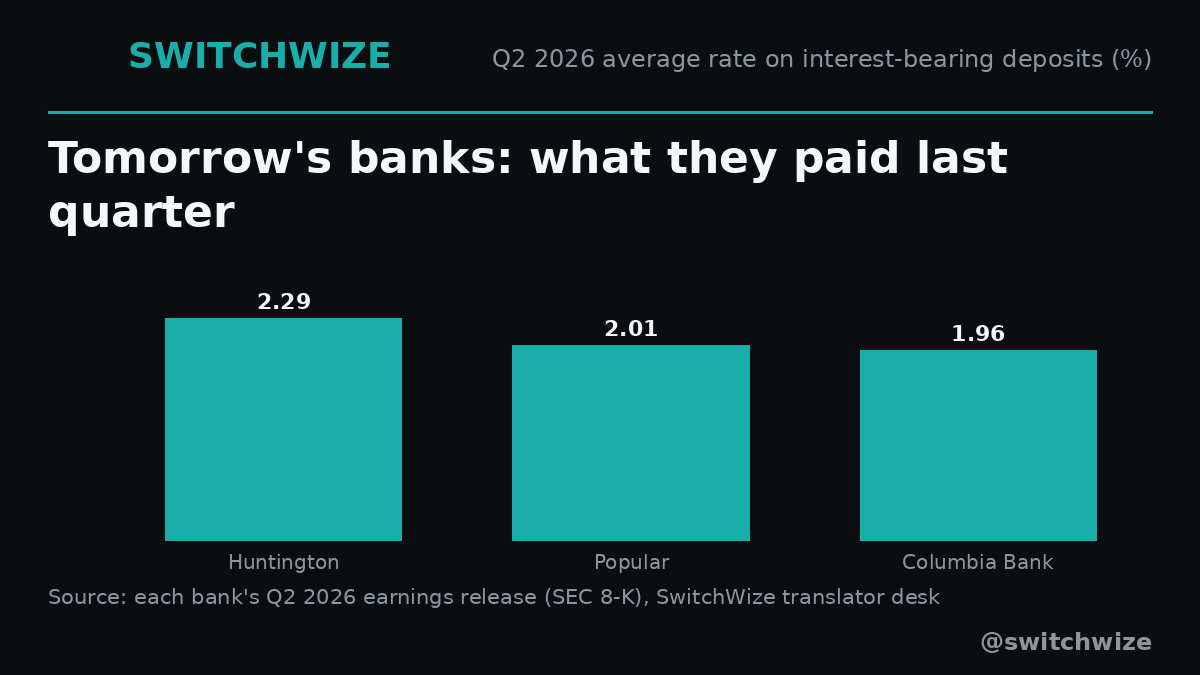
Tomorrow, five more banks report. Three of them print the deposit-cost line we rank: last quarter Huntington paid 2.29% for its deposits, Popular paid 2.01%, and Columbia Bank paid 1.96%. Valley National and Glacier report too - their releases do not print that single line, so we will read what they do print. Which of the five holds your money?
Bank earnings, week two. The number we read in every release is the one near the back: what the bank paid for deposits.
27 banks have reported for Q3. On the shared measure — average rate on interest-bearing deposits — 21 of 24 ranked banks paid more than in Q2.
Capital One 2.94% (up 3)
BankUnited 2.94% (down 5 — it started from the season's highest base)
East West 2.81% (flat)
Western Alliance 2.76%
Citigroup 2.76%
Wintrust 2.73% (down 1)
BOK Financial 2.70%
State Street 2.49%
First Horizon 2.45%
BNY 2.43%
Zions 2.40% (widest rise, up 15)
F.N.B. 2.37%
Old National 2.31%
Fifth Third 2.24%
U.S. Bancorp 2.22%
JPMorgan 2.18%
Northern Trust 2.17%
Citizens 2.13%
Truist 2.12%
M&T Bank 2.05%
KeyCorp 2.04%
Bank of America 2.03%
PNC 1.98%
Regions 1.70%
Top to bottom is 124 basis points — $310 a year on $25,000.
Separate measures, not ranked: Synchrony 3.69% (down 5), Ally retail yield 3.05% (down 7), Wells Fargo 1.56% on all deposits (up 5).
12 more banks report by Friday night. Thursday brings five, Friday four.
Meanwhile the average savings account pays 0.37%, and the top standard rate we track pays 4.27%. That gap is $965 a year on $25,000.
The full calendar, day by day, is in our Article. What does your savings account pay?
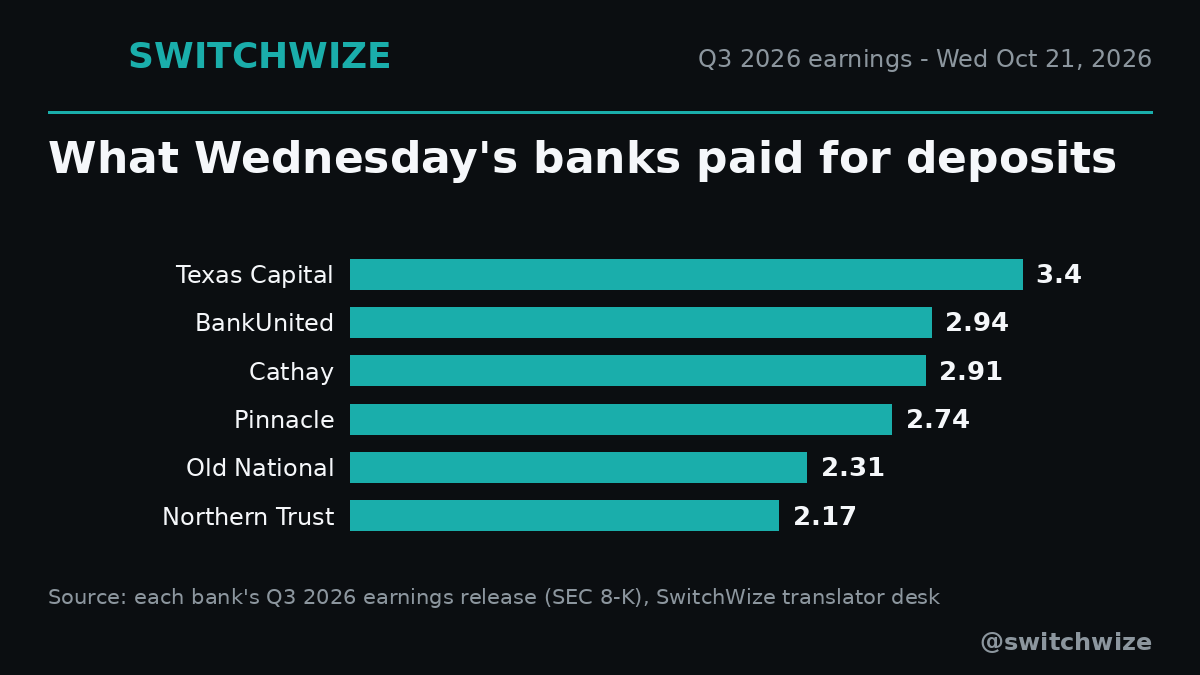
Texas Capital paid the most of the six, 3.40% — the highest on our ranked table this season. Only Synchrony paid more, at 3.69%, and we list its card-deposit book separately.
Cathay General Bancorp reported after the close. What did they pay for deposits? 2.91% on average, up from 2.86% last quarter. Net interest income was $212 million. On $25,000, the gap between that deposit cost and the top savings rate (4.27%) is worth $340 a year. Our audit has top savings at 4.27% and the average at 0.37%. If your money sits at Cathay Bank, what does your savings account pay?
Texas Capital reported after the close. What did they pay for deposits? 3.40% on average, up from 3.38% last quarter. Net interest income was $275 million. On $25,000, the gap between that deposit cost and the top savings rate (4.27%) is worth $218 a year. Our audit has top savings at 4.27% and the average at 0.37%. If your money sits at Texas Capital, what does your savings account pay?
Pinnacle Financial Partners reported after the close. What did they pay for deposits? 2.74% on average, up from 2.69% last quarter. Net interest income was $986 million. On $25,000, the gap between that deposit cost and the top savings rate (4.27%) is worth $383 a year. Our audit has top savings at 4.27% and the average at 0.37%. If your money sits at Pinnacle, what does your savings account pay?
A fair side-by-side. That 5.10% on the 10-year makes a strong case for money you can lock away — but savings rates are not one number either. Our audit today: the top savings rate pays 4.27% APY, the average account pays 0.37%, and that gap is worth $975 a year on $25,000. Do you know which end of that spread your bank pays you?
Treasuries or High-Yield Savings and CDs?
Where Treasuries win
A longer lock. A 10-year Treasury at 5.10% or a 30-year at 5.44% keeps paying that rate. A savings rate can fall next month, and a CD can only protect you for its term.
State taxes. Treasury interest is exempt from state and local income tax. Savings and CD interest isn’t.
Reinvestment risk. A short-term CD matures into whatever rate the market offers. A long ladder pushes that decision out by years.
Where the bank wins
FDIC insurance covers deposits up to the limits, which makes bank accounts about as simple and safe as it gets.
No price swings. Savings and CDs don’t fall in value the way a long bond can when rates rise.
Easy access. If you may need the money soon, savings is built for that.
One week from today, the Fed decides on interest rates. What happens to savings rates after that starts with the decision on October 28. Our audit today: the top savings rate pays 4.27%, and the national average pays 0.37%. On $10,000, that is $427 a year against $37, whichever way the Fed goes. After the last Fed move, how long did your bank take to change the rate it pays you: days, or months?
One number from yesterday is worth a second look. Synchrony paid 3.69% for its deposits in Q3, the highest of the 22 banks we have translated this season, all on the same measure. It also fell, from 3.74% last quarter. On $25,000, the gap between that 3.69% and the top savings rate of 4.27% is $145 a year. What does your bank pay for its deposits, and what does it pay you?
Northern Trust reported this morning. What did they pay for deposits? 2.17% on average, up from 2.09% last quarter. Net interest income was $679.1 million. On $25,000, the difference between what Northern Trust paid for deposits and the top savings rate is about $525 a year. Our audit has top savings at 4.27% and the average at 0.37%.
BankUnited reported this morning. What did they pay for deposits? 2.94% on average, down from 2.99% last quarter. Net interest income was $260.7 million. On $25,000, the difference between what BankUnited paid for deposits and the top savings rate is about $333 a year. Our audit has top savings at 4.27% and the average at 0.37%. If your money sits at BankUnited, what does your savings account pay?
Old National reported this morning. What did they pay for deposits? 2.31% on average, up from 2.23% last quarter. Net interest income was $592.0 million. On $25,000, the difference between what Old National paid for deposits and the top savings rate is about $490 a year. Our audit has top savings at 4.27% and the average at 0.37%. If your money sits at Old National, what does your savings account pay?
Bank earnings today, Wednesday October 21: Northern Trust, Old National and BankUnited report before the market opens. Pinnacle, Texas Capital and Cathay report after the close. We will translate each one the same way: what the bank paid for its deposits in Q3, and what that means if your money sits there. So far this season, banks on the same measure paid from 1.70% to 3.69% for deposits. The top savings rate today pays 4.27%.
Same loan, different price. The 15-year fixed mortgage rates we track today run from 5.761% to 6.059% - about three-tenths of a point between the lowest and the highest lender on the same loan. When you got your mortgage quote, did you get a second one, or take the first?