Building a community and engaging them is the best way to build your project well.
Here's an ultimate guide on how you can do it in web3 (It feels illegal to share this)
A🧵🧵
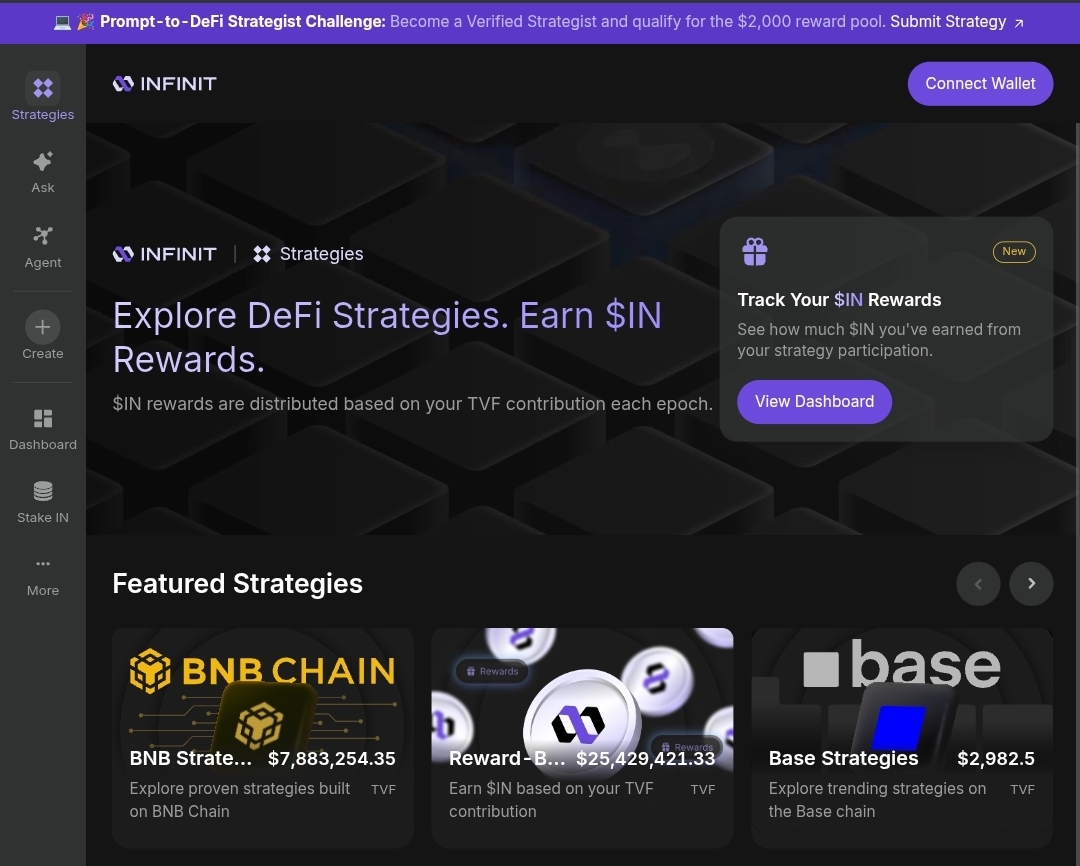
. @Infinit_Labs is running a 30-day Prompt-to-DeFi Strategist Challenge and time is ticking.
describe a defi strategy in plain language, ai agents handle execution across 14+ chains and 20+ protocols. no code, fully non-custodial.
i built the BNB-slisBNB Loop on Venus Protocol and it's crossed $4.9M in TVF. from a prompt.
strategists earn from a $2,000 reward pool based on TVF each epoch. the more your strategy attracts, the more you earn.
even if you're not chasing rewards, it's a solid way to learn how defi strategies actually work.
30 days goes fast. if you've had a strategy idea sitting in the back of your mind, now's the time.
crypto is not dead. you're just doomscrolling.
if your friends keep telling you to quit crypto, it's because they only see the hacks, rugs and liquidations on their tl. to survive this game, you have to zoom out.
here are 11 things that happened in crypto from january to april 10, 2026 that almost nobody on your timeline is talking about:
1/ japan's cabinet officially approved the bill to classify crypto as a financial asset. flat 20% tax, insider trading rules, the whole thing. the world's 3rd biggest economy just opened the door.
2/ ubs and 6 major swiss banks launched a live swiss franc stablecoin sandbox on april 8. the same banks that wouldn't touch crypto 3 years ago are now running stablecoin infra themselves. let that sink in.
3/ the sec and cftc signed a formal mou in march and ended the years-long "regulation by enforcement" war. one month later they dropped a joint interpretive release on how securities laws apply to crypto. builders have begged for this since 2018.
4/ the fed, occ and fdic jointly clarified the capital treatment of tokenized securities on march 5. boring sentence. massive unlock. banks were literally waiting on this paper to scale on-chain custody.
5/ the occ dropped a 376-page proposed rule implementing the genius act for federal stablecoin issuers in february. rules going from pdf to operational.
6/ hong kong just granted its first two stablecoin licenses to hsbc and a standard chartered-animoca brands jv (april 10). asia's regulated stablecoin hub is officially live. game on.
7/ the uk fca picked 4 firms for its dedicated stablecoin sandbox cohort. uk finally stopped watching from the sideline.
8/ solana foundation launched stride + an incident response network after the drift exploit. protocols over $100m tvl now get funded formal verification. translation: mathematical proofs, continuous monitoring, not one-off audits. this is the shift defi needed. expect ethereum and others to follow.
9/ tokenized rwas grew ~30% in q1 2026. from $21b to $27.5b while btc was bleeding. tokenized us treasuries crossed $10b on-chain. capital is not leaving. it's just moving to the quiet room.
10/ for the "defi yields aren't worth the risk" crowd: tokenized t-bills beat defi's stablecoin lending rate on 98% of days in q1 2026, with 3.6x lower volatility. the market is repricing risk by itself. safer yield is winning. that's not bearish for defi, that's defi growing up.
11/ south korea is reviewing a near-100% cold wallet storage mandate for exchanges. one of the biggest crypto markets on earth is structurally killing exchange hot wallet hacks. a ct headline that never existed, about to stop existing.
the rails are being laid. the rules are being written. the infra is being hardened. every bear market looks terminal from inside it. every bear market builds the thing the next cycle rides on.
but don't just feel good about this list and go back to sleep. news won't save you. hopium won't save you. upskill, build, network, show up like your future depends on it, because it does.
you won't find another space where a broke kid with wifi and obsession can out-earn a harvard mba in 18 months. just do the work.
crypto twitter will spend all day arguing about what "real adoption" looks like while fifa just showed you.
predictstreet, powered by @ADIChain_, is now the official prediction market partner for the world cup. 6 billion fans across 16 stadiums and 104 matches. first consumer app on a chain built for institutional-grade settlement, now in the hands of everyday fans.
every transaction settles on-chain with ADI. this might be the biggest partnership crypto has ever landed and most of the users won't even know it's crypto.
real adoption doesn't ask for your approval. it just happens while you're not looking.
i was wrong about the drift hack.
last week i wrote about it. said 2 out of 5 multisig signers were tricked into approving transactions they didn't understand. said it was social engineering in the way we usually think about it. someone got careless. someone clicked something they shouldn't have.
that's not what happened. and the real story is worse. much worse.
drift released their full incident background. i'd encourage everyone to read it. but i'm going to walk through it here because what they described isn't a hack. it's an intelligence operation. and it should change how every builder in this space thinks about security.
this started in fall 2025. six months before a single dollar was stolen.
a group approached drift contributors at a major crypto conference. presented themselves as a quant trading firm looking to integrate with the protocol. technically fluent. verifiable backgrounds. they didn't show up once. they showed up at multiple conferences. multiple countries. over six months.
they had months of real conversations about trading strategies and vault integrations. held working sessions. filled out onboarding forms. deposited over $1 million of their own capital into a drift vault.
one million dollars. of their own money. just to make the relationship look real.
by april these weren't strangers. drift's team had known them for half a year. met them in person multiple times. and the whole time they were sharing links. tools. apps they claimed to be building. normal stuff for a trading firm integrating with a protocol.
except some of those links were weapons.
drift's investigation identified three likely attack vectors. one contributor may have been compromised after cloning a code repository the group shared. supposedly a frontend for their vault. another downloaded a testflight app presented as their wallet product. for the repository vector there's a known vscode and cursor vulnerability the security community was flagging throughout this period. simply opening a file in the editor was enough to silently execute arbitrary code. no prompt. no permissions dialog. no warning. no click required.
you open a file in your code editor and it's over. silently. invisibly. completely.
and the moment the exploit fired on april 1st the attackers scrubbed everything. telegram chats. malicious software. all of it. wiped clean in real time. these people didn't just plan the attack for six months. they planned the cleanup too.
drift also clarified something important. all multisig signers used cold wallets. this wasn't someone keeping keys on a hot wallet and getting phished. cold wallets. the best practice. and it still wasn't enough. because when your device is compromised at that level the attacker can potentially bypass the protections we all assume cold storage provides.
my first post framed this as negligence. "2 out of 5 signed something they didn't understand." that was wrong. and i owe @DriftProtocol's team a correction for that. what actually happened is that competent people got targeted by an operation that most teams in this space would never have caught.
now here's what should terrify everyone.
drift's investigation, supported by the seals 911 team, assessed with medium-high confidence that this was carried out by the same threat actors behind the october 2024 radiant capital hack. that hack was attributed by mandiant to unc4736. a north korean state-affiliated group. the connection to drift is based on onchain fund flows tracing back to the radiant attackers and operational overlaps with known dprk-linked activity. mandiant has not yet formally attributed the drift exploit itself. that requires completed device forensics which are still underway.
but the picture is clear enough.
north korea.
and the people who showed up at conferences in person? not north korean nationals. dprk threat actors at this level use third-party intermediaries. real people with real identities. real employment histories. real professional networks. people built to pass every check a reasonable team would run.
drift's contributors met these people. shook hands. had dinner. talked shop. built trust over months. and those people were working for a state-sponsored hacking operation the entire time.
in my first post i asked how we onboard the next billion users into a system where social engineering can drain hundreds of millions. i was thinking about phishing emails and fake websites and someone clicking approve on a transaction they didn't read. that's amateur hour compared to this. this is the kind of operation where you do everything right and you still lose.
everything i said about defi having a people problem not a code problem is still true. but the people problem is deeper than i understood. it's not about carelessness. it's about nation-state actors with the patience to spend six months and a million dollars building a cover before they strike. and most teams are not built to catch that.
i'm not a security expert. i want to be clear about that. but i've been reading a lot since my first post and here's what feels obvious in hindsight.
treat every device that touches your multisig as a target. your laptop. your phone. anything that has ever been near your keys. do not clone repositories or download apps from anyone you haven't known and verified for a long time. the vscode vulnerability used here required nothing more than opening a folder. if you're a developer make sure your editor is patched. separate your dev devices from your signing devices completely. the machine you review code on should never go near your keys. and be suspicious of partners who are too perfect. too prepared. too eager. real partners have rough edges. intelligence operations don't.
if you think you've been targeted reach out to @SEAL_911 immediately. don't try to handle it internally.
and stop dunking on protocols when the attackers are nation-state actors running six month intelligence operations. this could have been any team. any chain. drift shared details so others can protect themselves. they engaged mandiant. they named the likely threat actor. that takes guts after losing $280 million.
i got things wrong and i'm correcting them here. i still believe we're not ready for the next billion users. but the problem is bigger than i realized.
we're not just fighting hackers. we're fighting governments.
stay safe out there. seriously.
some of my friends posted wallet checker from Tok-Edge yeaterday, so I decided to ran it on 100+ wallets from different KOLs… and only 3 came back as Smart Money.
are we ready for that conversation?
yeah, sure, there can be edge cases. empty wallets, old wallets, whatever. but let's be real, if only about 3% of KOL wallets actually look "good" on-chain, that's honestly kinda depressing. these are the people giving trading advice to thousands of followers every day.
talking about the wallet, I can easy rely on it, the team behind it comes from top tradfi investment funds and managing over $950B in aum, so think they know how to build good product and from what I know, now is actually a pretty good time to get in early, because at this stage you can earn way more points.
I'm no expert investigator, so I'm not gonna start naming and shaming who came back as a jeeter or an ape or whatever else. but I will say this, @Must_be_Ash, @KongBTC and @nobrainflip, your wallets checked out. respect you are rl smart.
the biggest surprise for me was that these three wallets
0x9a264D02Ce1a504405307d85388219A0089C91F9 – degen
0x150774C67BF8D10bECae64eB02eecCf8cB840Dbd – degen
0x03A101901BaFA5d179aDa227B3fC2c3CEc4cE000 – ape
ended up ranked so low. I'm not gonna say who they belong to, but trust me, you know these people. they're very well known and considered pretty big traders. drop your guesses in the comments.
the checker is @Tok_edge . but here's what I actually want to know.
how many of you are out here paying for alpha groups, following calls, retweeting KOLs every day, and you've never once looked at whether their wallet actually backs up what they're telling you?
like seriously. go grab the wallet of that KOL you trust the most. the one you'd go all in on if they said "buy now." run it through the checker. and then come back here and tell me what you got.
because I think a lot of you are not gonna like what you see, but share cards in comments👇
most crypto apps are still painful to use, and it’s not because the tech isn’t ready. the truth is, builders keep shipping outdated UX.
for instance, eip-7702 was heavily hyped but never truly delivered, until now. @ParticleNtwrk just made it real.
with universal account, we now get one account, one balance, across every chain, with no bridging or gas juggling.
After playing around with @trdEverything yesterday, I finally understood how their Points system actually works.
It’s basically your claim on the future $E airdrop.
The interesting part is the timing.
Right now the platform is in Phase 1, which means every point earned is multiplied by 3x. Later phases drop to 2x and eventually 1x, so the early window is where most of the weight is.
Points stack from a few simple actions:
• Participating in the public sale
• Trading on the platform
• Holding assets in your account
• Referring friends
Referrals are actually pretty strong too.
If someone you invite starts trading, you get 20% of their points, and 10% from the people they invite.
So the system basically rewards three behaviors:
early participation, real activity, and bringing other traders in.
I’ve just started testing it myself to see how fast the points accumulate during Phase 1.
If the activity keeps growing, the multiplier here could end up being the most valuable part of getting in early.
Try it yourself and see how the points move.
If you want the link I’m using, just DM me.
I just discovered something insane.
Over 2.7 billion gamers can’t access AAA games today.
Not because they don’t want to play
But because hardware is expensive and cloud gaming costs studios ~$2 per player/hour.
Which explains why most “cloud gaming” attempts failed.
Then I found a different approach.
Use idle gaming PCs around the world as edge nodes.
Costs drop to $0.05/hour with near-zero latency.
AAA gaming suddenly becomes borderless and hardware-agnostic.
That’s what @YOM_Official is building.
8 things to do in a bear market when you're not liquid.
1. Contribute to projects you actually like. Answer questions, write guides, help onboard confused people. Small things add up to roles, bounties, and retro rewards faster than you'd think. You don't need money to add value, just time.
2. Intern your way in. Write docs, test testnets, report bugs. Treat it like an internship at a startup you believe in. People have landed full time roles this way, no capital needed. More people should try this honestly.
3. Learn a skill the industry pays for. Content writing, smart contract development, on-chain analysis, video production. Pick one and go deep enough that you decide what you do with it. Get hired, go independent, build your own thing. The skill is the asset, not the job.
4. Get good at on-chain research. Learn to read Dune dashboards, track wallets, understand what TVL movements actually mean. Most people never go past price charts and that's exactly why the ones who do stand out.
5. Study your mistakes then move on. Write down the bad entries, the FOMO buys, every round-trip. Figure out the real reason behind each one and set a rule. Then close the notebook. Wallowing is a waste of a bear market imo.
6. Network with like-minded people. Find the ones actually building and thinking seriously. Bear markets are quiet which means people are more reachable than usual. Some of my best connections came from conversations started in a down market.
7. Post what you learn. Not price predictions, not vibes, just clarity. One honest breakdown a week beats ten hype tweets. Attention is genuinely cheap right now.
8. Write your plan and start exploring now. Which sectors interest you, what you would buy first, how much risk you would take. That kind of prep is what separates a good entry from a lucky one.
Touch grass too. Read something. Pick up a hobby. This is not the type of market you should be caught doing nothing.
HOW TO SURVIVE A BEAR MARKET
1. Accept that bear markets are normal. Stop thinking this is “the end.”
2. Reduce how often you check prices. Constant watching kills focus.
3. Detach your self-worth from your portfolio. You are not your PnL.
4. Protect your mental health before anything else.
5. Preserve capital first. Survival comes before profits.
6. Keep cash or stablecoins for peace of mind and future chances.
7. Avoid leverage and emotional trading. Bears punish impatience.
8. Cut unnecessary spending to reduce pressure.
9. Track your expenses so small losses don’t become big problems.
10. Build at least one income source outside trading.
11. Invest in skills that pay in any market: writing, research, AI, dev, data.
12. Learn deeply while others are panicking.
13. Build small tools, bots, or products instead of waiting for “perfect time.”
14. Ship fast, get feedback, improve, repeat.
15. Share what you’re learning and building in public.
16. Grow an audience quietly during the downtrend.
17. Study past cycles to understand how winners were made.
18. Position early for the next big narrative.
19. Sleep well and take care of your body.
20. Exercise regularly to keep your mood stable.
21. Stay connected to friends and builders. Don’t isolate.
22. Avoid doomscrolling crypto Twitter when fear is trending.
23. Focus on long-term systems, not short-term pumps.
24. Reinvest earnings into tools, learning, and better setups.
25. Build routines that make progress automatic.
26. Turn every mistake into a clear rule.
27. Keep multiple options. Don’t depend on one play.
28. Work in public. Let your timeline show growth.
29. Optimize for compounding, not quick wins.
30. Use slow periods to sharpen your edge.
31. Prepare seriously for the next bull, not just hope for it.
32. Stay patient. Most people quit right before things change.
33. TLDR: Protect your mind → protect your money → build quietly → compound later.
34. If you survive this phase, you’re already ahead of most people.
35. You didn’t lose. You’re being trained.
the most dangerous person on CT is the one who keeps studying what nobody cares about yet, even when there’s no attention or validation.
your returns are determined by how much uncertainty you can tolerate and how long you can sit on signal before it becomes a narrative.
Back after 2023.
quietly building.
behind the scenes of the catlumpurr x jup watch party with @jupinafrica.
grateful to @DUKETHAGREAT for the trust 🤝
now focused on web3 & tech events.
onwards 🚀