📢I’m actively taking commissions right now! If you’re interested, feel free to send me a request through Skeb or check out my website through the link!
I can draw M/M, M/F, F/F, yume/self-ships—anything! You can check my main account or Pixiv for examples of my art style and the kind of work I do. Requests are always welcome!
He still hunts azakana. He still draws his swords. He still distinguishes between something that must be stopped and something that must be protected. His journey isn’t an absolute philosophical rejection of righteous violence so much as a confrontation with what violence, hatred, guilt, and memory leave behind.
So I don’t see them as characters who reached the same answer.
If anything, Kageaki is a man who has already arrived at a terrible conclusion about the blade, while Yone feels like a man still walking through the consequences of having wielded one.(+)
Yone is no longer standing in a simple world where “I was right, therefore my enemy was wrong” can explain what happened between him and Yasuo. His brother was his enemy, but also his brother. Yone had duty and honor on his side, but also anger, grief, and his own mistakes. Killing did not neatly separate the guilty from the innocent. It left both of them carrying what happened.
That feels very Muramasa to me.
But I think the difference between Yone and Kageaki is just as important.
Kageaki reaches an almost merciless conclusion: there is no justice in killing. The moment you take up a weapon and kill another human being, you must acknowledge the whole horror of what you are doing rather than cleanse yourself with the word “justice.” That conviction becomes the foundation of how he understands violence itself.
Yone doesn’t go that far.(+)
And that, specifically, is where Yone starts overlapping with him in my mind.
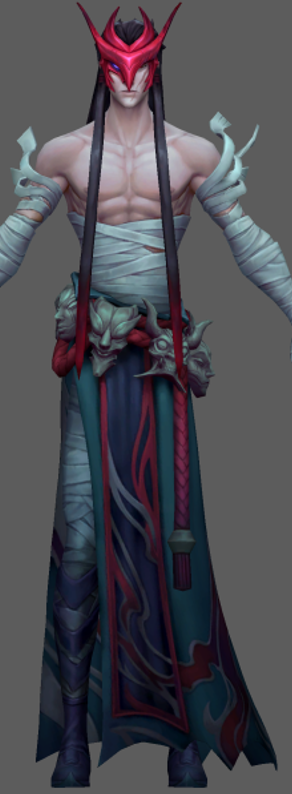
Yone once drew his blade against Yasuo believing he was fulfilling his duty. He died by that same brother’s hand. And after death, he returned with the mask of the azakana he slew literally fixed to his face.
There’s something almost painfully fitting about that: the thing he killed did not simply disappear. He has to carry its mark.
(+)
I think there’s something here that resonates deeply with Yone.
Not because I think Yone literally follows Muramasa’s Law of Balance, of course. Kageaki—Muramasa’s Mido, her wielder—takes this idea much, much further. For him, it becomes an absolute rejection of the idea of “righteous killing.” He refuses to call himself a hero simply because the person he killed could be called evil. A blade does not cut “evil” out of a person. It kills the entire person—their sins, their virtues, their loves, and everything they meant to someone else. (+)
There’s a passage from Full Metal Daemon Muramasa that always makes me think of Yone.
“Slay evil, and with the returning stroke, sever good as well. The Law of Balance.”
“It is the curse borne by every weapon—by every blade. For every single life holds both good and evil within it.”
“Someone’s enemy is someone else’s ally. Someone’s evil is someone else’s good. Whenever a blade takes a life, good and evil are invariably cut down together.”
“For an enemy is both evil and good. To kill while seeing only their evil, only their sins, is nothing but cowardly self-deception—to commit murder while hiding from yourself the ugliness of the act.”
“When I bring down this blade, I sever good and evil together. That is the resolve one must bear whenever one person takes another’s life—” (+)