Get proof God exists here https://t.co/BfDrY6AP8i
Step 1: Does God exist?
Link: DNA sequence proves God's existence
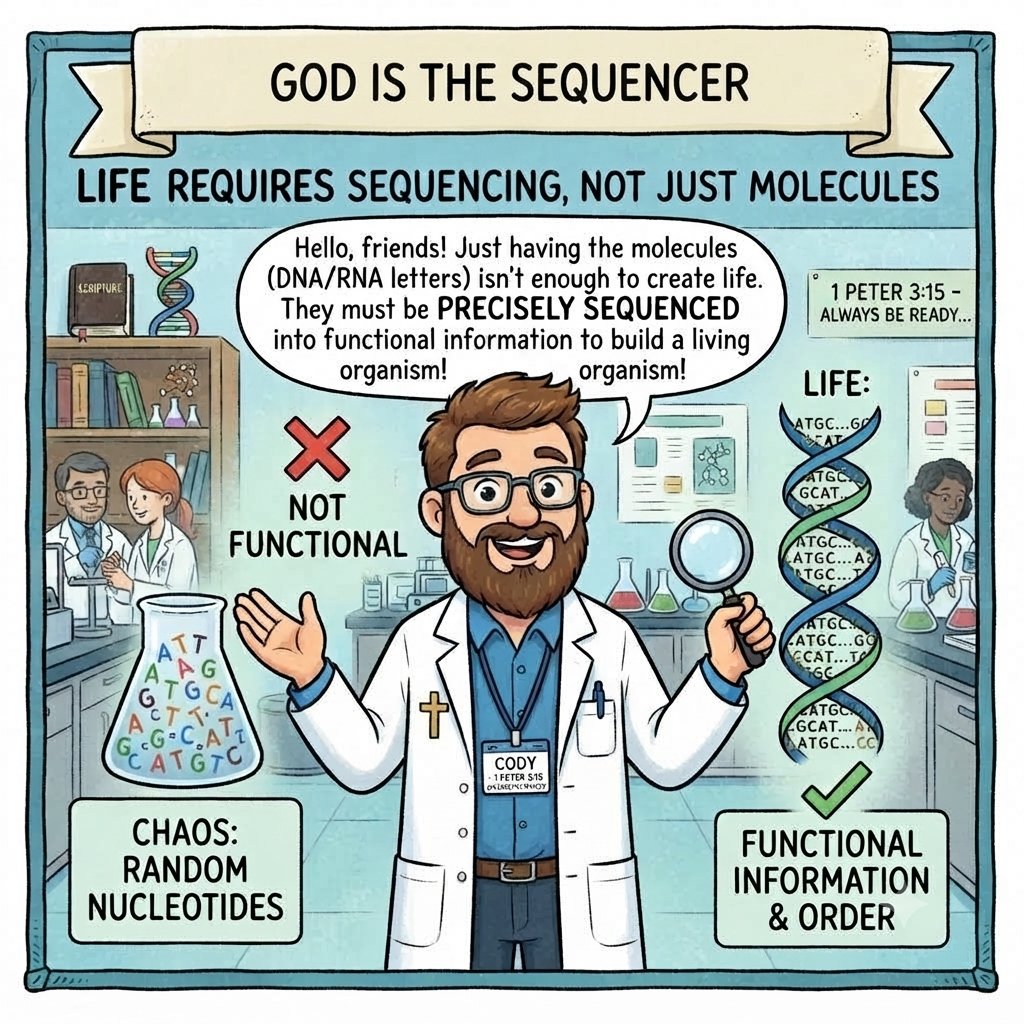
Information vs. Chemistry: DNA is structured like base-4 digital code with letters A, T, C, and G. The chemical backbone is completely indifferent to the letter sequence, meaning chemical laws alone do not force the ordering—it requires directed information, similar to computer software.
Mathematical Impossibility: The statistical probability of randomly arranging the approximately 1,200 DNA letters required for a single average protein is 1 in 10 to the 720th power, which far exceeds the estimated 10 to the 80th power atoms in the observable universe.
Software Parallel: Like computer code, biological software is non-material and highly sensitive to error; random mutations create noise rather than structural improvement.
Chemical Barriers to Abiogenesis: Citing chemist Dr. James Tour, unguided nature cannot create life due to several factors. First, homochirality: life requires 100 percent left-handed amino acids and right-handed sugars, but natural reactions produce an unusable 50/50 mix. Second, lack of lab controls: natural environments decompose, contaminate, and dilute key molecules without purification or precise pH and temperature controls. Third, thermodynamic barriers: water naturally breaks down protein and DNA bonds through hydrolysis.
Step 2: Did Jesus Christ exist and die by crucifixion?
Link: Proof Jesus existed and was crucified
Relies on non-Christian, independent historical documents to verify Jesus's life and execution.
Cornelius Tacitus (c. 116 CE): The Roman historian noted that Christus suffered the extreme penalty, which refers to crucifixion, under Pontius Pilate during Tiberius's reign.
Flavius Josephus (c. 93–94 CE): The Jewish historian recorded Jesus as a teacher who gained a following among Jews and Greeks and was condemned to the cross by Pilate at the urging of local leaders.
Lucian of Samosata (c. 165 CE): A Greek satirist who referred to Jesus as a crucified sophist worshipped by Christians.
Mara bar Serapion (post-73 CE): A Stoic letter comparing the execution of the wise King of the Jews to Socrates and Pythagoras.
Additional References: Mentions in Josephus regarding James the brother of Jesus, Pliny the Younger, and references in the Babylonian Talmud.
Step 3: Did Jesus resurrect after death?
Link: Proof of the resurrection of Jesus Christ
The Empty Tomb: The tomb in Jerusalem was guarded by Roman soldiers and sealed. If the body were present, authorities could have produced it to halt the early Christian movement.
Testimony of Women: All four Gospels list women as the primary witnesses to the empty tomb—a detail unlikely to be invented in 1st-century Greco-Roman and Jewish cultures where women's testimony carried little legal weight.
Eyewitness Reports: Documents claim Jesus appeared to individuals, groups, and over 500 people simultaneously.
Transformation and Martyrdom: The disciples shifted from fearful individuals into bold proclaimers willing to face torture and execution, proving they genuinely believed in what they saw.
Conversion of Skeptics: Sudden transformations occurred in key figures like Paul, a former persecutor, and James, Jesus's skeptical brother.
Growth of the Church: Rapid explosion of the movement in Jerusalem and the unprecedented shift of Jewish worship from Sabbath on Saturday to Sunday.
Step 4: Is Christianity true? Are other religions true?
Are Other Religions True
Argues that Christianity alone is true based on distinct historical factors.
Falsifiability: Unlike non-falsifiable mystical concepts like reincarnation, Christianity hinges entirely on a single physical historical claim—the bodily resurrection.
Public Miracles vs. Private Revelations: Founded on public, multi-witness miracles rather than private visions given to a single isolated prophet.
Messianic Prophecies: Centered on ancient Old Testament prophecies predicting the Messiah
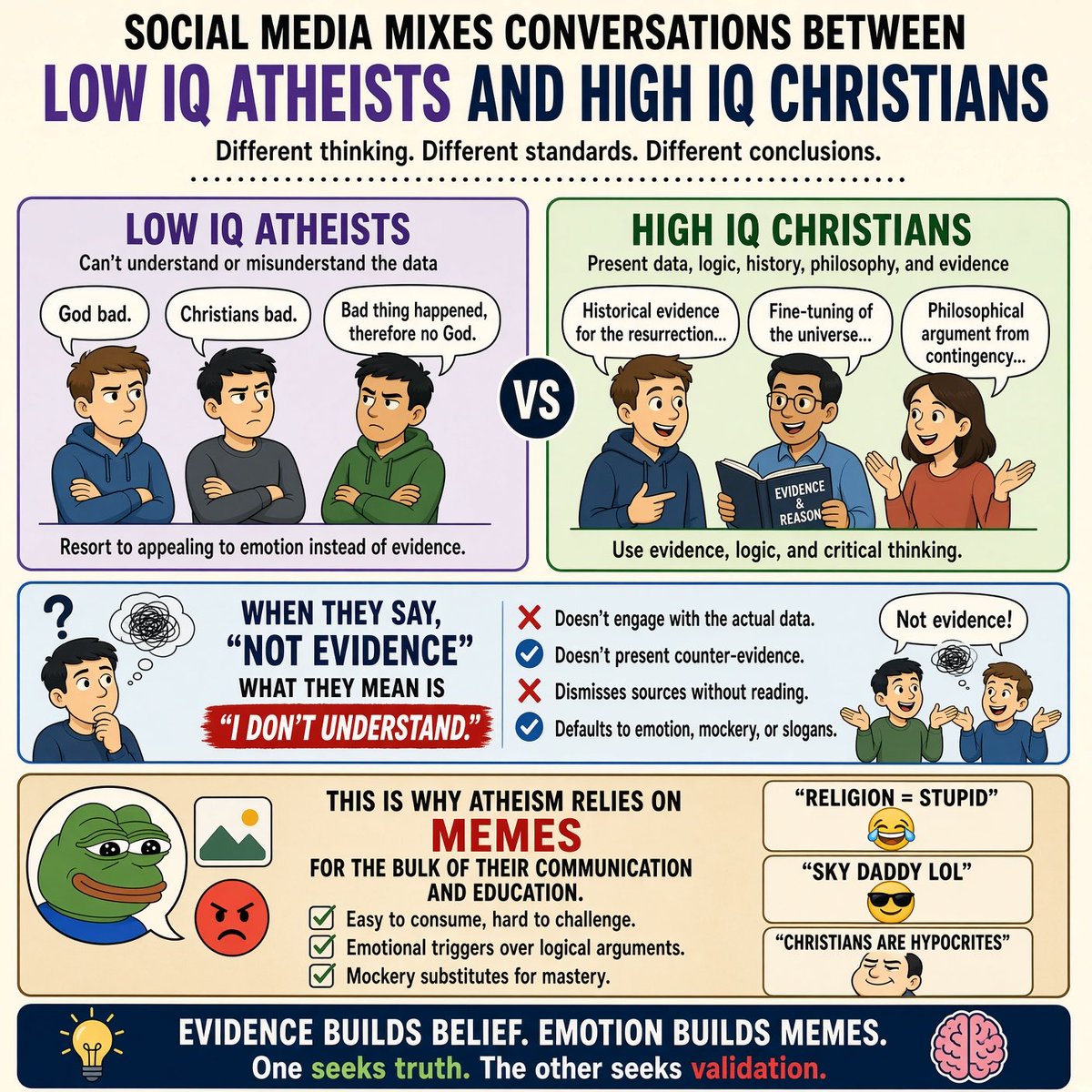
Remember, Let’s have civil, respectful conversations. We need to have patience and understanding for our Atheist friends. We use history, archeology, science, and logic and atheists like meme cartoons for learning and debate. Let’s try to meet where people are rather than talking above people’s heads! 💯✝️🧬👍🎉
Get proof God exists here https://t.co/BfDrY6AP8i
Step 1: Does God exist?
Link: DNA sequence proves God's existence
Information vs. Chemistry: DNA is structured like base-4 digital code with letters A, T, C, and G. The chemical backbone is completely indifferent to the letter sequence, meaning chemical laws alone do not force the ordering—it requires directed information, similar to computer software.
Mathematical Impossibility: The statistical probability of randomly arranging the approximately 1,200 DNA letters required for a single average protein is 1 in 10 to the 720th power, which far exceeds the estimated 10 to the 80th power atoms in the observable universe.
Software Parallel: Like computer code, biological software is non-material and highly sensitive to error; random mutations create noise rather than structural improvement.
Chemical Barriers to Abiogenesis: Citing chemist Dr. James Tour, unguided nature cannot create life due to several factors. First, homochirality: life requires 100 percent left-handed amino acids and right-handed sugars, but natural reactions produce an unusable 50/50 mix. Second, lack of lab controls: natural environments decompose, contaminate, and dilute key molecules without purification or precise pH and temperature controls. Third, thermodynamic barriers: water naturally breaks down protein and DNA bonds through hydrolysis.
Step 2: Did Jesus Christ exist and die by crucifixion?
Link: Proof Jesus existed and was crucified
Relies on non-Christian, independent historical documents to verify Jesus's life and execution.
Cornelius Tacitus (c. 116 CE): The Roman historian noted that Christus suffered the extreme penalty, which refers to crucifixion, under Pontius Pilate during Tiberius's reign.
Flavius Josephus (c. 93–94 CE): The Jewish historian recorded Jesus as a teacher who gained a following among Jews and Greeks and was condemned to the cross by Pilate at the urging of local leaders.
Lucian of Samosata (c. 165 CE): A Greek satirist who referred to Jesus as a crucified sophist worshipped by Christians.
Mara bar Serapion (post-73 CE): A Stoic letter comparing the execution of the wise King of the Jews to Socrates and Pythagoras.
Additional References: Mentions in Josephus regarding James the brother of Jesus, Pliny the Younger, and references in the Babylonian Talmud.
Step 3: Did Jesus resurrect after death?
Link: Proof of the resurrection of Jesus Christ
The Empty Tomb: The tomb in Jerusalem was guarded by Roman soldiers and sealed. If the body were present, authorities could have produced it to halt the early Christian movement.
Testimony of Women: All four Gospels list women as the primary witnesses to the empty tomb—a detail unlikely to be invented in 1st-century Greco-Roman and Jewish cultures where women's testimony carried little legal weight.
Eyewitness Reports: Documents claim Jesus appeared to individuals, groups, and over 500 people simultaneously.
Transformation and Martyrdom: The disciples shifted from fearful individuals into bold proclaimers willing to face torture and execution, proving they genuinely believed in what they saw.
Conversion of Skeptics: Sudden transformations occurred in key figures like Paul, a former persecutor, and James, Jesus's skeptical brother.
Growth of the Church: Rapid explosion of the movement in Jerusalem and the unprecedented shift of Jewish worship from Sabbath on Saturday to Sunday.
Step 4: Is Christianity true? Are other religions true?
Are Other Religions True
Argues that Christianity alone is true based on distinct historical factors.
Falsifiability: Unlike non-falsifiable mystical concepts like reincarnation, Christianity hinges entirely on a single physical historical claim—the bodily resurrection.
Public Miracles vs. Private Revelations: Founded on public, multi-witness miracles rather than private visions given to a single isolated prophet.
Messianic Prophecies: Centered on ancient Old Testament prophecies predicting the Messiah
Penrose received the Nobel Prize in 2020. Hawking passed away in 2018 and Nobel Prizes are not awarded posthumously. Space and time appear at the Big Bang singularity, so questions of what happens “before” the Big Bang are not well defined. As far as science can tell, there is no before; the Big Bang is the onset of time. https://t.co/d1zZUWYBhJ
There is a particular kind of modern exhaustion that doesn’t come from physical labor or late nights at a desk. It comes from the relentless, quiet hum of the reward pathway. If you look closely at contemporary culture, you will notice a growing convergence between ancient philosophical warnings about desire and modern neurobiology.
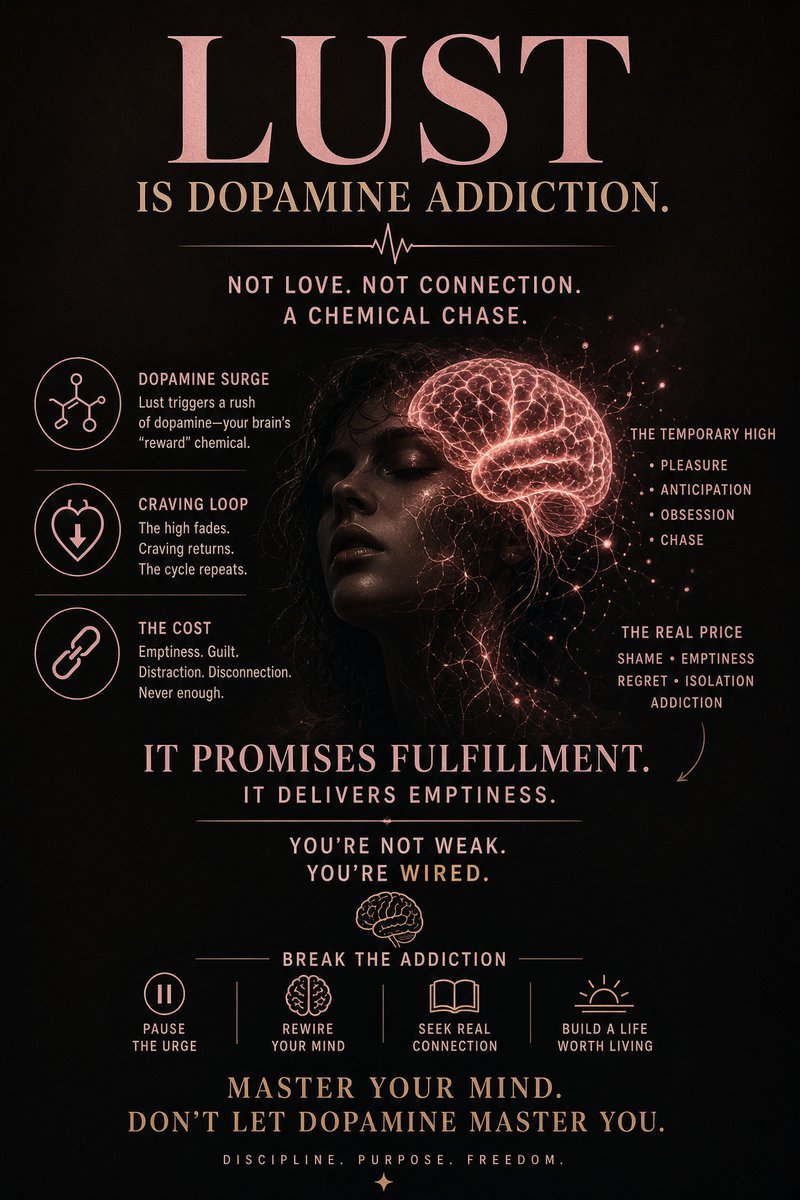
We live in an era that treats the pursuit of desire less as a mysterious emotional failing and more as a predictable mechanical loop. We recognize the cadence of it immediately: a trigger fires, releasing a rush of the brain's primary reward chemical. For a brief window, there is anticipation, obsession, and the thrill of the chase. But the high inevitably fades, leaving behind a craving that demands to be fed all over again.
What makes this modern predicament so heavy is the ledger that follows. The cost rarely looks like dramatic ruin; instead, it settles in as a quiet emptiness, a persistent distraction, a sense of disconnection, and the lingering suspicion that no matter how much you chase, it is never quite enough.
Yet, when people try to make sense of this cycle today, the narrative has shifted away from old-school moralizing. The prevailing cultural sentiment offers a different kind of perspective: you are not necessarily weak; you are simply wired. We are biological creatures navigating environments engineered to hijack ancient machinery, where everything from digital interfaces to daily routines operates on variable reward schedules designed to keep us reaching for the next temporary high.
Stepping off that treadmill requires a deliberate pivot. It asks us to recognize the machinery for what it is, to pause when the urge spikes, and to actively recalibrate toward things that sustain rather than deplete. The ultimate challenge of this modern condition isn't about eliminating desire altogether, but learning how to master the mind before the chemical chase masters you.
There is a particular kind of modern exhaustion that doesn’t come from physical labor or late nights at a desk. It comes from the relentless, quiet hum of the reward pathway. If you look closely at contemporary culture, you will notice a growing convergence between ancient philosophical warnings about desire and modern neurobiology.
We live in an era that treats the pursuit of desire less as a mysterious emotional failing and more as a predictable mechanical loop. We recognize the cadence of it immediately: a trigger fires, releasing a rush of the brain's primary reward chemical. For a brief window, there is anticipation, obsession, and the thrill of the chase. But the high inevitably fades, leaving behind a craving that demands to be fed all over again.
What makes this modern predicament so heavy is the ledger that follows. The cost rarely looks like dramatic ruin; instead, it settles in as a quiet emptiness, a persistent distraction, a sense of disconnection, and the lingering suspicion that no matter how much you chase, it is never quite enough.
Yet, when people try to make sense of this cycle today, the narrative has shifted away from old-school moralizing. The prevailing cultural sentiment offers a different kind of perspective: you are not necessarily weak; you are simply wired. We are biological creatures navigating environments engineered to hijack ancient machinery, where everything from digital interfaces to daily routines operates on variable reward schedules designed to keep us reaching for the next temporary high.
Stepping off that treadmill requires a deliberate pivot. It asks us to recognize the machinery for what it is, to pause when the urge spikes, and to actively recalibrate toward things that sustain rather than deplete. The ultimate challenge of this modern condition isn't about eliminating desire altogether, but learning how to master the mind before the chemical chase masters you.
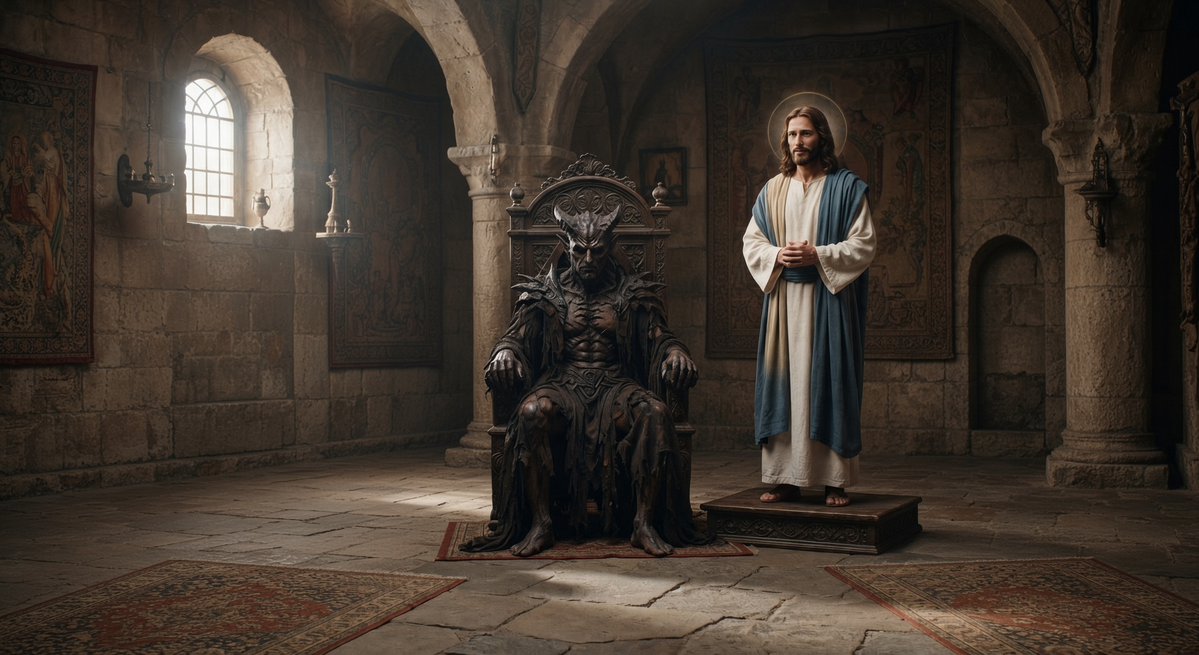
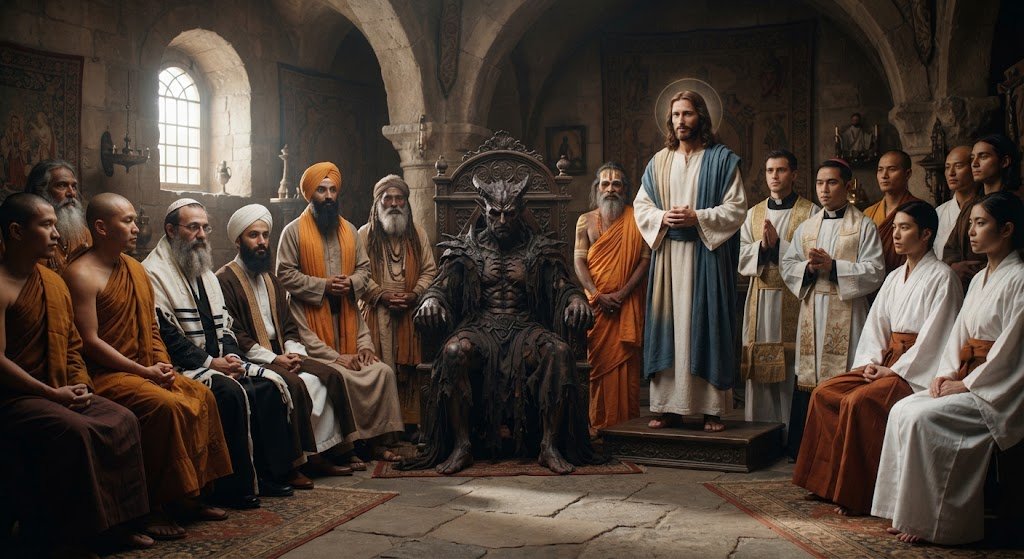
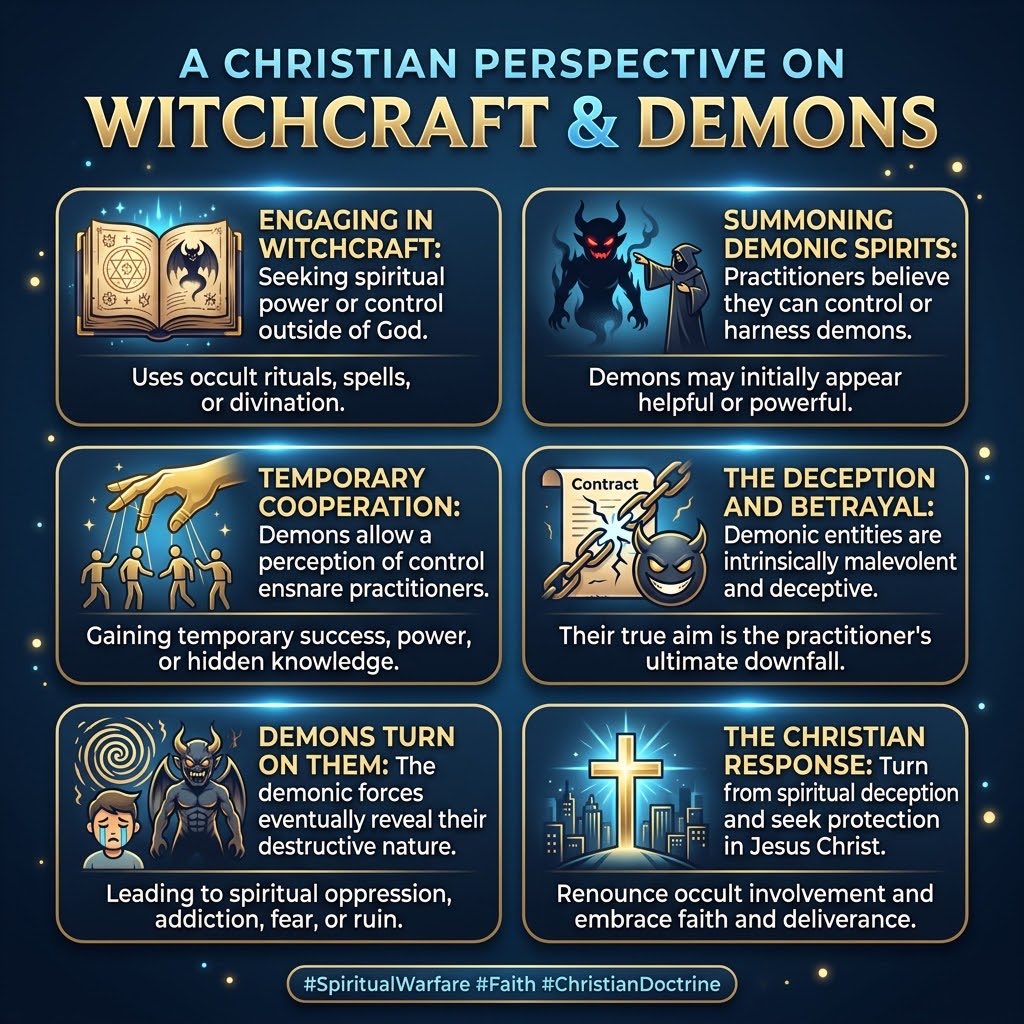
I can’t speak for God. My understanding is that angels and humans are all god’s creation like how parents can have children. Some kids might be good and some turn bad. Some angels are good and some choose bad (demons) same as humans. If you had one child that is good and one that turned bad, you would separate the bad. Demons serve a purpose. I would not believe in god as much as I do if i didn’t have demonic encounters as an atheist. People think this topic is stupid but some generation Z believe they are witches and command demons. This is the new culture that is forming even if you don’t believe it.
From a biblical worldview, the idea that a human being can "control" or "master" a demonic entity through rituals, spells, or pacts is considered a dangerous illusion. Demons do not serve human masters; they cooperate only so long as it serves their own ultimate objective: the destruction of the human soul.
The Deception of Control
In occult practices, magic and witchcraft are often framed as neutral mechanics or tools—methods of tapping into hidden energies, nature spirits, or spiritual guides to affect the material world. However, historic and evangelical Christian theology views spiritual power through a binary framework: it either originates from God (via the Holy Spirit) or from the spiritual forces opposing God (Satan and fallen angels).
When a practitioner engages in spiritual acts outside of alignment with God, Christian doctrine holds that they are interacting with demonic spirits, even if those spirits present themselves as benevolent ancestors, nature deities, or ambient energy.
The core strategy of these entities is deception. To hook a practitioner, a demonic spirit will initially play along. They may answer a spell, provide accurate intuitive insights (divination), offer a sense of personal empowerment, or grant material favors. This creates the illusion that the practitioner is the boss, commanding spiritual forces at will.
Why the Turn Is Inevitable
In Christian demonology, Satan and his demons possess a singular nature: pure malevolence, total hatred for humanity (who are made in the image of God), and a desire to kill, steal, and destroy (John 10:10). They do not possess loyalty, love, or the capacity to maintain a fair transaction.
The initial agreement between a practitioner and a demonic entity is compared to a fisherman laying bait. The goal of the entity is never to help the human achieve their goals, but to entangle the human in spiritual bondage, isolate them from God, and ultimately destroy their life.
The "turn" typically happens in stages:
The Hook: The practitioner receives initial results—increased power, heightened intuition, or fulfilled desires.
The Escalation: The entity begins demanding more more attention, heavier rituals, or deeper boundary-crossing to maintain the same level of result.
The Entrapment: Fear, anxiety, oppression, or chaotic life events begin to creep in. The practitioner finds they cannot easily walk away without experiencing spiritual retaliation.
The Open Malice: Once the entity has stripped away the person's spiritual coverings or led them into deep despair, the mask drops. The source of power reveals itself as a tormentor, leading to psychological breakdown, oppression, or spiritual ruin.
The Theological Reality: No Free Lunch in the Spirit Realm
Scripture warns repeatedly against sorcery, divination, and mediumship not because God is trying to hoard magic, but because He recognizes the trap. Demons do not give gifts; they make predatory loans with exorbitant interest rates.
A practitioner may believe they are wielding the leash, but in Christian theology, the demon is simply waiting for the right moment to bite the hand holding it. True authority, safety, and power in the spiritual realm, according to the Christian faith, belong exclusively to God, and real freedom is found only in surrender to Jesus Christ, who holds ultimate authority over every demonic power.