Validators don't necessarily make cross-chain swaps safer.
Pact takes a different path
No validator set. No bonded nodes. No secondary consensus layer.
Reactive smart contracts read L1 state directly. Outcomes enforced by code.
Fewer actors = less risk.
If you're managing a multichain treasury, here's the math:
Every cross-chain move on a bridge costs you 1-2% in fees, validator risk, and timing exposure.
Every cross-chain move on Pact averages 0.36% in cost and clears in minutes.
Compounded over a year, that gap is seismic.
LP yield on Pact comes from one place: real swap volume.
No emissions. No token inflation. No farming incentives propping up APR.
If the swaps stop, the yield stops. If the swaps grow, the yield grows.
Honest unit economics for liquidity providers.
Uniswap became infrastructure.
Not because it was the best swap UI.
Because dApps could build on top of it.
Pact brings that concept further.
→ Fully deployed as smart contracts.
→ Composable across all supported chains.
Any dApp can use Pact as its native liquidity layer.
Just Pact it 🔄️
Because your BTC was never meant to take the scenic route.
→ No bridge risk.
→ No extra trust layer.
Just assets traded across chains the way they should: native, direct, and built for DeFi.
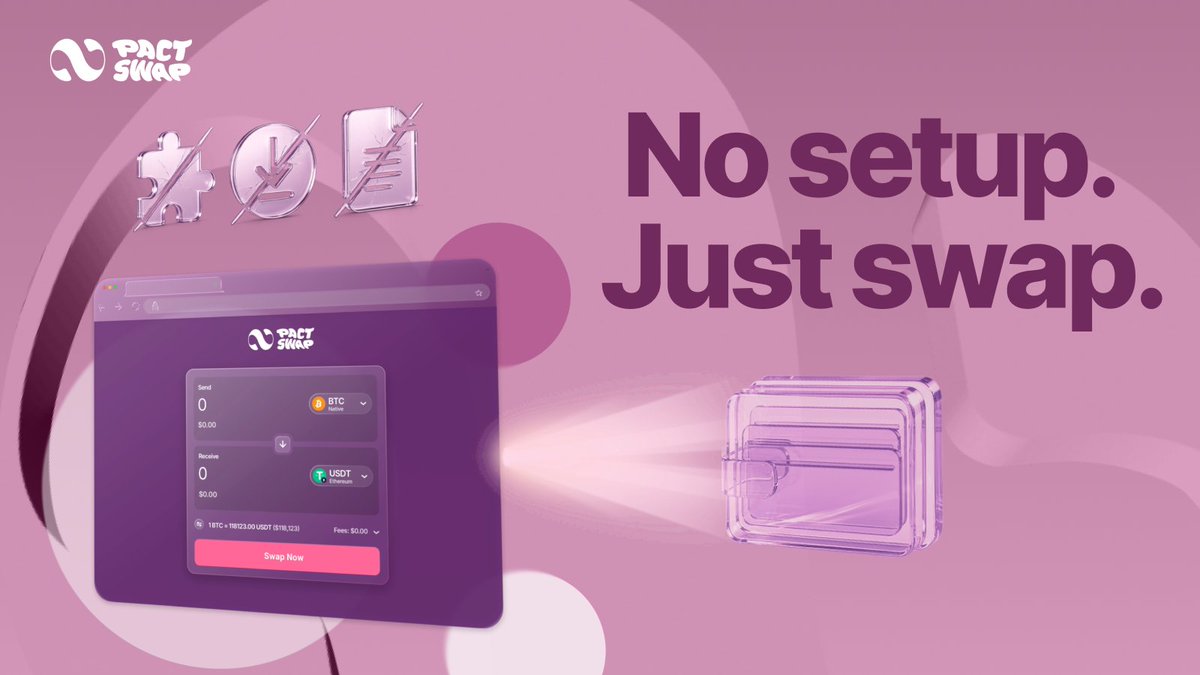
You don't need to download anything to use Pact.
No app. No browser extension specific to us. No new seed phrase to write down.
Connect the wallet you already have, swap, close the tab. That's the entire onboarding flow.