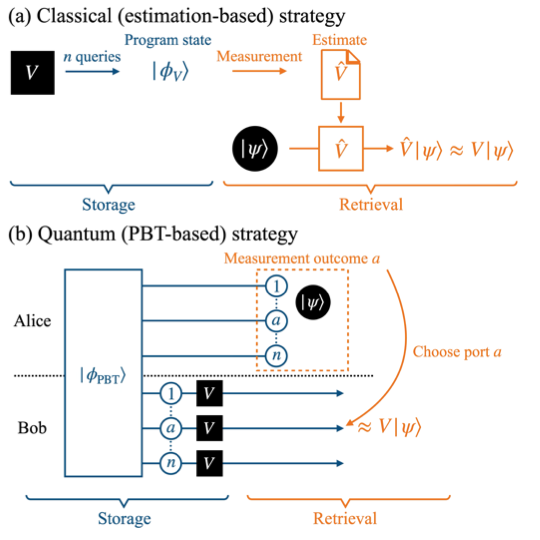
Our paper “Quantum Advantage in Storage and Retrieval of Isometry Channels” has been published in Physical Review Letters as Editor’s Suggestion!
https://t.co/zTfdQoFfwB
A press release has been published on this paper:
https://t.co/bvfmTc8H3a
For isometry channels, quantum protocols based on port-based teleportation outperform classical estimate-and-prepare strategies in terms of both query complexity and program cost, achieving a provable asymptotic advantage https://t.co/zRDxZUDLU7
Paper uploaded. We rigorously prove a finite fault-tolerance threshold for the union-find decoder under circuit-level noise. Our analysis also shows its quasi-polylogarithmic average runtime in the code size. Joint work with Satoshi Yoshida and Ethan Lake. https://t.co/7ZIacAarfK
We present a quantum circuit transforming an unknown quantum channel to parallel queries of randomly chosen dilation isometry of the input channel. As applications, we show storage-and-retrieval, superreplication, and Petz recovery map algorithms.
https://t.co/UP2AskRmwZ
We show that simulation of quantum switch with standard quantum circuit is exponentially hard, even with multiple queries to one input channel!
https://t.co/YjGpmuM0CE
In our companion paper, we show no-go theorems in more general settings (probabilistic, approximate and multiple queries to both input channels) by computer-assisted proof, mainly done by Jessica and Marco.
https://t.co/587PQJLoeM
New work!
We establish a canonical circuit decomposition of any quantum comb with group invariance or covariance. This framework allows for a significant reduction in the number of parameters subject to optimization of the quantum comb.
https://t.co/NyGZrtDn78
For their student researcher-ship, Satoshi Yoshida extended our work on dynamic surface code circuits to color codes. They built and simulated iswap color code circuits and wiggling color code circuits. The iswap circuits use fewer layers than CX ones!
https://t.co/l1ZFvA05HN
New paper on QEC!
We propose two new types of syndrome extraction circuits for the color code. One mitigates leakage errors by interchanging the roles of measurement and data qubits. The other reduces the depth by using CXSWAP gates instead of CNOT gates.
https://t.co/L1Phq97XIf
New work on random unitary!
We construct an exact simulator of a random unitary for any compact group, allowing forward, backward, conjugate, and transpose queries. We also show an efficient quantum circuit for the forward query of the unitary group.
https://t.co/H7gq8PR4qH
New work is out!
We show the optimal infidelity of estimating unknown qutrit-unitary channel up to a leading order. The proof of optimality utilizes reduction of graph Laplacian eigenvalue problem to the continuous one using the finite element method.
https://t.co/u7Bogeq5UO
Our new work is out!
We show quantum advantage in storage and retrieval of isometry channels, while classical strategy is optimal for unitary channels. This difference comes from “phase transition” in estimation error of isometry channel.
https://t.co/IEplxxrn6e
@CraigGidney Thank you for your question! We discuss the reason why we report lower threshold than previous works in Sec. B of the Supplementary Information, and the detail of the analysis is shown in Sec. A2b.
If you need detailed discussions, let’s continue in the email!
Our FTQC paper is out! We construct a fault-tolerant protocol based on concatenated codes, achieving a substantially lower space overhead and a higher threshold than that for the surface code. This is a joint work with @Shiro_Tamiya and @HayataYamasaki.
https://t.co/l7F7gy2aG1