New paper!
Automating entry-level jobs can shrink the economy in the long run by disrupting experience accumulation.
Why? See below.. 🧵
“Immiserizing Automation,” w/ Vladimir Asriyan & @shelegia
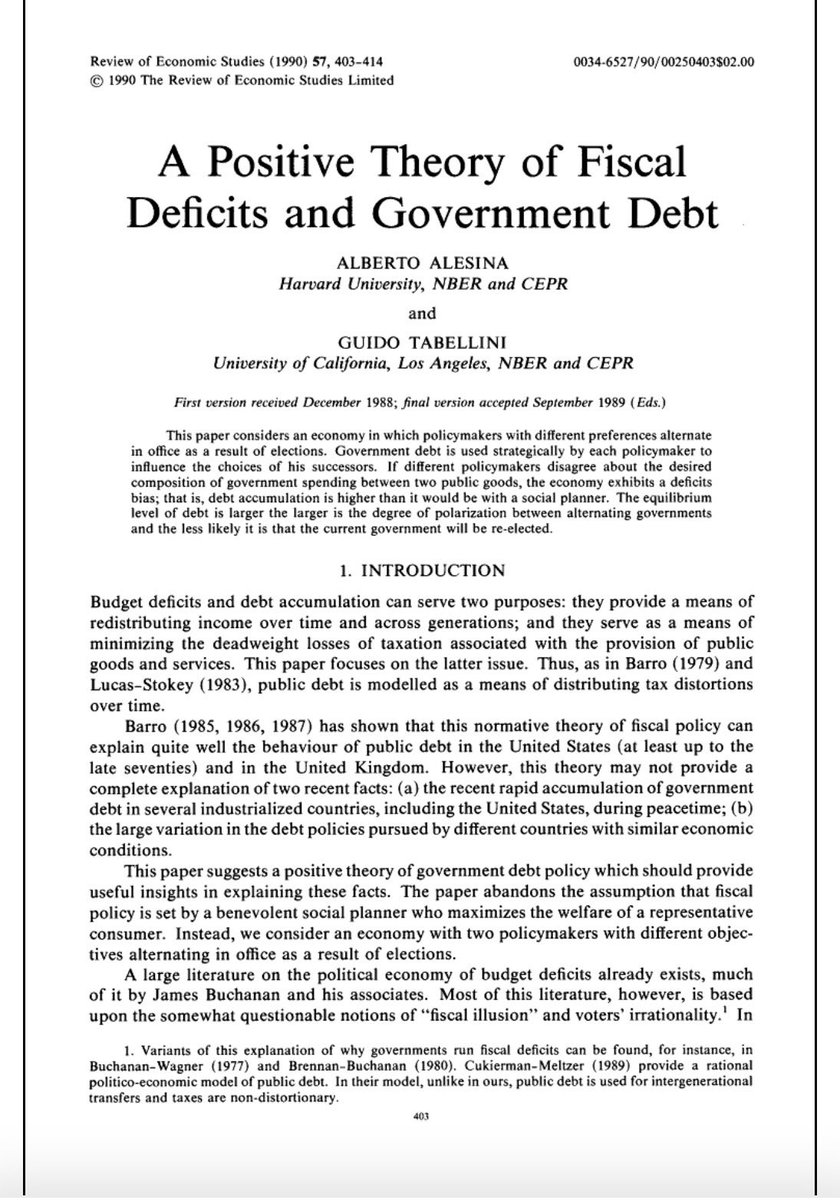
We are launching a new BREAD-IGC virtual PhD course on political economy for the fall 2026. This is jointly organized with Mike Callen and Fred Finan https://t.co/SicZenTTdV via @The_IGC
New! Solis-Garcia’s Macroeconomic Modeling | Preparing students for graduate study, the text introduces dynamic stochastic general equilibrium (DSGE) models through equilibrium theory.
Find out more: ☑️ https://t.co/zysnhJtRl6
Very valuable!
"Rich Heterogeneity in Dynare 7: A Practical Description" by Normann Rion.
"This document is the mathematical companion of the heterogeneous-agent toolkit shipped with Dynare 7."
https://t.co/Cv9PuHrPVe
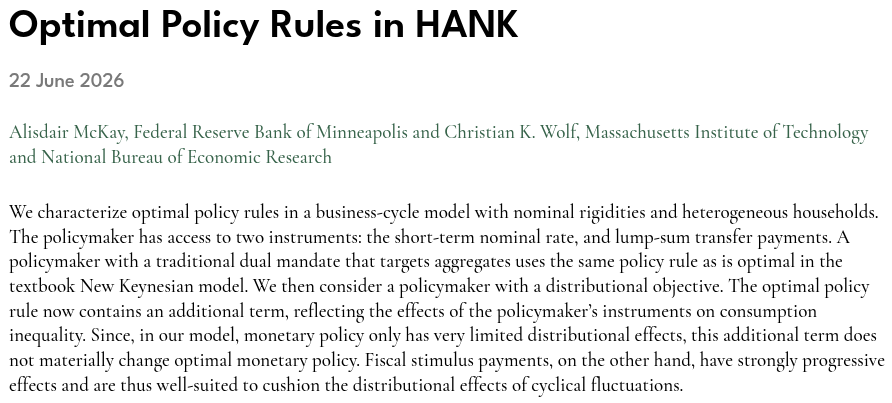
What role can monetary policy play in offsetting distributional shocks? @AlisdairMcKay & @ChristianKWolf argue it cannot do very much because the impacts of monetary expansions and contractions are borne relatively evenly across the population.
https://t.co/DTbkrfWaL3
#EconX
You're a macroeconomist and want to learn RL. Which book to read? My two favorites below.
Analogy to macro textbooks:
- Zhao = Gali: ~200 pages, super clear, only the basics
- Sutton-Barto = Woodford: ~600 pages, comprehensive, the bible
Both very accessible! Take your pick 😃
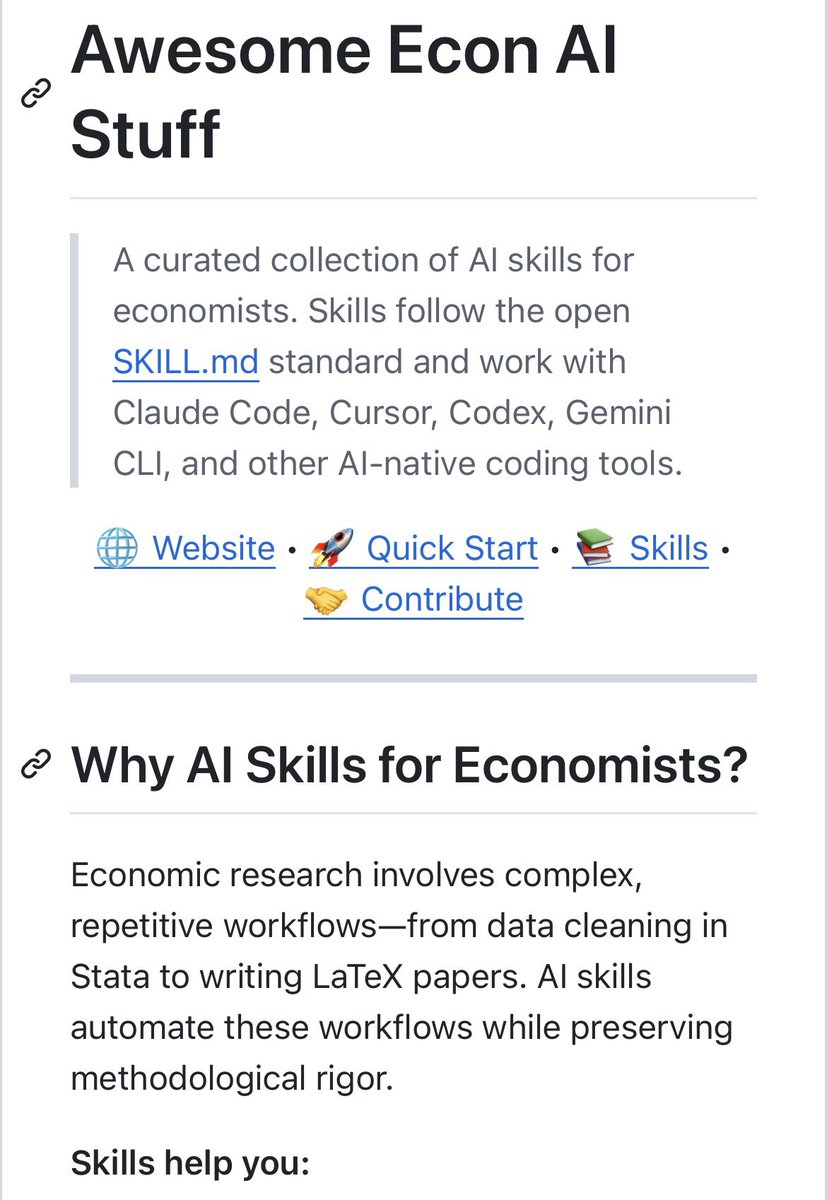
İktisatçılar için hazırlanmış bir AI “skill” koleksiyonu.
LSE’den Antonio Mele’nin derlediği açık kaynak koleksiyon, iktisatçılara özel 17 hazır AI skill sunuyor.
Claude Code, Cursor, Codex ve Gemini CLI ile uyumlu, ücretsiz.
Link 👇
https://t.co/HQkG69TgGM
Great news!
The Global Macro Database has been updated
"The 2026_06 update adds 39 new historical and country-level sources, bringing the database to 160 sources, extends automated error monitoring, resolves dozens of data-quality issues, and improves the Stata, R, and Python packages."
https://t.co/xBMXCjgnUW
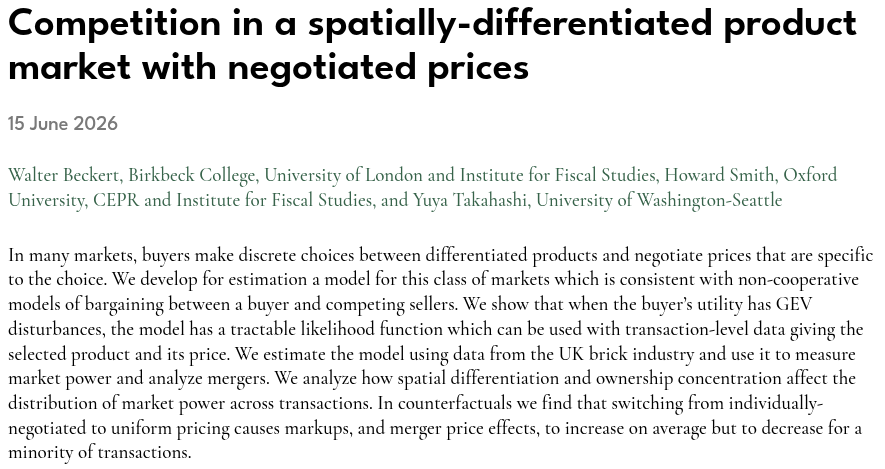
Buyers often make choices between differentiated products and negotiate prices specific to the choice. This paper specifies a model for this setting and estimates it on transactions data for the UK brick market.
New paper by @howardwsmith, Beckert, and Takahashi
#REStud#EconX
🚨 NEW ECONOMICS JOURNAL 🚨
We are excited to announce the launch of The Review of Economic Studies: Insights, a new open-access journal in the REStud family.
Mission: publish concise, high-quality research on important questions across economics and economic policy.🧵1/13
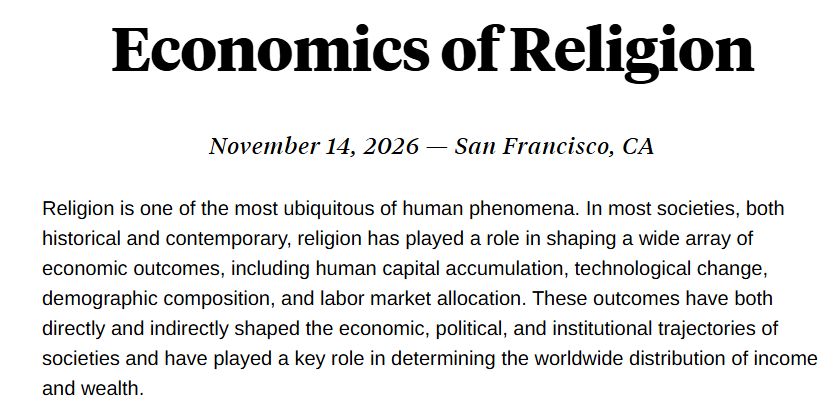
Open call for papers, Economics of Religion. Conference to be held in San Francisco, CA on November 14, 2026. Submit papers by 11:59pm EDT on September 1, 2026. More information: https://t.co/xULRC7z8qp
Super interesting!
"Quantifying the Sensitivity of Quantitative Trade Models" by Habib Chenguiti Ansari, Dave Donaldson, and Edward Wiles.
"Modern quantitative trade models emphasize cross-country heterogeneity in productivity across goods as the source of trade and its benefits. In workhorse versions, this heterogeneity is assumed to follow specific functional forms, such as i.i.d. Frechet or Pareto. We provide a systematic exploration of how sensitive the gains from trade estimated from these models are to relaxing this assumption—first, with a new formula for sharp bounds on gains from trade across all possible distributions, and then with a numerical characterization for the case where distributions must be close to the workhorse form. Importantly, for each candidate distribution we ensure that its implied trade model is consistent with standard estimation methods such as the ability to match all bilateral trade data points and an exogeneity assumption. Our estimated bounds are wide, even for small departures from the canonical model: the maximal gain is about four times larger and the minimal gain is zero. Imposing highlevel restrictions on the distributions considered—for example, maintaining Frechet or Pareto marginals while relaxing independence, or vice versa—does little to shrink these bounds."
https://t.co/jTQgix2uHR
Build Advanced Modeling Skills from Anywhere
Looking to strengthen your quantitative modeling skills? EcoMod ONLINE provides a flexible, hands-on learning experience tailored for economists, researchers, analysts, and policy professionals worldwide.
What makes EcoMod ONLINE unique?
✔️ Learn on your schedule with fully self-paced online courses
✔️ Access comprehensive modules designed for real-world applications
✔️ Gain insights from experienced modeling experts and practitioners
✔️ Work with real datasets, applied models, and interactive exercises
✔️ Connect with an international community of modelers and researchers
✔️ Develop practical skills that can be immediately applied to research and policy challenges
Read more: https://t.co/lG9IQBqb22
Great to see the new generation of political economy coming out from Brazil —- Elections that inspire: Effects of Black mayors on educational attainm... https://t.co/o7nHNciavi
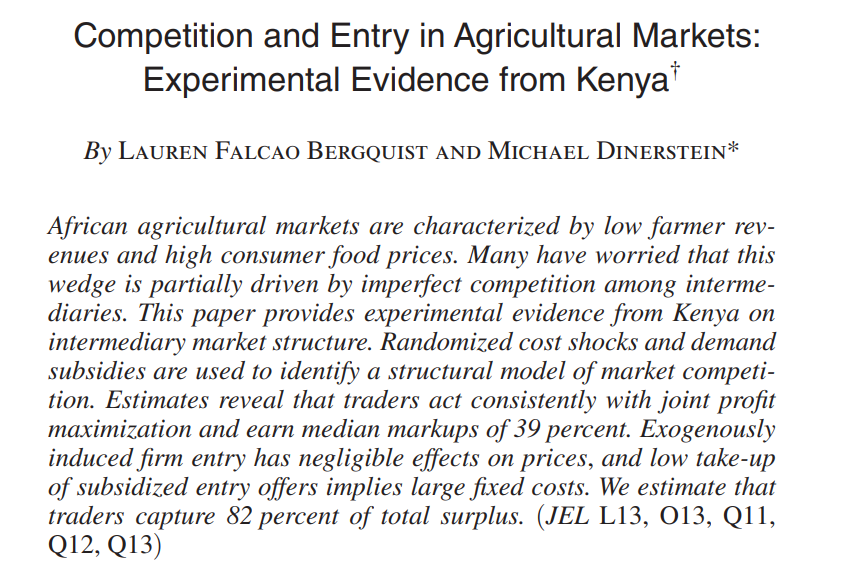
This paper is so unbelievably good. Absolutely blown away. Why is it the case in Kenya that the cost of food is so high, but the prices received by farmers so low? It's the intermediaries -- they all know each other, and they're colluding. 1/
We're hiring a Research Assistant in Economics!
Join the new Policy Hub within the Huth Initiative for a New Political Economy (HINPE), supporting research, data analysis and policy engagement.
Apply: https://t.co/8j65JXtBxg
#LSEPublicPolicy
Forthcoming in the AER: "The Effect of Omitted Variables on the Sign of Regression Coefficients" by Matthew A. Masten and Alexandre Poirier. https://t.co/A8RpcJ3xtE