Most AI learns by predicting what happens next.
But physical reality doesn't work like that.
A robot can learn to pick up a mug. Replace it with a sponge, glass, spring, or wet cable - and the physics completely changes.
The problem isn't more data.
It's understanding why.
That's why we're building mechanistic world models at Syky 🧵👇
Learning a mechanism once is interesting.
Using it on a new object is the real test.
Did the robot learn a rule it can adapt, or memorize a scene it can repeat?
That is why at SYKY “update and reuse” belongs inside the learning loop.
The next useful robotics dataset could begin with a robot that is doing nothing.
DARE is our vision for turning idle capacity into structured experiments across real environments.
The goal: collect evidence that changes what the model understands.
A camera sees a surface.
The robot still needs to work out: slippery, heavy, soft, stuck?
That gap between appearance and physical properties is where a lot of robotics gets interesting.
SYKY starts with a question: which hidden variables matter?
A recovery behavior can hide in a tiny slice of data. A new robot-foundation-model study reports that masking fewer than 1.4% of training tokens removed the targeted failure-recovery behavior.
https://t.co/kT2JqYIhpY
94% TaskGrasp success versus a 74% baseline in real-robot deployment.
The grasp is stable. The handoff is wrong. TGrasp6D uses task language plus collision-aware pose refinement so a knife grasp can change between cutting and handoff.
https://t.co/aJAhnn1dr3
A physical result without provenance is hard to reuse.
Carry the starting state, intervention, sensor conditions, model version and outcome - so the next robot knows not just what happened, but when the evidence applies.
This is the right question. A successful throw can come from a reusable policy or a task-specific program. The distinguishing test is counterfactual transfer: change distance, payload or geometry and measure what survives.
@Google@GoogleDeepMind The video-to-sim-to-real pipeline is the interesting part here. Was Argon optimizing a reusable control policy, or synthesizing task-specific trajectories/programs through simulation?
What a day to announce that I've joined @GoogleDeepMind as a Research Scientist! 🚀
We are witnessing a paradigm shift in Physical AI: Agentic Robotics. Learning skills directly from watching a human video has been a holy grail of robotics. Seeing Gemini 4 Argon unlock this through sheer reasoning, coding and multimodal physics understanding was surreal. Sinking cornhole shots on a humanoid takes control over fluid whole-body dynamics and pinpoint accuracy - I can't even hit this anywhere near that consistently! You give Argon a video of a person doing it, let it cook and boom: it's draining shots like its nobody's business.
I'm super thrilled to be pushing towards Physical AGI with this incredibly talented team and leadership at this unprecedented time for robotics - the pace of progress is going to be insane!
And the craziest part? This was just v0. We are barely scratching the surface of what these models are capable of doing. Buckle up 👀🤖
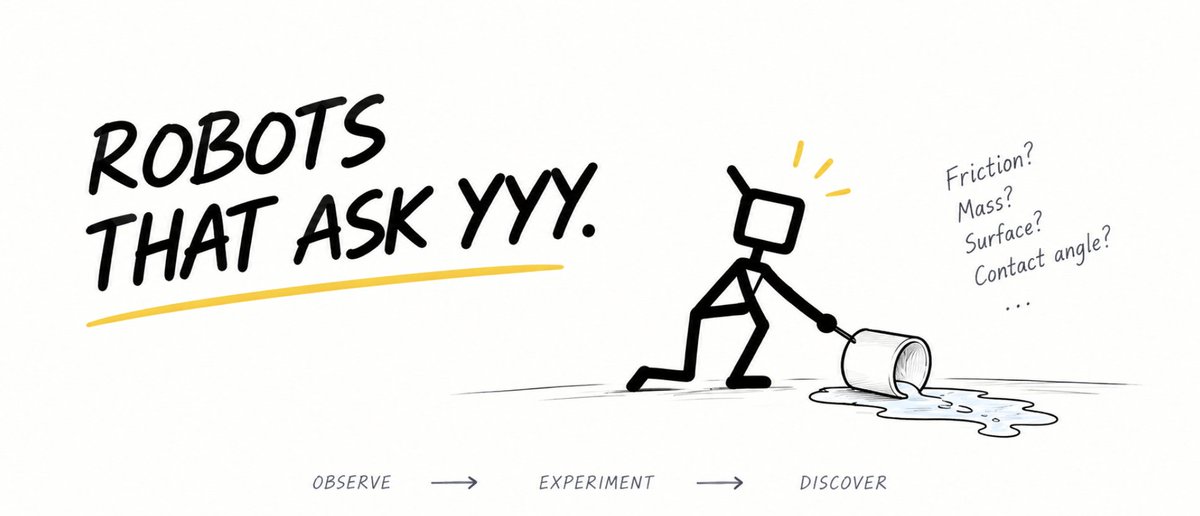
A robot failed. Good. Which variable moved?
Object mass? Surface friction? Contact point? Timing?
A stronger world model does not hide the miss inside an average. It turns the miss into a controlled experiment—change one thing, observe the response, update the mechanism.
This is how we're building causal world model.
A failed action does not always contain enough evidence to explain itself.
Fly-by-Code adds diagnostic programs: change the viewpoint when the outcome is hidden; run a targeted physical probe when causes remain ambiguous.
Better feedback is sometimes an action, not another replay.
https://t.co/1Za7TZYXz4
A robot can know how to move and still misunderstand “left of,” “second,” or “larger.”
Spa-Bench separates spatial grounding from object and motor novelty, then tests it on a real arm.
Aggregate success hides mechanisms. Diagnostic conditions reveal which relation broke.
https://t.co/xonaYaiXwU
@pythianism This is the loop we’re building at SYKY: deploy robots, use targeted experiments to gather more informative data, and feed it into causal world models. Each deployment becomes a place to learn which physical mechanisms transfer. Check us out, Vance: https://t.co/iJ0ANKDpd7
Two boxes look identical. The robot has to decide what to do next.
This simulation illustrates SYKY’s vision: interact to uncover hidden physics, use what you learn to guide the next action, then test whether that knowledge transfers.
From SYKY labs👇
Inferring what is inside a box is useful. Knowing when to test that inference is the next question.
If two explanations imply different handling, a small, safe probe could be worth more than a more confident guess.
Robots that adapt, not just repeat. 🤖
See how Doosan Robotics uses NVIDIA Cosmos Reason to infer box contents and adjust handling in real time, reducing damage and improving safety.
And @ToyotaResearch and @mimicrobotics are taking it further with Cosmos open world models, pushing robotics to be smarter, faster, and more physics‑aware.⚡
Learn more 📖 https://t.co/AaUvkvzqsO
#NationalRoboticsWeek
What exists? How does it interact? What should I test? What can I reuse? How does it scale?
Five questions behind SYKY’s mechanistic learning framework.
A robot’s downtime could help pay for the robot.
DARE: Distributed Autonomous Robot Ecosystem.
Our vision: idle robots run experiments, turn discoveries into reusable physical knowledge, and earn rewards that could help owners offset their costs.
The hardest part of a robot experiment can happen before the robot moves.
Which action will separate the plausible explanations?
SYKY’s thesis: choosing that action is part of intelligence. Each learned mechanism should make the next experiment more informative.
> Discover variables → What exists?
pixels → object, mass, friction, compliance
> Discover mechanisms → How do they interact?
mass + force → acceleration
friction + contact → slip/stick
> Active inquiry → What should I do to learn what I’m missing?
push? lift? squeeze? tilt?
> Update & reuse → Store the discovered structure and use it in new situations.
> Scale experiments → capable world models.