Canada's New Social Media Ban is NOT About Your Children | Here's What They're NOT Telling You
Canada just announced the Digital Safety Act — a social media ban for anyone under 16.
Most Canadians think this is about protecting children. It isn't.
To enforce a social media ban, every single Canadian will have to prove their age by attaching government-approved ID to their social media accounts. That's not child protection. That's a digital ID.
And once you're verified on one platform, that verification follows you everywhere — linking every account you own under your real identity.
But it gets worse.
This isn't a standalone policy. This is the missing piece that connects Bill C-9, C-22 and C-8 into a complete surveillance and censorship system.
Bill C-9 defines what you can and cannot say online. Bill C-22 forces platforms to save your data for up to one year. Bill C-8 gives the government the power to cut you off the internet entirely.
The digital ID created by this social media ban is what connects all three.
And they're selling it to you as child protection.
Don't be fooled. All these bills are interconnected — and this is the last piece of the puzzle.
https://t.co/8fky3EXQmF
1946/89 The Common Cold Unit tried to infect more than 20k people with Influenza "Virus".
Head Scientist Nigel Dimmock said the chances of getting sick were so low that housewives used to go on holiday there.
After 40 years the unit shut, none the wiser.
🔻 SUNSCREEN ENTERS YOUR BLOODSTREAM IN UNDER 24 HOURS. THE FDA CONFIRMED THIS IN 2019. THEY DID NOT PULL A SINGLE PRODUCT. THEY TOLD YOU TO KEEP APPLYING.
In January 2020, a randomized clinical trial published in JAMA found that six active sunscreen chemicals — including oxybenzone and avobenzone — absorb into the bloodstream after a single application. Not after years. After one use. At concentrations exceeding the FDA's own safety threshold by 180x to 500x.
The FDA did not recall them. They issued a statement: "Continue to use sunscreen."
Oxybenzone is a confirmed endocrine disruptor. It mimics estrogen. It crosses the placental barrier. It has been found in 97% of Americans tested. It is in breast milk. It is in amniotic fluid. It is in your children before they are born.
A former formulation chemist — 11 years at a top-3 sunscreen manufacturer:
"We had internal absorption data by 2014. Full transdermal penetration within 26 minutes of application. The compounds don't sit on the skin. They were never designed to. The delivery mechanism is identical to a pharmaceutical patch. We knew this. The mitigation strategy was never reformulation — it was public messaging. Keep the consumer applying. The margins on chemical sunscreens are 1,400% above production cost. Mineral alternatives cost 4x more to produce. The decision was financial. Every internal document confirmed that."
They told you the sun causes cancer. What they didn't tell you:
Vitamin D — produced only through direct sun exposure — is the single most critical regulator of immune surveillance against malignant cells. A 2023 meta-analysis confirmed: Vitamin D deficiency correlates with a 30-60% increased risk of colorectal, breast, and prostate cancers.
They blocked the one thing your immune system needs to fight cancer. Then sold you a chemical that enters your blood and mimics hormones. Melanoma rates have increased 320% since 1975 — the exact period sunscreen use became widespread.
The paradox is published. McGill University, 2023: "Sunscreen usage is climbing, but so are melanoma and skin cancer rates."
They didn't protect you from cancer. They removed your defense against it and charged you $14 a bottle.
15 minutes of direct sun daily. No screen. Arms and face exposed. Your body produces 10,000-20,000 IU of Vitamin D in that window — the amount they sell you in pills because they blocked the free version.
CODE: JAMA-2020-6CHEM / OXYBENZONE-97PCT / VIT-D-IMMUNE / MELANOMA-320-1975 / MCGILL-PARADOX-2023
⟁
They made you afraid of the sun so they could sell you a hormone disruptor and call it protection. The sun is free. That's why they taught you to fear it. Share this.
A British biologist looked at 200,000 years of human history and found that the entire reason humans broke out of poverty was not intelligence, not language, not even agriculture, but one mechanism so simple a 6-year-old could explain it.
His name is Matt Ridley.
He is a zoologist by training, an evolutionary biologist by career, and in 2010 he wrote a book called The Rational Optimist that quietly argued the most important fact about human progress had been hiding in plain sight for the entire history of economics.
Naval Ravikant has been telling people to read everything Ridley has ever written for the last 15 years. The reason is the argument inside this one book.
For 200,000 years, anatomically modern humans walked around with the same brain you have right now. Same skull size. Same neural architecture. Same raw capacity for language, planning, and abstract thought.
For roughly 190,000 of those years, almost nothing happened. Generation after generation lived and died inside the same Stone Age toolkit their great-great-grandparents had used. Then somewhere around 50,000 years ago, the line on the chart of human progress started to tick upward. Then it bent. Then it exploded.
The question Ridley spent years on was the only question that mattered. What changed.
It was not the brain. The brain had been the same for 190,000 years. It was not language, which had existed long before the takeoff. It was not even agriculture, which arrived only 10,000 years ago and was actually preceded by the upward bend, not the cause of it.
What changed was that humans started trading with strangers.
This sounds too small to be the answer. Ridley argues that it is the answer to almost everything. The moment one human exchanged a useful object with another human from a different group, something happened that no other species on earth had ever done.
Two ideas that had developed in isolation came into contact. The flint knapper learned what the spear maker had figured out. The fisherman from the coast learned what the hunter from the forest had figured out. The two pieces of knowledge fused into something neither side could have produced alone.
Ridley calls this ideas having sex. The phrase sounds frivolous and it is meant to. The point is that ideas, like genes, get better when they combine with other ideas from different lineages.
An idea sitting inside one head, no matter how brilliant the head, eventually hits a ceiling. The same idea exposed to ten thousand other ideas does something genes do under sexual reproduction. It mixes. It recombines. It produces offspring nobody planned.
The cleanest proof of this argument is the most uncomfortable case study in the book. Tasmania.
Around 10,000 years ago, rising sea levels cut Tasmania off from mainland Australia. A population of roughly 4,000 humans was now isolated on an island, with no possibility of contact with the rest of humanity. They had the same brains. The same language. The same starting toolkit as their cousins 150 kilometers north. The natural experiment was now running.
What happened next is something no economist or geneticist had ever predicted.
The mainland Australians kept inventing. Boomerangs. Spear-throwers. Fishing nets. Bone needles for sewing fitted clothes. Watercraft with paddles. Their technology compounded slowly across the centuries.
The Tasmanians went the other way. They did not just fail to invent the new tools their cousins were developing. They started losing the tools they already had. Fishing was abandoned within a few thousand years. Bone tools disappeared. Fitted clothing disappeared. They forgot how to make fire from scratch and started carrying lit firebrands from camp to camp instead, relighting their fires from a neighbor's whenever their own went out.
By the time European explorers arrived in the 17th century, the Tasmanians had the simplest toolkit of any human society ever recorded. Their material culture had gone backward for 8,000 years.
The archaeologist Rhys Jones called it a slow strangulation of the mind.
Joseph Henrich at Harvard later proved with formal mathematical models that there was nothing wrong with Tasmanian brains. There was something wrong with their network. A toolkit requires a critical mass of people exchanging skills to maintain itself.
The act of teaching a skill is imperfect. Every generation loses a small percentage of what the last generation knew. If your population is large enough and trading widely enough, those losses get caught and corrected by someone else who still remembers.
If your population shrinks below a certain threshold and stops mixing with outsiders, the small losses compound until entire technologies disappear.
This is the part that should haunt anyone reading this in 2026.
Intelligence is not a property of the individual brain. Intelligence is a property of the network the brain is connected to. A genius in isolation will produce less than a mediocre thinker inside a dense exchange of other mediocre thinkers.
The thing your ancestors needed in order to break out of 190,000 years of stagnation was not better brains. It was better connections between brains they already had.
The implication for any individual is direct and uncomfortable. If you are smart and isolated, you will be outproduced by people half as smart who are connected.
The most successful people in any field are almost never the smartest people in it. They are the ones positioned at the intersection of the most idea flows. They are reading more authors than their competitors. They are talking to more people from more disciplines. They are in the rooms where ideas from different lineages bump into each other.
Ridley ends the book on the line that sounds optimistic but is actually a warning its this "The future will be invented by people who connect ideas, not by people who guard them."
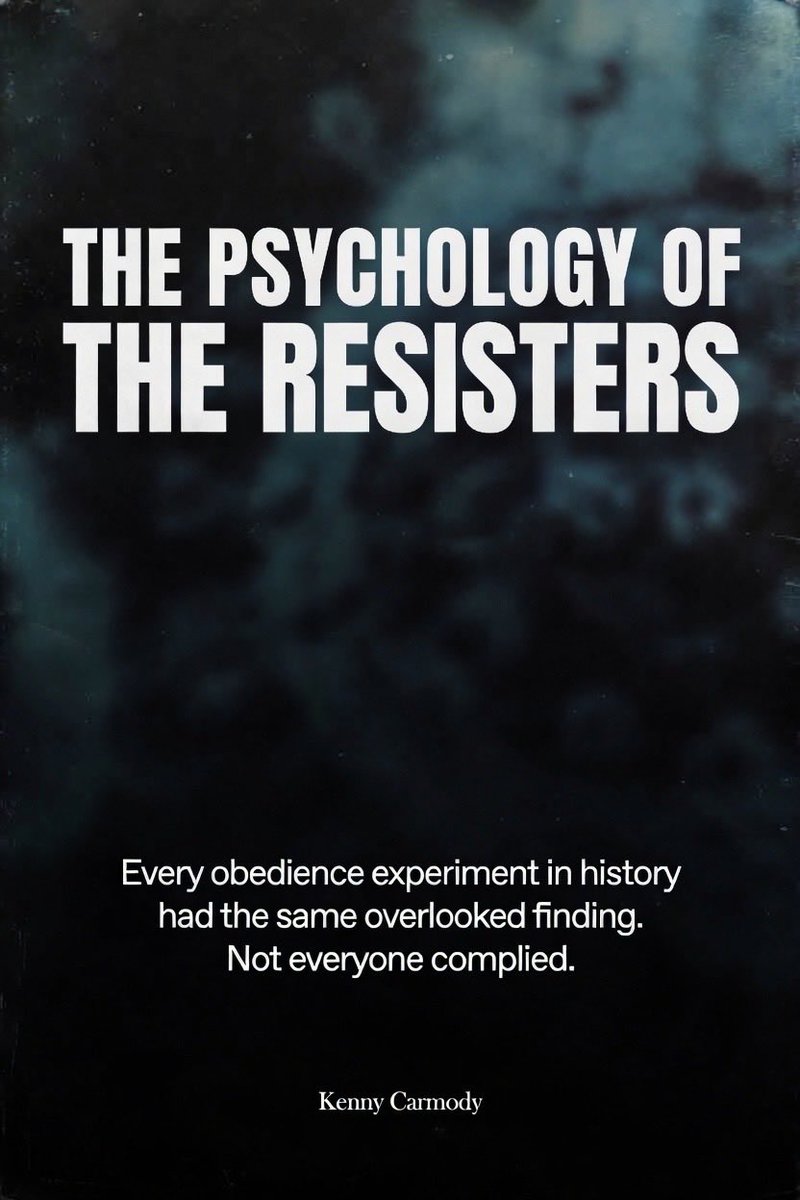
Every obedience experiment in history had the same overlooked finding.
Not everyone complied.
In Milgram’s lab, 35% refused to deliver the final shock. In Asch’s line experiments, 25% never conformed, not once, across any trial. In Zimbardo’s prison, at least one guard refused to dehumanize. One prisoner demanded a lawyer instead of a doctor and broke the psychological frame entirely.
We spent decades studying the ones who obeyed.
We barely asked what made the others different.
That question matters more now than it ever has.
The resisters in the COVID era were not difficult to find. Physicians who filed exemptions and lost their licenses. Nurses who walked away from careers rather than mandate patients into decisions they hadn’t genuinely chosen. Scientists who published contrary data knowing what it would cost them. Parents who stood alone at school board meetings. Ordinary people who simply said, quietly, without drama , no.
What made them different?
Research consistently identifies a cluster of factors. Not personality traits you either have or don’t. Situational and cognitive patterns that can be cultivated.
First: prior reflection on authority. The resisters had usually thought, before the crisis, about the limits of institutional trust. They weren’t cynics. They were people who had already asked the question “under what conditions would I refuse?” before anyone was asking them to comply.
Second: a concrete reference point outside the consensus. A value, a principle, an oath, a relationship that existed independently of the institutional structure demanding compliance. Something the system couldn’t reach.
Third: at least one other person. Milgram found that a single dissenting confederate reduced compliance dramatically. The resisters rarely stood entirely alone. They found each other. Sustained each other. Gave each other permission.
Fourth: the willingness to tolerate social pain. Not immunity to it. Tolerance of it. They felt the pressure. They felt the exclusion. They chose the discomfort of integrity over the comfort of belonging.
None of this is innate. All of it is learnable.
The most important thing Milgram, Asch, and Zimbardo taught us is not how fragile conscience is.
It’s that conscience can hold, if you’ve trained it, named its limits, and found even one other person willing to hold theirs beside you.
Build that now. Because the experiment is always running.
Until then stay humble.
😷 During the COVID era, many Canadians removed from work under workplace “vaccine” mandates were reportedly coded as guilty of misconduct, triggering EI denial pathways with devastating consequences for families and livelihoods. Justice 4 EI Misconduct is calling for accountability and public awareness.
Farmers have figured out that the cheapest pesticide is a strip of flowers.
When you plant wildflowers through a crop field, not just around the edge but in strips running through the middle, you get ladybugs, lacewings, hoverflies, and parasitic wasps living in the field instead of visiting it.
They eat the aphids, the caterpillars, and the mites for free, all summer long.
In controlled trials, fields with tailored flower strips had leaf-beetle numbers 40 to 50% lower and crop damage cut by around 60%, enough to drop below the threshold where spraying was even considered worth it.
The flowers attract a standing army to our fields.
We spent decades engineering chemicals to kill the insects eating the crop, when the insects that eat those insects would have worked for the price of seed.
We observed the lag between temperature increases which preceded CO2 emission by means of the 2023 heat pulse...
Folleagues knew... 😎
"Paleoclimate data from Vostok ice cores reinforce
this dynamic, showing CO₂ increases lagging temperature rises by 800 years across glacial-inter-
glacial transitions, indicative of temperature-driven oceanic outgassing rather than prolonged at-
mospheric retention [19]."
https://t.co/45hX4tIEhi
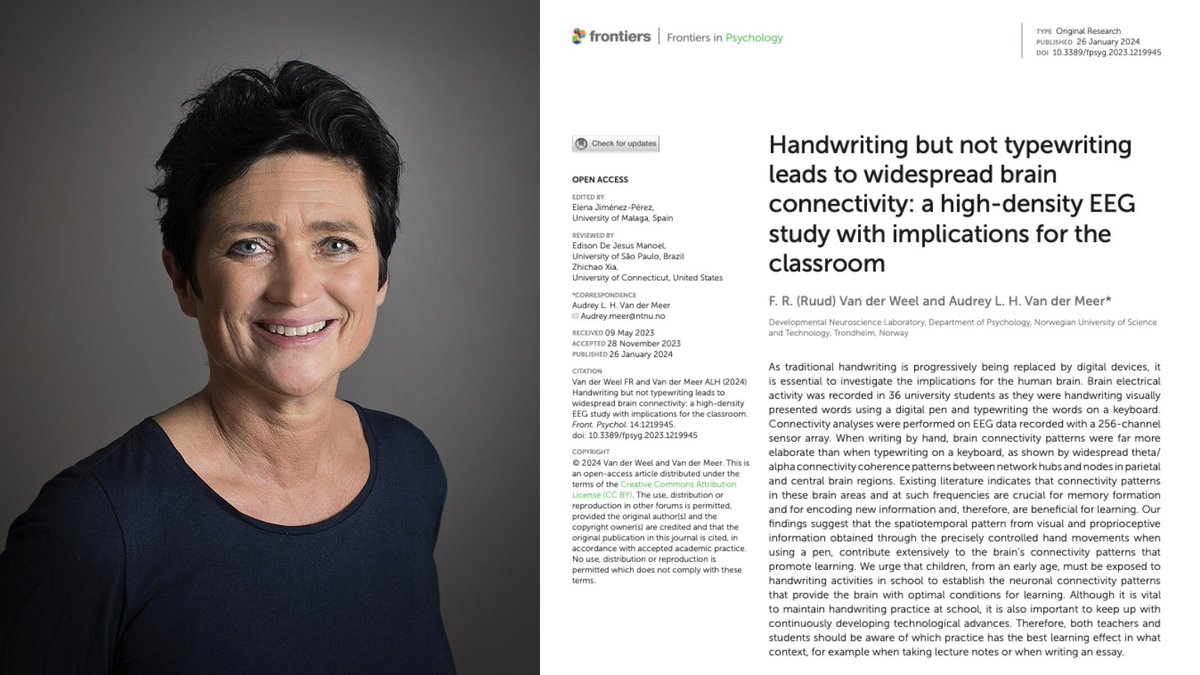
A Norwegian neuroscientist spent 20 years proving that the act of writing by hand changes the human brain in ways typing physically cannot, and almost nobody outside her field has read the paper.
Her name is Audrey van der Meer.
She runs a brain research lab in Trondheim, and the paper that closed the argument was published in 2024 in a journal called Frontiers in Psychology. The finding is brutal enough that it should have changed every classroom on Earth.
The experiment was simple. She recruited 36 university students and put each one in a cap with 256 sensors pressed against their scalp to record brain activity. Words flashed on a screen one at a time.
Sometimes the students wrote the word by hand on a touchscreen using a digital pen, and sometimes they typed the same word on a keyboard. Every neural response was recorded for the full five seconds the word stayed on screen.
Then her team looked at the part of the data most researchers had ignored for years, which is how different parts of the brain were communicating with each other during the task.
When the students wrote by hand, the brain lit up everywhere at once.
The regions responsible for memory, sensory integration, and the encoding of new information were all firing together in a coordinated pattern that spread across the entire cortex. The whole network was awake and connected.
When the same students typed the same word, that pattern collapsed almost completely.
Most of the brain went quiet, and the connections between regions that had been alive seconds earlier were nowhere to be found on the EEG.
Same word, same brain, same person, and two completely different neurological events.
The reason turned out to be something nobody had really paid attention to before her work. Writing by hand is not one motion but a sequence of thousands of tiny micro-movements coordinated with your eyes in real time, where each letter is a different shape that requires the brain to solve a slightly different spatial problem.
Your fingers, wrist, vision, and the parts of your brain that track position in space are all working together to produce one letter, then the next, then the next.
Typing throws all of that away. Every key on a keyboard requires the exact same finger motion regardless of which letter you are pressing, which means the brain has almost nothing to integrate and almost no problem to solve.
Van der Meer said it plainly in her interviews.
Pressing the same key with the same finger over and over does not stimulate the brain in any meaningful way, and she pointed out something that should scare every parent who handed their kid an iPad.
Children who learn to read and write on tablets often cannot tell letters like b and d apart, because they have never physically felt with their bodies what it takes to actually produce those letters on a page.
A decade before her, two researchers at Princeton ran the same fight using a completely different method and ended up at the same answer. Pam Mueller and Daniel Oppenheimer tested 327 students across three experiments, where half took notes on laptops with the internet disabled and half took notes by hand, before testing everyone on what they actually understood from the lectures they had watched.
The handwriting group won by a wide margin on every question that required real understanding rather than surface recall.
The reason was hiding in the transcripts of what the two groups had actually written down.
The laptop students typed almost word for word, capturing more total content but processing almost none of it as they went, while the handwriting students physically could not write fast enough to transcribe a lecture in real time, which forced them to listen carefully, decide what actually mattered, and put it in their own words on the page.
That single act of choosing what to keep was the learning itself, and the keyboard had quietly skipped the choosing and skipped the learning along with it.
Two studies. Two countries. Same answer.
Handwriting makes the brain work. Typing lets it coast.
Every note you have ever typed instead of written went into your brain through a thinner pipe. Every meeting, every book highlight, every idea you captured on your phone instead of on paper was processed at half depth.
You did not forget those things because your memory is bad. You forgot them because typing never woke the part of the brain that would have made them stick.
The fix is the thing your grandmother already knew.
Pick up a pen. Write the thing down. The slower road is the faster one.
COVID changed my worldview permanently.
Nearly six years after COVID began, not one world leader has seriously examined what the vaccines did to the people they harmed.
Not one investigation. Not one parliamentary inquiry with genuine teeth. Not one head of state who has stood at a podium and said, we owe the injured an honest accounting and we are going to provide it.
The silence is universal. And it is coordinated in a way that individual negligence cannot explain.
This is the observation that matters most to me, more than any document, more than any leaked communication, more than any specific piece of evidence. Because the behaviour of every major government simultaneously tells you something that the individual pieces cannot tell you alone.
Genuine public health emergencies produce genuine review. What worked. What did not. Who was harmed and how. That is what accountable institutions do.
What we have instead is a wall.
And on the other side of that wall, the vaccine injured, still without diagnostic codes, still without compensation, still without the basic acknowledgment that what happened to them was real.
While Long COVID is promoted heavily by the same governments and the same media that will not ask a single honest question about the injections. The parallel presentations. The overlapping symptoms. The convenient framing that points everywhere except at the product.
The universal silence of world leaders on vaccine injury is not the behaviour of people who have nothing to hide.
It is the behaviour of people who have collectively decided that the cost of honesty exceeds the cost of continued silence.
That decision is itself the answer.
The Hantavirus Scamdemic's Real Purpose:
Cement the International Health Regulations (IHR) and "Global Medical Surveillance" of All Humans on Earth
Please share this video essay if you think "hantavirus" is a scam and WHO is a terrorist organization
🔊Sound on for narration
Each picture is worth a thousand words. World data reveals the lies. Covid wasn't a major killer; but the so-called covid "vaccines" definitely are. Thanks @denisrancourt and Frontline Health
"The International Panel on Climate Change has essentially just admitted that all the climate scare stories of the past 20 years are junk. Turns out, the alarmist forecasts that led to mass climate psychosis are 'implausible'."
@cmorrisonesq on the Sceptic.
Full episode👇
If you trusted "settled science" throughout history, you'd have:
- Drunk radioactive water for vitality (1920s)
- Had your healthy teeth pulled to cure mental illness (1910s)
- Smoked cigarettes for your throat, on doctor's orders (1940s)
- Taken heroin for your child's cough (1890s)
- Eaten lead paint chips as a calcium supplement (decades of this)
- Used asbestos to insulate your child's bedroom (1950s)
- Given thalidomide to pregnant women for morning sickness (1960s)
- Eaten margarine for your heart (1970s)
- Lobotomised your sister for being unhappy (1940s and 50s)
- Sprayed DDT on the children in the playground (1950s)
- Avoided all fat to lose weight (1990s)
- Replaced butter with trans-fat spreads on the doctor's recommendation (1990s)
Every generation has its medical catastrophe dressed up as health advice. Endorsed by the experts. Printed in the textbooks. Recommended by your doctor. Featured on the front of the magazines in the waiting room.
Ours is seed oils, statins, grain-based diets, ultra-processed convenience food, and the steady chemical maintenance of conditions that better food would resolve in 90 days.
Future generations will look back in horror. Just like we look back at radioactive tonics and cigarette prescriptions and wonder how anyone fell for it.
The pattern never changes. Only the product on the shelf.
@farms_ch@Fynnderella1 Veld Grape (Cissus Quadrangularis) is an Ayurvedic herb nicknamed “the bone builder”. It will speed your healing time dramatically and helps you grow strong flexible bones.
FOUR independent datasets from THREE countries have now confirmed that COVID shots induced a CANCER EPIDEMIC
1. U.S. government SEER cancer data (+6.4% surge in early-onset cancers since 2021)
2. CDC WONDER mortality data (138,000 excess cancer deaths since 2021)
3. South Korean study of 8.4 MILLION (increased risk of SIX major cancers)
4. Italian study of 300,000 (increased risk of THREE major cancers)
WHY ISN’T THIS FRONT PAGE NEWS?




![EthicalSkeptic's tweet photo. We observed the lag between temperature increases which preceded CO2 emission by means of the 2023 heat pulse...
Folleagues knew... 😎
"Paleoclimate data from Vostok ice cores reinforce
this dynamic, showing CO₂ increases lagging temperature rises by 800 years across glacial-inter-
glacial transitions, indicative of temperature-driven oceanic outgassing rather than prolonged at-
mospheric retention [19]."
https://t.co/45hX4tIEhi](https://pbs.twimg.com/media/Gm_qUVoW4AA45Cl.jpg)