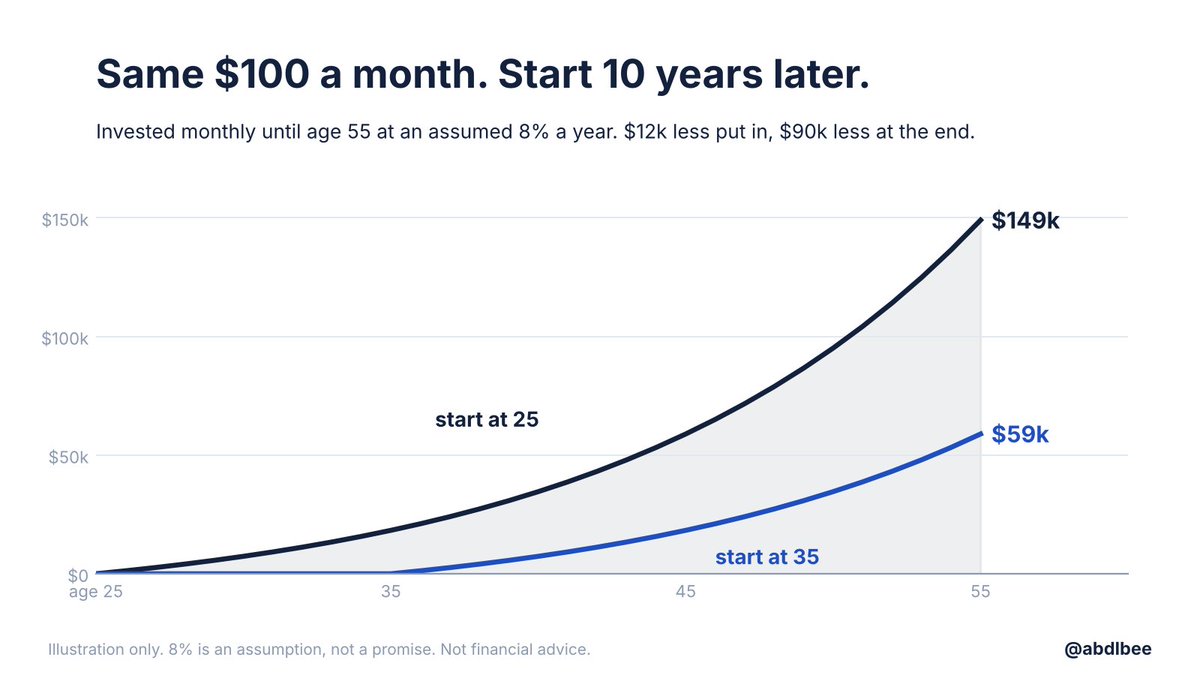
Doctors start earning late. That's the hidden cost nobody tells you about.
And unless you're working in a country with decent pay, you're likely going to end little for long.
Here's why it matters, with simple math.
Invest $100 a month at 8% a year (an assumption, not a promise):
Start at 25, stop at 55: about $149,000
Start at 35, stop at 55: about $59,000
You put in only $12,000 less.
You end up with $90,000 less.
$149,000 may not seem like much at 55, but better $149,000 at 55, than $0 at 55
That gap is compounding. The first decade does the heavy lifting.
Medicine delays your first real salary by years. You can't change that. What you can do:
- Start small, even during training
- Automate it the day salary lands
- Increase it every time your pay goes up
The amount matters less than the start date.
Not financial advice.
A CALM CALL IS A RETROSPECTIVE DIAGNOSIS
In Nigeria, doctors do not work in shifts the way colleagues in many countries do. There is no clean separation between day and night, weekday and weekend. Instead, the doctor on call continues from the morning routine into the uncertain hours of the night, and sometimes beyond dawn, while the hospital, always full, continues to demand attention.
Over time, doctors develop an adaptive vocabulary to describe this life. One phrase, shared with caution, is “a calm call.” It sounds like comfort, but the way it is used reveals much about how healthcare is experienced. No one calls a call “calm” while it is still in progress. To do so feels like tempting fate, inviting the hospital to respond with more emergencies. So the phrase is held back, only permitted once the experience is safely in the past. A calm call, by definition, is a retrospective diagnosis.
Calls differ in their character. Some announce themselves immediately. Even before you drop your bag, the emergency department is requesting a review: a farmer with a painful groin swelling a hernia now strangulated; a teenager with perforated typhoid fever, the bacteria having eaten through his bowel; a motorbike crash victim with abdominal trauma, brought in by anxious relatives. The theatre becomes the axis of the night. Time dissolves into sutures, drips, and decisions. You do not notice the fatigue, the missed meals, or the long hours until the cases pause; your body delays acknowledgement until it is safe.
Other calls begin with a sense of deceptive quiet. The wards appear stable. The monitors beep steadily. You walk through, update notes, and answer questions. You allow yourself to hope briefly that this might be one of the easier nights. But stability, here, is fragile. A child admitted with dehydration from an enterocutaneous fistula stops responding. A postoperative abdomen distends. A transfer-in arrives without imaging and with a rapidly dropping blood pressure. You feel the pace shift the night has redefined itself.
And then there are the calls that stretch beyond the normal meaning of the word. Dawn arrives not as relief but as another layer of responsibility. A patient with an obstructed bowel appears just as the sun rises. There are more ward reviews to do, a clinic waiting, and colleagues arriving who did not see the night you just lived through. You continue not because you have capacity, but because there is no one else.
When, finally, the work ends, you remember your cold food and the sleep debt you must repay. You head home, collapse, and sleep heavily. With a few hours of rest, memory softens the edges. You recall the night’s crises and how they were resolved. You count the victories. And so, you allow yourself to say it: “It was a calm call.”
The calmness is not in what happened but in what did not happen. Calm means no devastating loss. Calm means the system held just barely. Calm means survival, for both doctor and patient.
That unspoken superstition refusing to name calm until call has finished is more than a habit. It is a cultural adaptation to a system where emergencies can materialise from silence, where resources are stretched thin, and where a single call can rewrite the course of a life.
#medtwitter
#NARD
I made this video 3 days ago and I just wanted to leave a reminder.
Over 300 students at the University of Calabar have been told to leave and “learn a trade”, after 7 years studying dentistry.
I indulge you to kindly RT and lend your voice.
#SaveDentalStudentsOfUnical
An institutional disaster where heads are supposed to roll, offices sacked and resignations tendered - as usual have silhouetted behind "God"
Overtly religious societies are normally irresponsible societies.
A girl committed suicide because of your ineptitude.
WHOSE HEAD IS ROLLING?
@Wizarab10 It’s not just in soaps. Various colour dyes are found in foods and snacks. “The Food and Drug Administration (FDA) has banned the use of Red Dye No. 3, which is used in thousands of food products and is made from petroleum”. Be guided.
A young doctor with a dream 9 years ago started sharing easy-to-understand health stories.
Now I have friends all over the world in places I've never even visited.
Affecting lives. Changing narratives.
I'm happy I didn't give up.
Big things from a small place.
One year later, I am very grateful to everyone who gave me a hand to climb the ladder
@Cyblackorg Internship and SOC academy Done ✅
@Tech4DevHQ WTF’24 Graduation in view
I remember being an aspiring mentee and look at me now 😎 Dr. @ireteeh ‘s mentee.
Your Dreams are Valid
This is how you can protect yourself from monkeypox this period.
1. Pay attention to rash like these: At different stages of the disease, it can take different looks, so the number 1 rule is this: Do not try to diagnose any rash in your house, get a doctor to look at it