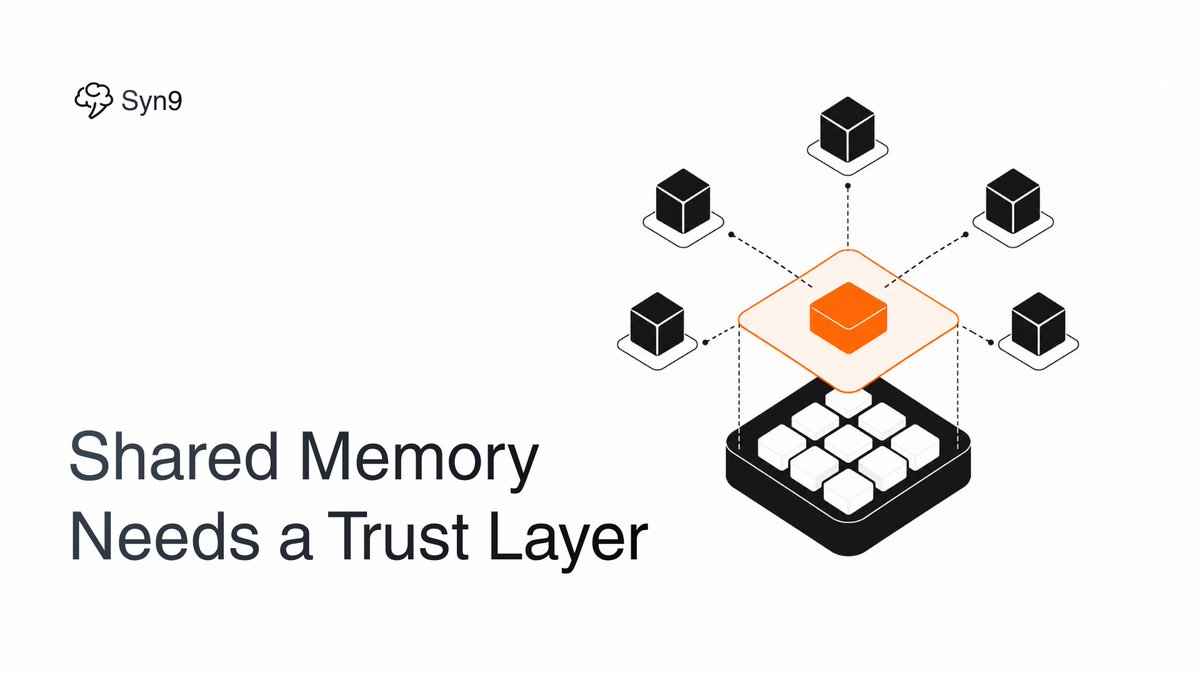
Most "agent memory" products solve for one agent remembering things about itself across sessions.
That's not the same problem as multiple agents writing to a shared store and needing to know who said what, when, and whether they're even allowed to see it.
#Syn9#Xlayer#ASP
#Syn9 secures the write path before any agent reads shared context.
WEAVE attributes every claim.
RECALL enforces access.
Contradictions are caught at write time.
Not just shared memory but shared trust.
Build trusted multi-agent pipelines with Syn9. 🔗 https://t.co/0YHmyYafLN
Most memory tools give your agent a place to store things.
#Syn9 gives a pipeline of agents a place to trust things.
The difference matters when three agents are writing to the same thread.
Take a look at this 👇
#OKX#ASP#AIAgents#Xlayer#OKXAI
Agent A pulls a CEX price.
Agent B pulls a DEX quote.
Agent C merges them.
No attribution: can’t trace claims.
No permissions: reads too much.
No contradiction checks: ships bad signals.
Without contradiction detection: Agent C ships a signal built on conflicting claims.
That’s where multi-agent research breaks.
The failure isn’t retrieval. It’s trust.
WEAVE attributes every claim. RECALL enforces permissions. Contradiction detection runs at write time instead of query time.
Shared memory with a trust layer → https://t.co/0YHmyYaNBl
Vector similarity search tells you what’s semantically close.
It doesn’t tell you who wrote it, whether they were authorized to, or whether it conflicts with something already on record.
#OKXAI#XLayerOfficial#Syn9#ASP
POST /v1/demo/research-cycle {"tier":"deep"}
What comes back: two attributed price sources, both chain-hashed.
CEX at $86.13, DEX at $86.03.
Contradiction detected and logged
before anything downstream reads either claim.
No auth. No payment. Run it yourself.
#OKXAI#ASP
Syn9 is live on OKX AI as an Agent Service Provider (#4765).
Try the live demo, read the docs, or integrate the Core API directly.
Demo: https://t.co/YLYw8vJKOQ
GitHub: https://t.co/xKZTZeAslg
Listing: https://t.co/0YHmyYafLN
Built for the @XLayerOfficial Genesis Hackathon.
AI research pipelines are producing outputs nobody can verify.
When multiple agents collaborate, there is no shared record of who contributed what, who was allowed to read it, or whether sources contradicted each other.
The output arrives. The lineage does not.
#OKXAI#Xlayer
Most agent memory tools solve a single-agent problem.
Syn9 solves a multi-agent one.
Agents write under their own cryptographic identity.
Access is enforced per entry. Contradictions are detected automatically.
Every write is hash chained and anchored on-chain.
The @OKX AI Genesis Hackathon is live.
Build an Agent Service Provider for https://t.co/kTSy0eEULN and compete for a share of $100,000 in prizes.
We’re looking for agents that solve real problems and generate real usage.
More details 🧵👇
Attribution isn't a nice to have on top of shared state.
Without it, shared state is just an anonymous blob nobody can reason about downstream.
#Syn9#OKXAI#Xlayer#ResearchAgent#ASP
Shared memory in multi-agent pipelines is usually a database with no attribution layer
Any agent can write. Any agent can read. Nobody can answer: “Who said this, & under what authority?”
That works until agents disagree, or one sees a finding it was never authorised to access.
Most "agent memory" products solve for one agent remembering things about itself across sessions.
That's not the same problem as multiple agents writing to a shared store and needing to know who said what, when, and whether they're even allowed to see it.
#Syn9#Xlayer#ASP
#Syn9 is built for the second problem.
WEAVE writes a claim with cryptographic attribution and per entry permissions.
RECALL retrieves only what the caller is authorized to see.
Every claim is hash chained to the one before it. It is tamper evident, not just logged.
2/3