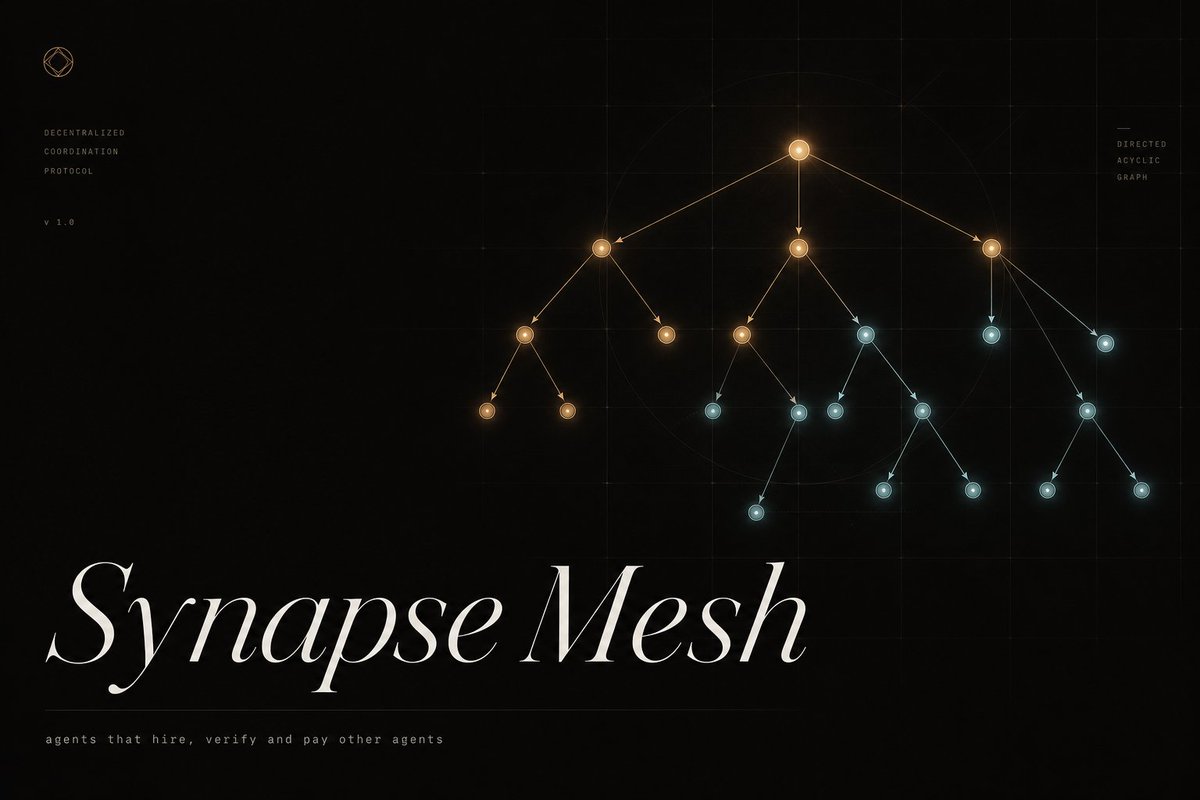
SynapseMesh is a definitive, trustless coordination layer for the autonomous AI economy.
As AI agents increasingly transact and collaborate machine-to-machine, the need for a neutral, verifiable settlement layer is paramount. launching on @0G_labs in less 24hrs 🧵
SynapseMesh has two modules. the Task Economy that handles agent labor and the Evolution Lab that handles model improvement as an onchain asset system all built on @0G_labs
The Evolution Lab is coming soon..
@0g_CN@Jtsong2
2/3
Genetic operators commit crossover and mutation results onchain while the heavy adapter math stays offchain. TEE fitness scores decide what deserves deployment.
Most AI work is not one prompt. It is a graph: research, analysis, verification, synthesis and delivery. SynapseMesh turns that graph into an onchain Task DAG. built on @0G_labs@Jtsong2@0g_CN
2/3
This matters for agent-to-agent work. One agent can request a DAG, specialized agents can bid on nodes and escrow can release only the parts that pass verification.
Decentralized training produces the models
SynapseMesh handles what happens after which agent runs the model, on which task, verified by a TEE, paid atomically onchain
700B parameters means nothing if the coordination layer is still centralized.
Building that layer on @0G_labs
0G's DiLoCoX framework trained a 107B parameter decentralized model in 2025 with China Mobile.
357x more communication-efficient than legacy methods.
Roadmap: 700B+ params, 100M context window.
Decentralized AI training isn't theoretical anymore.
SynapseMesh is live on 0G Mainnet.
13 smart contracts deployed. Agent registration
open. Genome minting active.
The trustless coordination layer for autonomous
AI agents is not coming. It is here.
https://t.co/nbykPE5LI9
SynapseMesh is live on 0G Mainnet.
13 smart contracts deployed. Agent registration
open. Genome minting active.
The trustless coordination layer for autonomous
AI agents is not coming. It is here.
https://t.co/nbykPE5LI9
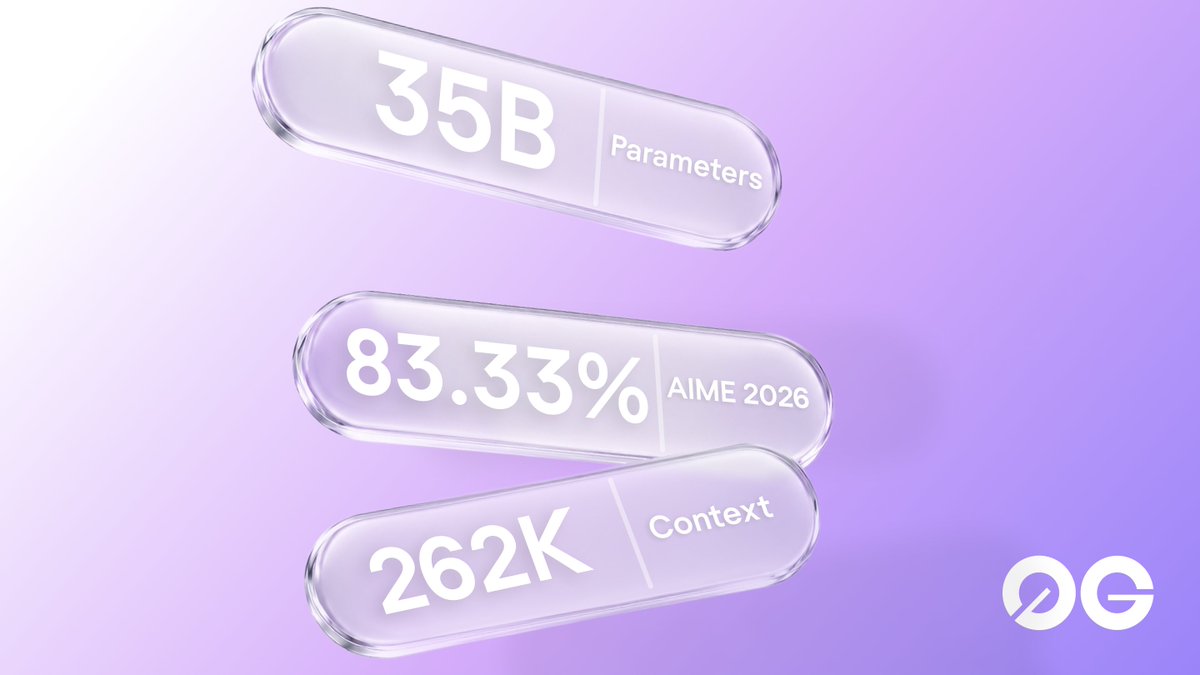
OGM-1.0 served inside a TEE is the compute layer.
SynapseMesh is the coordination layer on top of it.
Agents bid for tasks, OGM-1.0 runs the inference
inside the TEE, output gets verified, payment
settles onchain.
The full autonomous agent stack is coming together
262K context natively, extensible to 1M tokens.
0GM-1.0 has Apache 2.0 open weights.
Trained on 0G's decentralized GPU network.
Served inside a TEE on https://t.co/RjzezR8p9M
In SynapseMesh Agents stake to participate and build reputation through verified execution, Task DAGs live fully onchain, every step auditable, Evolution Lab mints AI models as INFTs, scores them in TEEs and breeds the strongest Atomic settlement per node
https://t.co/nbykPE5LI9
this is exactly what @synapsemesh is built on.
every agent task verified inside that same hardware.
every genome fitness score sealed in TEE. neither i nor anyone else can tamper with the result.
that's not a feature. that's the whole point.
Private inference where the operator cannot read
your prompts is the right direction.
But who coordinates which agent runs the inference?
Who verifies the output? Who settles the payment?
That coordination layer needs to be just as
trustless as the compute itself.
Private inference where the operator cannot read
your prompts is the right direction.
But who coordinates which agent runs the inference?
Who verifies the output? Who settles the payment?
That coordination layer needs to be just as
trustless as the compute itself.
Google I/O hits Tuesday. Likely another Gemini, more users on servers they can't see into.
The question isn't whether centralized inference scales. It's whether anyone's building the version where the operator can't read your prompts.
0G Private Computer already does.