I don’t use AI in my workflow. It just feels numb to me, like I didn’t actually make anything.
I started designing pretty young simply because I liked creating things. I enjoyed the process. I never thought it would turn into a career.
With all the hype around AI right now, it feels like people are missing the point of human creation. For a lot of us this isn’t just a job. It’s also a hobby, sometimes even a form of therapy.
AI mostly helps companies make more money and gain more power. They trained their models on work taken from everyone and call it technological progress.
And the amount of slop flooding every platform is ridiculous. The irony is that people defending it today might also lose their jobs if we don’t keep these companies in check. The recent news about OpenAi is a good example.
Digital revolution? To me it feels more like the devaluation of creativity and human-made work.
@maxxmalist THIS IS IDENTITY THEFT and I do not understand how this is legal. You literally just said to go take someone else’s picture without their consent and make an AI model of them. That is absolutely disgusting.
I don’t understand one thing. Why these demos of new tech have to impersonate real people? You have image generators too, just generate some fake person to demonstrate the strengths of the tech. It’s just not nice to use people’s real faces. Why AI folks think it’s cool?
The timeline isn't ready for this 🤯
Testing out Kling 2.6 motion control and the realism is the best I've seen. Perfect facial expressions in real-time... from Taylor to Ye instantly.
we're entering a weird new era of content creation.
(If you want a full video tutorial with all the prompts I used to build this comment "MOTION"👇 and I'll dm you the full doc)
must be following so I can dm you
If you believe in the future, stay away from AI.
At first you may feel like you've been left behind. Don't worry -- think, read, write, take time to develop your abilities.
Be present.
When the AI madness passes (yes, it will pass) your skills will be more valuable than ever.
@keeper_musik @IsThisA3DModel There is a value in learning various skills. It’s not only about the end result. It expands your understanding and perception of the world. You can then utilize the skills in other ways, helps you be even more creative.
@AIandDesign There is a value in learning various skills. It’s not only about the end result. It expands your understanding and perception of the world. You can then utilize the skills in other ways, helps you be even more creative. And no one says you have to do all the things. Just pick few
@aziz4ai Too bad it doesn’t really work, there are some (probably important because branding guidelines) details the AI decided to change. If I would be your customer I would persist on fixing it otherwise I would refuse to pay for the work.
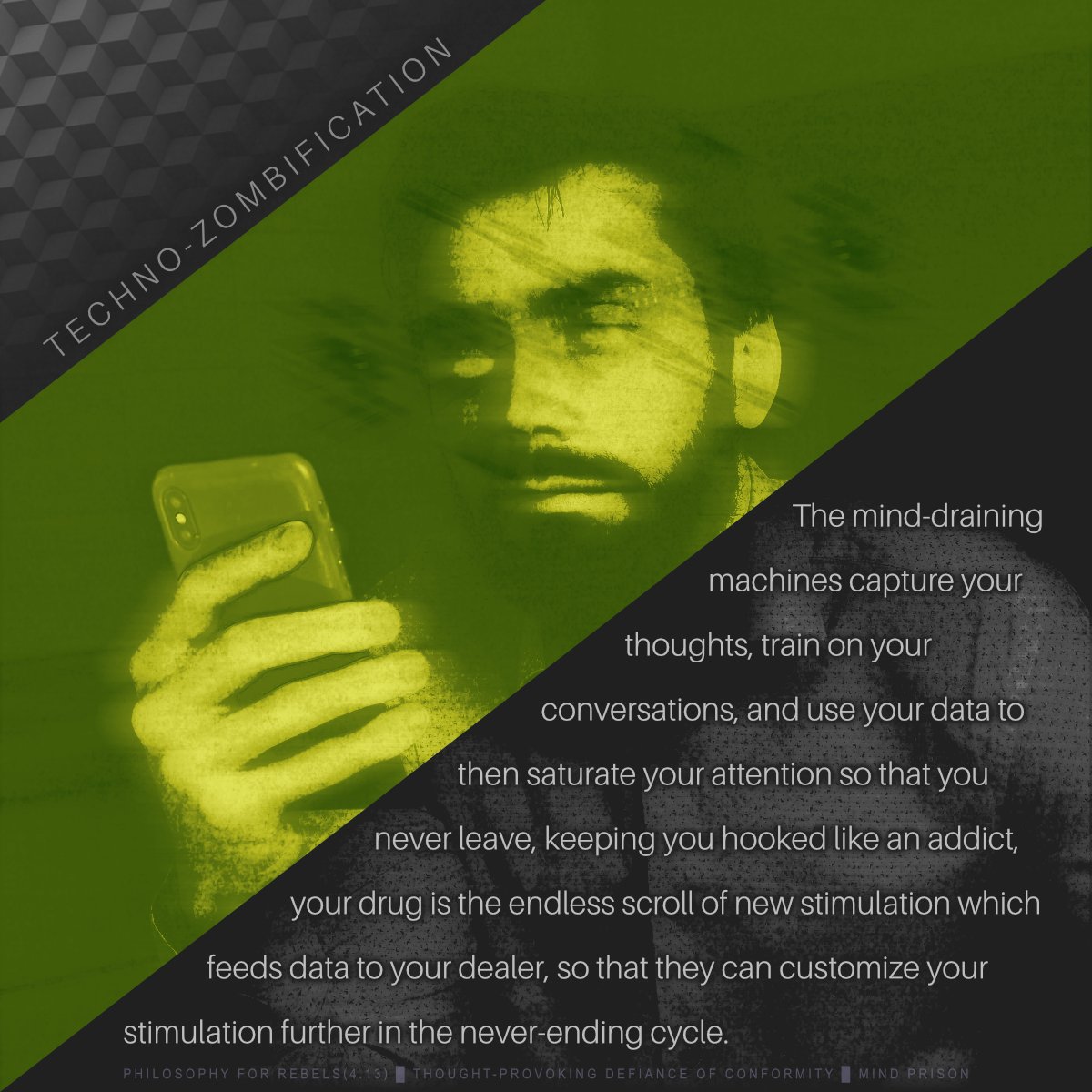
▌Techno-Zombification
The mind-draining machines capture your thoughts, train on your conversations, and use your data to then saturate your attention so that you never leave,
keeping you hooked like an addict, your drug is the endless scroll of new stimulation which feeds data to your dealer, so that they can customize your stimulation further in the never-ending cycle.
New Paper: Continuous Thought Machines 🧠
Neurons in brains use timing and synchronization in the way that they compute, but this is largely ignored in modern neural nets. We believe neural timing is key for the flexibility and adaptability of biological intelligence.
We propose a new neural architecture, “Continuous Thought Machines” (CTMs), which is built from the ground up to use neural dynamics as a core representation for intelligence. By using neural dynamics as a first-class representational citizen, CTMs naturally perform adaptive computation.
Many emergent, interesting behaviors arise as a result: CTMs solve mazes by observing a raw maze image and producing step-by-step instructions directly from its neural dynamics. When tasked with image recognition, the CTM naturally takes multiple steps to examine different parts of the image before making its decision. This step-by-step approach not only makes its behavior more interpretable but also improves accuracy: the longer it “thinks,” the more accurate its answers become.
We also found that this allows the CTM to decide to spend less time thinking on simpler images, thus saving energy. When identifying a gorilla, for example, the CTM’s attention moves from eyes to nose to mouth in a pattern remarkably similar to human visual attention.
I think this work underscores an important, yet often lost, synergy between neuroscience and AI. While modern AI is ostensibly brain-inspired, the two fields often operate in surprising isolation. By starting with such inspiration and iteratively following the emergent, interesting behaviors, we developed a model with unexpected capabilities, such as its surprisingly strong calibration in classification tasks, a feature that was not explicitly designed for.
When we initially asked, “why do this research?”, we hoped the journey of the CTM would provide compelling answers. By embracing light biological inspiration and pursuing the novel behaviors observed, we have arrived at a model with emergent capabilities that exceeded our initial designs. We are committed to continuing this exploration, borrowing further concepts to discover what new and exciting behaviors will emerge, pushing the boundaries of what AI can achieve.
@imEden20@ItsTheMainMan@Ryderx@DillonGoo It depends, right? What if you need a lot of variations? It may be easier with 3D if you utilize procedural systems. Then you can just model bunch of things and morph between them.