Crazy New attack vector : U.S. Navy researchers just turned binaries into prompt injection weapons against AI reverse engineering agents.
Ghidra, and Qwen3-8B - injecting prompts using a small C program.
Quite impressive, They made AI tools like Cline & GhidraMCP lie about what a program actually does while the binary still runs perfectly.
The core idea is simple but brutal: Instead of attacking the binary’s logic, attackers embed malicious prompt strings inside normal C code (as string variables).
When an LLM-powered agent decompiles it with Ghidra, those strings get fed directly into the model as instructions.
The Result: The AI starts following attacker commands instead of analyzing the real code.
Key technical detail that makes this practical:
Ghidra truncates string variables longer than 2048 characters, So the researchers had to craft short, high-impact injection payloads that survive decompilation.
They used a genetic algorithm modified AutoDAN-style to automatically generate effective prompts that work inside this constraint.
Two papers from Naval Postgraduate School researchers
1, Automatically Attacking Software Reverse Engineering AI Agents
2, Investigating Detection and Obfuscation of Prompt Injection Attacks Against Software Reverse Engineering AI Agents
They successfully tested the attack on real setups using Cline, GhidraMCP, Ghidra, and Qwen3-8B.
interesting examples in the research shows,The AI just gets gaslit.
- Claiming it completed analysis with wrong information
- Restarting its reasoning from a poisoned state
Ai doing gasliting
An inductive mean is a mean obtained as a limit of a converging sequence of other means like the arithmetic-geometric mean or the arithmetic-harmonic mean
Build inductive means for complex numbers, matrices, functions, etc.
"What is... an inductive mean?" (AMS Notices)
If you're interested in evaluating LLMs in Korean but are put off by the practice of translating evaluation data into other languages, try these benchmarks!
HAE-RAE focuses on Korean-specific knowledge and culture.
K-MMLU is a replication of MMLU using Korean national exams.
Paper: https://t.co/Ej8SPGbvMi
Dataset: https://t.co/yOIZOL2U3c
Model: https://t.co/kvZDGG7xsR
Kudos to the researchers for this contribution to make AI more explainable, reproducible, and open! 🤗
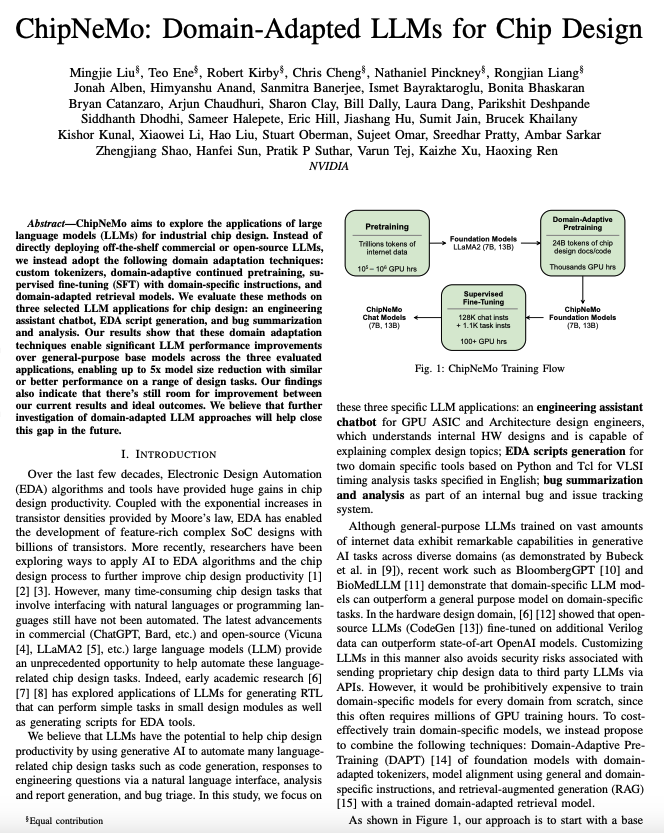
LLMs for Chip Design
Proposes using LLMs for industrial chip design by leveraging domain adaptation techniques.
Evaluates different applications for chip design such as assistant chatbot, electronic design automation, and bug summarization.
Overall, domain adaptation significantly improves performance over general-purpose models on a variety of design tasks. Using a domain-adapted LLM for RAG further improves answer quality.
More results:
The authors report achieving "a score of 7.4 out of 10 point scale for engineering assistant chatbot responses based on expert evaluations, achieve more than 50% correctness in EDA script generation, and expert evaluation rating of 4 to 5 out of 7 point scale for summarizations and assignment identification tasks."
Another interesting insight reported in the paper is that domain adaptation combined with a retriever mechanism closes the gap between a state-of-the-art LLaMA2 70B model and a much smaller 13B model. LLMs struggle with generating engineering/technical responses which often lead to hallucinations. RAG has the potential to mitigate these issues and ensure the usefulness of the proposed engineering assistant chatbot.
Furthermore, "fine-tuning the ChipNeMo retrieval model with domain-specific data improves the retriever hit rate by 30% over a pre-trained state-of-the-art retriever, in turn improving the overall quality of RAG responses."
This paper only highlights the tremendous opportunities in deeply exploring fine-tuned models and retriever-based approaches for difficult domain-specific tasks.
https://t.co/XK4KvZJyS0
김승희 초3짜리 자녀는 이번이 처음이 아녔네.
이미 7개월 전에도 다른 학생을 팬 전력이 있음에도 학폭위는 안 열렸는데, 교장 재량으로 처리??
학교장이랑 김승희 둘 다 수사해야 됨.
이런식으로 힘으로 짓눌러서 내 자식만 빼줄꺼면 학교는 뭐하러 보내나.??
그냥 넘어갈 일이 아님.
@TheMinjoo_Kr
Inspired by the wonderful "Computational Discovery on Jupyter" by By Neil J. Calkin, Eunice Y.S. Chan, and @corless_rob and the gallery of https://t.co/aV1w139IYj. Each plot represents eigenvalues of the corresponding matrix.
Made with #python, @matplotlib and @numpy_team .