Starlink equipment has been delivered to help restore communications in earthquake-hit Indonesia 🇮🇩
The equipment was provided to residents of Tado village in Riung, East Nusa Tenggara, by the local NasDem organization following a visit by Indonesian parliament member Julie Sutrisno Laiskodat
The goal is to reconnect communities affected by the earthquake and support disaster recovery
This is exactly where Starlink becomes critical infrastructure
When terrestrial networks go down, satellite internet provides a lifeline for communities, helping residents reconnect and emergency teams coordinate recovery efforts
Connectivity matters most when everything else fails
Elon Musk just hinted at something huge coming from SpaceX next year:
“When we unveil the details of the StarMind computer next year, it will blow people’s minds”
And this is not the first time Elon has talked like this before a major reveal
He used similar language around the new Tesla Roadster, and that ended with literally SpaceX rocket engines packed in a car that literally takes off like a rocket, does flips in the air, sticks upside down, and stabilizes itself in the air
So when Elon says StarMind is going to “blow people’s minds,” it’s worth paying attention...excitement is very much guaranteed
The first StarMind systems are going to be deployed next year, with much larger scale targeted after that, which is going to be at an insane scale
Space-based SI compute is about to get very, very huge
SpaceX is now officially preparing to catch both Super Heavy and Starship on the same mission
Flight 15 is targeting launch as early as Friday, November 13, pending regulatory approval…..with both stages planned to return to Starbase for tower catches
Super Heavy will attempt its return minutes after liftoff, marking the first catch attempt for a V3 booster
Starship will deploy 26 Starlink V3 satellites and spend more than 22 hours in orbit. If its reentry and landing systems are confirmed healthy, it will then return to Starbase for the ship’s first tower-catch attempt
Launching the entire system is one challenge. Bringing both stages home ready for reuse is another
Flight 15 is going to bring SpaceX a major step closer to full and rapid reusability
https://t.co/A1JNXIHhTb
SpaceX just released a detailed blog post explaining how Starship will return to Starbase for its first tower-catch attempt on Flight 15
and it is going to be the first full recovery of an orbital launch system
The mission brings together both sides of Starship’s future: delivering a major payload to orbit and bringing the entire launch system home for reuse.
Super Heavy will return minutes after liftoff, while Starship will deploy 26 Starlink V3 satellites, fly a mission of more than 22 hours, then make its way back through the atmosphere toward the tower at Starbase, provided it passes the required vehicle-health checks
The update walks through the orbital safety checks, heatshield inspections, alternative splashdown locations, the precise approach over northern Mexico and southern Texas, and the final sequence of bellyflop, engine ignition, flip and catch
Flight 15 is targeting launch as early as Friday, November 13, pending regulatory approval. The 75-minute launch window opens at 4:45 p.m. CT. Here is the full plan, from liftoff to bringing both stages home
1. LAUNCH AND THE BOOSTER’S RETURN
Super Heavy will lift Starship from Starbase before the vehicles separate through hot-staging: Starship ignites its engines while still attached, then continues toward space as the booster turns back.
The booster will perform its boostback burn, descend toward Starbase and begin its landing burn roughly six minutes after liftoff. The catch is planned for approximately 6 minutes 35 seconds into flight.
This will be the first catch attempt for a V3 Super Heavy booster. SpaceX has already caught three V1 boosters, with two subsequently flown again.
2. THE HARDWARE DESIGNED FOR CATCHING
Super Heavy V3 has three grid fins instead of four. Each is 50% larger and significantly stronger, with a new catch point and revised positioning to support lifting and catching operations.
The tower’s mechanical arms......the chopsticks are shorter to allow faster movement and better tracking during a catch. Their main actuators have changed from hydraulic to electromechanical, improving speed, redundancy and reliability
These changes are part of the broader V3 architecture, designed around making recovery and reuse routine operations.
3. STARSHIP DOES NOT COMMIT TO ORBIT IMMEDIATELY
The ship initially follows a passively safe suborbital trajectory rather than entering a sustained orbit directly.
This is deliberate. If a problem occurs during ascent or shortly afterward, the trajectory takes Starship toward a cleared reentry area over the Indian Ocean without requiring a successful orbital mission.
After ascent, flight controllers assess the vehicle’s health and make a go/no-go decision for orbit.
With a go, one sea-level Raptor performs an orbital insertion burn approximately 26 minutes after liftoff, increasing Starship’s speed enough to establish orbit.
4. DEPLOYING 26 STARLINK V3 SATELLITES
Satellite deployment is planned to begin around 35 minutes into flight and finish around 1 hour 18 minutes.
Each Starlink V3 satellite adds approximately 1 terabit per second of network capacity. SpaceX compares this mission’s 26 satellites with roughly 10 Falcon 9 launches carrying V2 Mini satellites.
After deployment, the satellites unfold their antennas and solar arrays, establish radio and laser communications, and use onboard propulsion to raise their orbits. Customer service is expected to begin as soon as a few weeks after launch.
Three satellites have an additional job: photographing Starship’s heatshield.
Those images will be transmitted to operators and become one of several sources of information used to assess whether the ship is ready to return to Starbase. SpaceX has already tested this inspection method on previous flights.
5. ALMOST A DAY IN ORBIT
The planned mission lasts more than 22 hours, with approximately 14 orbits at an altitude of roughly 275 kilometers.
After deploying the satellites, Starship will coast for around another 21 hours until its orbit aligns with Starbase for the return.
Throughout that period, controllers will run continuous manual and automated checks. These cover engine health, power, communications, flight computers, navigation sensors, tank and feedline integrity, tank pressure and attitude control......the ability to maintain the ship’s intended orientation.
These checks are intentionally conservative. Returning to the tower is something the vehicle must qualify to do through its condition in flight.
6. ALTERNATIVE RETURN OPTIONS THROUGHOUT THE MISSION
The flight includes opportunities to end the mission early in precleared Pacific Ocean areas if the vehicle is not suitable for a Starbase return.
These include early- and late-mission splashdown options around Hawaii and a mid-mission opportunity several hundred kilometers off Chile’s coast. The same areas were used during Flight 14.
The mission therefore has multiple decision points rather than a single commitment to return home regardless of the vehicle’s condition.
7. THE DEORBIT BURN AND REENTRY
Starship will proceed toward Starbase only if it meets SpaceX’s internally developed, FAA-approved conditions for return and catch.
A single Raptor 3 engine will perform the deorbit burn, planned around 21 hours 36 minutes after launch. That changes the ship’s trajectory toward atmospheric entry over the Pacific Ocean, thousands of kilometers uprange from Starbase.
Reentry is planned to begin around 22 hours 11 minutes into flight.
The four control flaps will guide Starship along its intended trajectory while allowing small, deliberate turns to route it over sparsely populated areas of northern Mexico and southern Texas.
8. THE FLIGHT PATH BACK TO STARBASE
Starship will approach from the west and steer around the major cities of the Rio Grande Valley.
It will pass north of South Padre Island, continue out over the Gulf, then make its final turn south toward Starbase.
This is not an entirely untested maneuver: SpaceX has demonstrated the banking maneuver on previous Starship flights.
Residents of Cameron County and nearby areas may hear one or more sonic booms. What people experience will depend on weather and other conditions.
Reentry over land also has extensive spaceflight precedent, including the Space Shuttle, Dragon’s previous Florida returns, and Soyuz and Shenzhou missions.
9. HOW EARLIER FLIGHTS PREPARED THE HEATSHIELD
Previous ocean-return tests allowed SpaceX to deliberately push the heatshield, structure and control systems beyond the demands of a normal return to the launch site.
Experiments included removing dozens of heatshield tiles from critical locations and flying maneuvers that subjected the vehicle and flaps to higher heating and aerodynamic forces than a nominal reentry.
Flight 15 also retains Flight 14’s heatshield improvements, including additional tile-retention mechanisms in vulnerable areas, measures addressing plasma intrusion behind tiles, and curved tiles across a large portion of the shield to reduce heating between them.
The V3 rear-flap mechanism uses a single actuator with three motors per flap, improving redundancy while reducing mass and cost.
10. THE FINAL BELLYFLOP, FLIP AND CATCH
Arriving over Starbase, Starship will descend toward the tower at Pad 2 in its bellyflop orientation.
Shortly before reaching the tower, it will ignite its three sea-level Raptors, flip upright and stow its flaps.
Once vertical, it will reduce to two engines and maneuver between the tower’s arms. It will then reduce to one engine as it approaches a near hover.
The arms will close rapidly around two catch fittings just below the forward flaps.
Once Starship detects contact with the arms, it will shut down its final engine.
The ship catch is planned for approximately 22 hours 32 minutes after liftoff. All mission timings are approximate and subject to change.
11. SAFETY OPTIONS REMAIN AVAILABLE DURING REENTRY
SpaceX has built in options to end reentry before the ship reaches land if necessary, including intentionally tumbling the vehicle to ensure atmospheric breakup.
There is also a late option to divert into the Gulf if either the ship or the tower develops a problem that prevents a safe catch.
The objective is ambitious, but the return is governed by explicit vehicle-health requirements and multiple alternatives throughout the flight.
12. WHY THIS MISSION MATTERS
Catching the booster solves one part of the recovery challenge. Bringing the upper stage back from orbit addresses the other.
SpaceX described recovering the entire orbital launch system as the “Holy Grail of rocketry” the foundation for full and rapid reuse and an eventual airplane-like flight cadence.
That is the capability behind Starship’s larger mission: expanding Starlink, deploying the planned Starmind supercompute constellation, establishing a permanent human presence on the Moon and making life multiplanetary.
Flight 15 is taking SpaceX another major step toward that future: launch, deploy, orbit, return and bring both stages home
SpaceX’s full catch update:
https://t.co/rdUq9q5hrw
Official Flight 15 mission details:
https://t.co/A1JNXIHhTb
Elon Musk raises a major concern about America's dependence on Asia for semiconductor manufacturing
Even with TSMC, Samsung and other chipmakers expanding production in the United States, the overwhelming majority of advanced semiconductor manufacturing remains concentrated in Asia
Elon highlights the scale of the challenge:
• TSMC is building a massive semiconductor manufacturing complex in Arizona, with some facilities already operational
• Samsung operates chip fabrication facilities in Texas and is developing additional manufacturing capacity, including production intended for Tesla's AI5 and AI6 chips
• TSMC, Samsung and Micron are critical players in the global semiconductor supply chain
• Even under optimistic assumptions about announced US fabrication projects, Elon estimates American capacity would represent only around 10% of Asia's
And this is where the geopolitical risk becomes enormous
Taiwan plays an extraordinary role in global semiconductor manufacturing, especially advanced chip production
Any major disruption to manufacturing in the region could severely affect America's access to the chips needed for computing, vehicles, robotics, defense systems and countless other technologies
Elon's warning is clear:
America needs the ability to manufacture semiconductors at massive scale domestically, including the entire supply chain required to support that production
Because building the world's most advanced technologies means very little if you cannot manufacture the chips that power them
SpaceX is taking another huge step toward making manufacturing in space a reality
SpaceX now has a dedicated website for STARFALL, its new spacecraft designed to carry experiments and manufactured products into space and safely return them to Earth
And the scale is extraordinary
• Up to 1,000 kg of return payload capacity
• Designed for microgravity research and manufacturing
• Compatible with Falcon 9 and Starship
• Two demonstration missions launched in 2026
• Commercial missions planned for 2028 and 2029
Starfall is opening the door to manufacturing pharmaceuticals, advanced materials and other products in an environment that simply doesn't exist on Earth
And SpaceX is building the transportation infrastructure to make it possible at scale
We're watching the foundations of an entirely new space economy being built
https://t.co/HB1cfl74ip
Neuralink is on track to achieve "Jesus-level miracles"
Neuralink is giving people back abilities they thought were lost forever
And it's already started: people with paralysis and ALS are using their neural signals to communicate and interact with the world
• Controlling computers with just their minds
• Restoring speech through synthesized voices
• Doing everyday things on their own again
Neuralink's mission says it all:
"Our goal at Neuralink is to restore abilities that were thought to be lost forever due to injury, accident, or disease"
This is so much bigger than advanced technology
It's about giving people back their independence, their voice, and the ability to do things they once thought would never be possible again
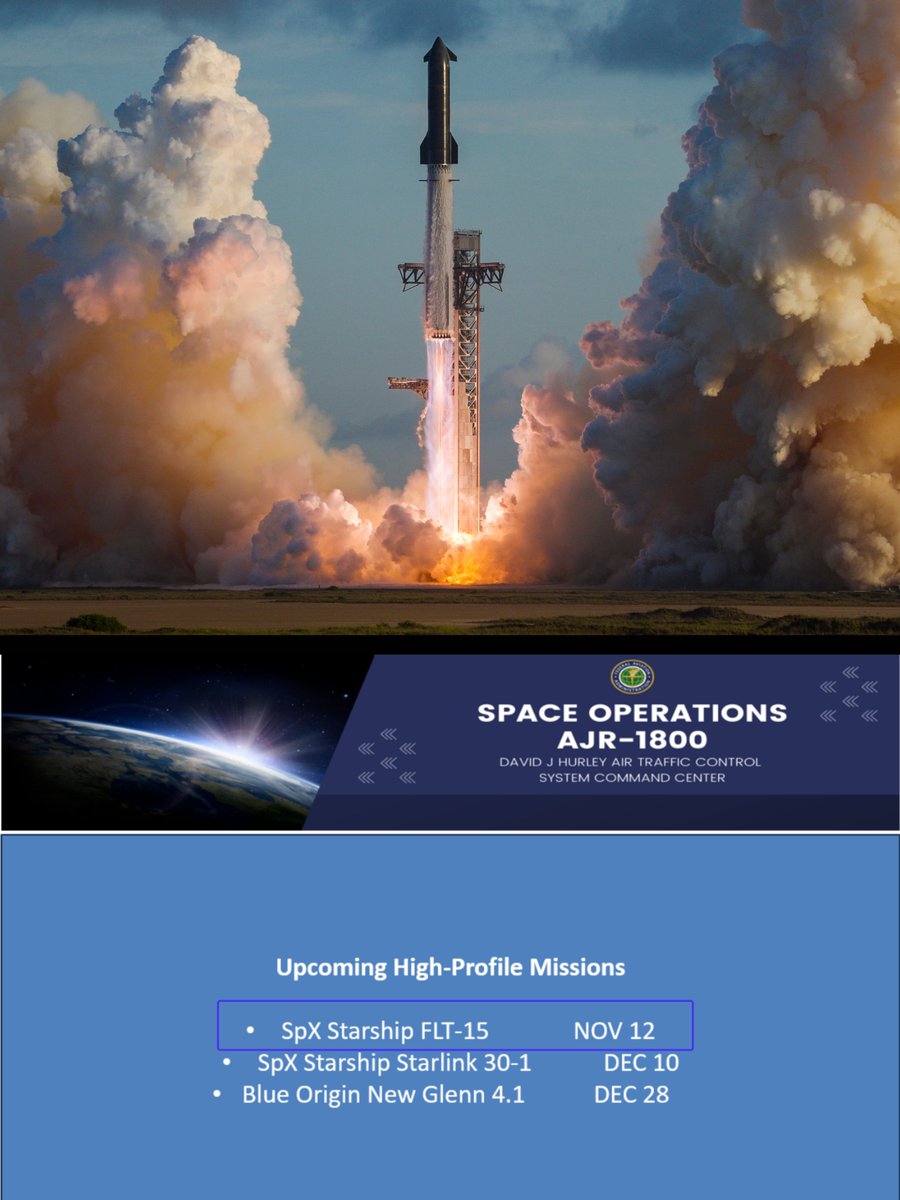
SpaceX is gearing up to launch Starship Flight 15 as early as November 12, and this mission is going to be absolutely epic
The date has appeared in an FAA air traffic planning presentation, listing November 12 as the preliminary planning date for Starship's next flight
And preparations are moving fast:
• Super Heavy Booster 22 has completed its full-duration 33-engine static fire
• Starship Ship 42 has completed its six-engine static fire and a single-engine simulated deorbit burn
SpaceX is preparing to attempt catching both Super Heavy and Starship with launch towers for the first time in a single mission
Flight 15 represents an extraordinary milestone in SpaceX's journey toward the world's first fully and rapidly reusable orbital rocket system
November is shaping up to be an incredible month for Starship