UPDATE IN CASE TO CLAIM LEGAL TITLE OVER SATOSHI’S BITCOIN
on may 29, @btclawyerguy filed an amicus arguing that the ‘noah doe’ case was bunk.. in response the court ordered a stay.. noah doe's lawyers opposed the stay, but @btclawyerguy has just filed a strong rebuttal 👇
Prediction markets hit a record $10.8 billion in weekly trading volume in the week ending June 15 — their biggest week ever. Several big events coincided that contributed to the all-time high: the SpaceX IPO, a U.S.-Iran peace deal, the NBA Finals, the Stanley Cup, and the opening of the World Cup, among them.
A year ago, a typical week on prediction markets ran around half a billion dollars, and even the busiest weeks stayed under $1 billion. That floor has climbed steadily since. It climbed past $1 billion last fall, past $4 billion by winter, and into the $6–7 billion range this spring.
Even a quiet week today dwarfs the biggest week of a year ago.
DAGGERS ARE OUT at the Fed toward a Trump appointee—very likely from some of the same Fed staffers who themselves broke Fed blackout periods WITH IMPUNITY. The Fed’s prior IG never investigated those incidents. And now they make a big deal of blackouts? Double standard much?🤔
One reason why the daggers might suddenly be out for Bowman inside the Fed is that she hired an outside firm to reassess the Fed’s own role in the 2023 bank failures. The Fed’s internal report at the time whitewashed what really happened & was drafted by the very people who had roles in what happened. Bookmark this—is the not-so-pretty truth about to come out, and they’re shooting the messenger to get ahead of that???
NEW: Michelle Bowman, the Federal Reserve’s vice chair of supervision, spoke at an invitation-only, private dinner that Bank of America hosted for clients in New York on Wednesday evening, hours after the central bank announced its latest policy decision
She says she did not comment on monetary policy and complied with all FOMC and ethics policies https://t.co/3yXNvz4FKb
Following up on yesterday's post with some additional context and data that may help explain what we saw on Friday.
A few people asked why I believe the selloff was driven primarily by a leverage liquidation event.
No issuer has perfect visibility into every investor's financing arrangements, so no one can know with certainty exactly what happened across every account.
That said, three things stand out.
First, we knew leveraged strategies had developed around Digital Credit securities. We had seen examples of trades that involved meaningful leverage and had publicly discussed the risks associated with some of those approaches.
Second, we received anecdotal reports from market participants indicating that liquidations were occurring during the selloff.
Third, the trading data itself is consistent with what is often observed during forced selling events.
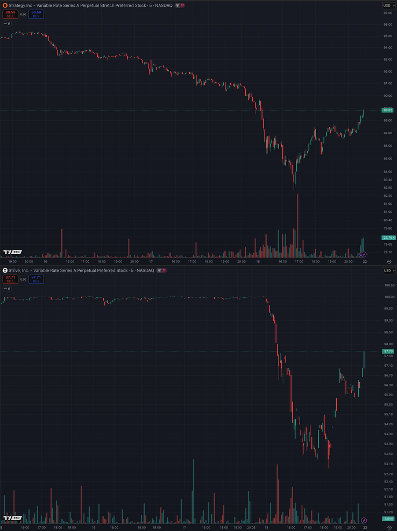
The STRC chart shows volume remained relatively modest through much of the decline, then exploded as the security moved from roughly $89 toward its intraday low of $82.50. After the low was established, volume quickly subsided and the price recovered materially into the close.
That pattern is often associated with a liquidation cascade. Forced selling drives volume sharply higher, prices overshoot fundamentals, and then buyers step in once the selling pressure has been exhausted.
The SATA chart also shows a price decline, but a very different volume profile. Volume remained much more consistent throughout the session (and the entire week) and did not exhibit the same relative spike around the lows that was observed in STRC.
That distinction is important.
To me, the data suggests that the primary stress event occurred in STRC, while weakness elsewhere in Digital Credit was more likely a spillover effect from the broader selloff than a similar wave of liquidations occurring across every security.
This is not a statement that one credit is stronger than another. In my view, both STRC and SATA remain strong credits, and neither issuer experienced a sudden deterioration in credit quality during Friday's trading session.
Digital Credit is a new asset class. As it grows, there will be periods where market structure, liquidity, leverage, and investor behavior create volatility that has little to do with underlying credit fundamentals.
Understanding those dynamics is part of the maturation process.
Friday was the most significant stress test Digital Credit has faced so far.
The market absorbed it, buyers emerged, and both securities recovered substantially from their lows.
That is a constructive outcome and an important data point for the future of the asset class.
Los Angeles County voters just approved raising their own sales tax to 10.25%, meaning millions of residents will pay more on most everyday purchases. In the middle of a cost-of-living crisis, they literally voted to make things more expensive🤡🌎
Franklin Templeton files for two ETFs that automatically invest dividends from stock holdings into bitcoin…
Targeting 95% stock & 5% btc allocation.
Extremely savvy way to introduce btc into portfolios w/ zero friction.
ETF innovation never ceases to amaze.
Standard Nuclear, a maker of fuel for nuclear reactors, filed for an IPO as the power needs to fund the artificial intelligence boom continue to grow https://t.co/nrGwvIkHJq