Don’t code alone. Slack Code is live.
Humans and agents. Same channel. Same work.
Launching today with agents from @AnthropicAI, @github, @Cognition, and @vercel. This is real multiplayer coding. See it at @Dreamforce#DF26
The whole go to market motion now runs from one window.
Not because one tool does everything. Because every tool in the stack is reachable from the same place, through MCP.
For years the work wasn't the strategy, it was the moving. Export a list, reformat it, paste it into the enrichment tool, wait, export again, upload to the sender. Five exports to ship one campaign, and none of them were the thinking part.
That layer is gone.
Here's what the motion looks like when one person runs it:
1️⃣ Build the list
Pull from more than one database in the same session. No CSV round trip and no reformatting between tools, because the model reaches the databases directly.
2️⃣ Enrich and QA
Clay runs the waterfall across providers. The QA pass happens before segmentation rather than after someone spots a bad send.
3️⃣ Score against the ICP
The ICP lives in a file, and the scoring prompt is generated from that file. Change the ICP and the scoring changes with it, so nobody is hand editing a prompt to keep up.
4️⃣ Tier and allocate
The score drops each account into a tier, and the tier decides which channels are allowed to touch it:
↳ Tier 1: everything. Email, LinkedIn, paid, calls.
↳ Tier 2: email and LinkedIn.
↳ Tier 3: email only.
5️⃣ Build and push the sequences
Copy is generated per account off one email written by hand, then pushed straight into the sending tools. HeyReach carries LinkedIn at 10 to 19 connection requests a day.
6️⃣ Route the signals back
Site visits, replies, post engagement. All of it written into the CRM as custom events, so the fifth signal doesn't overwrite the first four.
Now the part that usually gets left out of posts like this.
None of it runs unattended. Something that's 90% accurate per step is 59% accurate across five of them, which is why this is a control surface and not an autopilot. A person still sets the ICP, writes the first email by hand, and reviews the batch before it sends.
A single connection per tool, and one place to direct all of them from.
Which of those six would you not let run without you reviewing it?
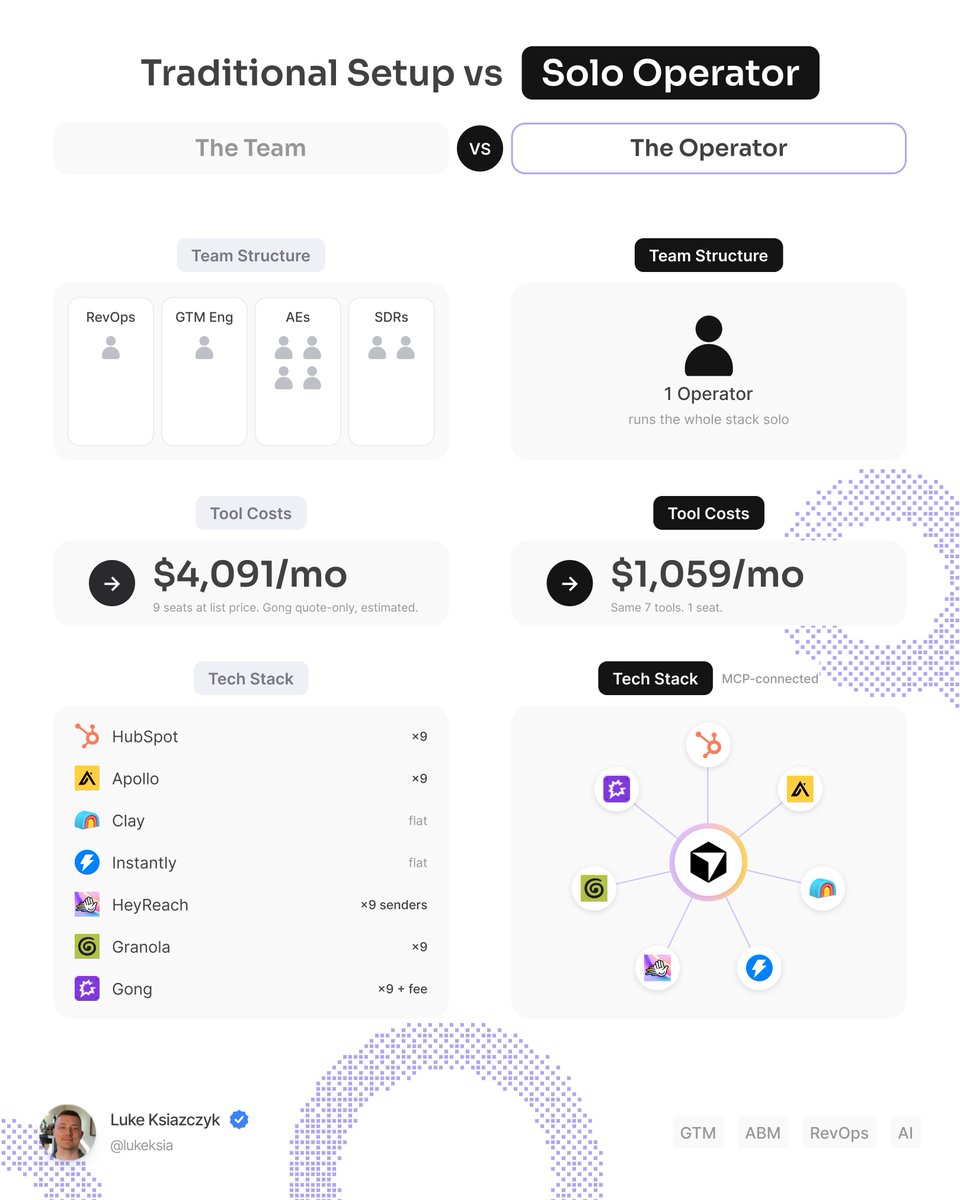
One person now runs a seven-tool GTM stack.
The stack is identical to the nine-seat version. What changed is what sits between the tools.
A seat is rarely just software access. It is mostly a person to move things between systems: pulling a list out of one tool, pushing it into the next, keeping the CRM honest about what actually happened.
That middle layer is the part AI is genuinely good at.
Here is the same setup, run two ways:
1️⃣ The traditional version
Seven tools, nine seats, someone in front of each one. RevOps, a GTM engineer, AEs and SDRs, all working in separate tabs.
Cost: $4,091 a month at list price.
2️⃣ The AI-native version
The same seven tools, wired into one control surface through MCP. HubSpot, Apollo, Clay, Instantly, HeyReach, Granola and Gong all reachable from one place, so the model works inside them instead of someone copying rows between them.
Cost: $1,059 a month on one seat.
Being straight about the numbers: Clay and Instantly are workspace-priced, so they cost the same at one seat as at nine. Gong is quote-only, so that line is an estimate.
If you are costing out an AI-native GTM setup, start with which of your tools expose an API or an MCP server. The ones that do not are exactly where the headcount comes back.
Full breakdown in the graphic 👇