It’s out! 📚
First Steps With Linux is finally available in paperback.
And I have to admit…
Turns out I accidentally wrote a bible.
Holding the finished book in my hands for the first time was a surreal feeling.
If you’ve been waiting for a physical copy, it’s here:
https://t.co/SOu6yw6BGz
Linux was never meant to dominate the world. It was just a solution for one broke student. That solution now runs the global economy and most people still don't know its name.
Sometimes I think I need more shoes and clothes for work, then I remember my manager drives luxury cars and has been rocking the same pair of shoes and two pairs of jeans for almost a year now.
Ubuntu 26.10's curl now checks whether a site's TLS certificate has been revoked, thanks to a new Rust tool called upki.
Background: Firefox and Chrome have their own systems for catching revoked certificates, but command-line tools, package managers and language runtimes on Linux mostly never check. upki, from the rustls project, brings Mozilla's CRLite approach to the whole OS. A compact revocation list syncs locally every few hours, so lookups happen offline without telling a certificate authority which sites you visit.
Canonical's Julian Andres Klode told curl maintainer Daniel Stenberg on Mastodon that the 26.10 patch makes curl pass upki_openssl_verify_callback to OpenSSL, and that next cycle "we're working on patch that makes libssl dlopen() the upki-openssl library." Because it landed late, 26.10 only enables it for curl. Ubuntu 27.04 plans to put it in OpenSSL so every OpenSSL-based app gets the check.
You can try it by hand: curl -sw '%{certs}' https://t.co/9Rm5fujBV4 | upki revocation check
The creator of CentOS and Rocky Linux has turned Ginux, his AI-built kernel experiment, from a standalone kernel into a "userspace kernel" that runs on top of Linux.
Background: in October Gregory Kurtzer published Ginux, a Rust x86-64 kernel of roughly 139,000 lines produced over 11 days by one persistent OpenAI Codex task working under his direction. It booted through UEFI and brought Rocky Linux 10's systemd up to https://t.co/mASWJbpKtH inside QEMU.
The README now says that research phase is complete and preserved on a bootable-kernel branch. Ginux runs as a normal Linux process and intercepts every syscall from a managed Rocky Linux instance, choosing to emulate it, mediate it or deny it. Kurtzer quotes Linus Torvalds, "And we simply do not break user space," then flips it: "Linux must not break userspace; Ginux is designed to break the full Linux ABI guarantee deliberately and selectively."
The goal is for each instance to get only the syscalls and devices its workload needs. The repo sits at about 500 stars and Apache 2.0, with commits still landing today.
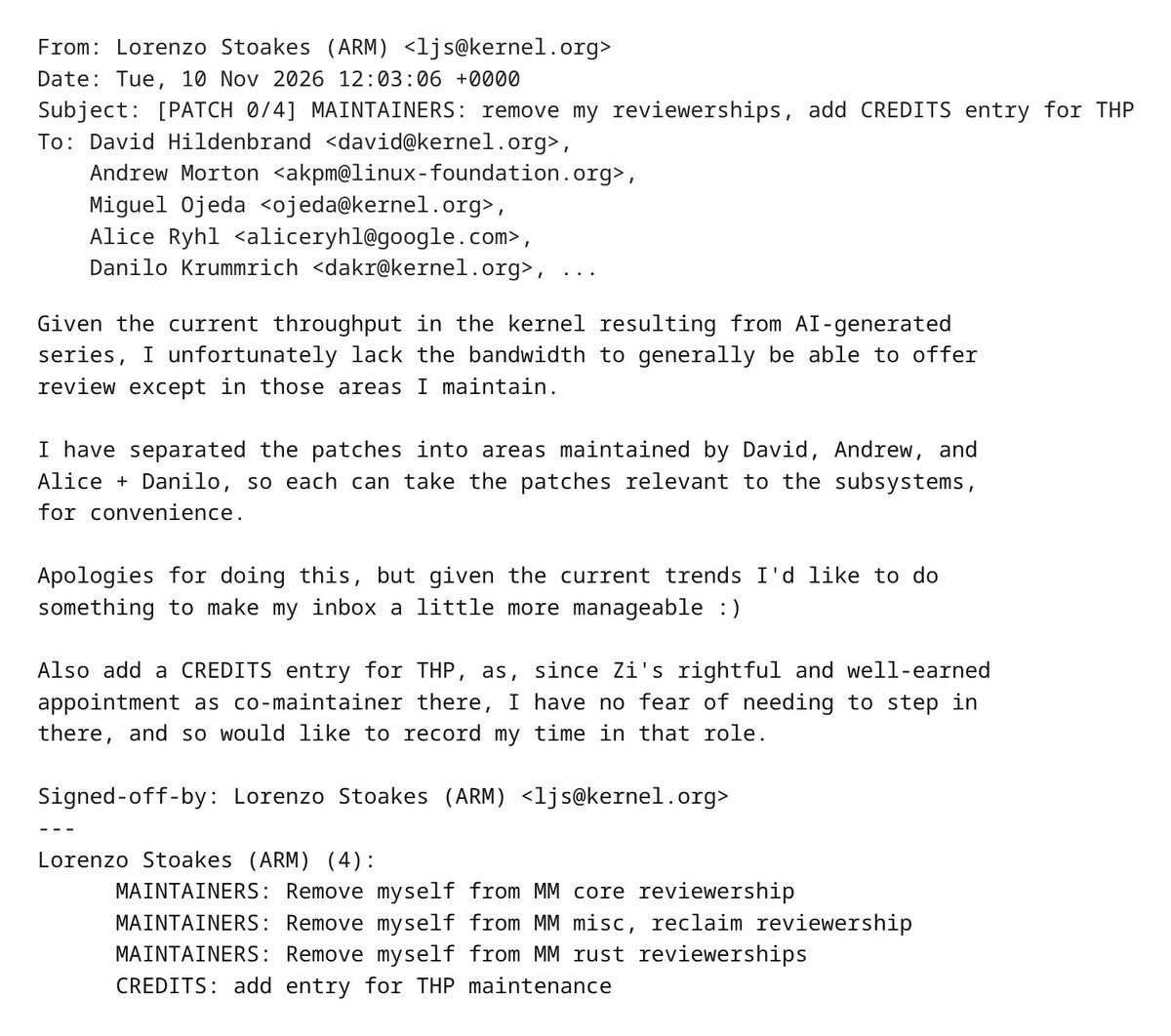
A longtime Linux kernel developer is stepping back from code review, and he's blaming the flood of AI-generated patches.
Lorenzo Stoakes works on memory management at Arm, has contributed to the kernel since 2014, and literally wrote the book on it, "The Linux Memory Manager." Today he sent patches dropping himself as a reviewer for the kernel's memory management, core, misc and Rust areas.
His reason, in his own words: "Given the current throughput in the kernel resulting from AI-generated series, I unfortunately lack the bandwidth to generally be able to offer review except in those areas I maintain."
He split the patches so David Hildenbrand, Andrew Morton, and Alice Ryhl and Danilo Krummrich can each pick up the ones for their areas, and he added: "Apologies for doing this, but given the current trends I'd like to do something to make my inbox a little more manageable :)"
He's still a maintainer for the code he owns. This also isn't his first step back: in August he gave up co-maintaining transparent huge pages, saying "the sheer throughput and attention required has reached a point where it's become infeasible for me time-wise."