Three other teams have also announced proofs this week. Our proof is short and purely information theoretic. It was obtained independently of these works.
Ky & Tran (https://t.co/4UKaqjfJ7e): Fourier theoretic
Chen et al. (https://t.co/t5M1E44Zfd): computer-assisted differential method
Mahdavifar & Beirami (https://t.co/IbCJm9TBz6): differential method + Fourier analysis
With my colleague Dimiter Kramer at @DeepInfra, we proved the Courtade–Kumar conjecture. We show that a delicate refinement of the conjecture, incorporating the output bias, admits an induction on dimension.
Paper: https://t.co/YjB9xUL9Eh
Take a uniform random bit string X. Flip each bit independently with probability 10% to get Y. Looking at Y alone, output one bit B that reveals as much information as possible about X.
The conjecture says that the best you can is to output the first bit of Y.
Three other teams have also announced proofs this week. Our proof is short and purely information theoretic. It was obtained independently of these works.
Ky & Tran (https://t.co/4UKaqjfJ7e): Fourier/entropy methods
Chen et al. (https://t.co/t5M1E44Zfd): computer-assisted differential method
Mahdavifar & Beirami (https://t.co/IbCJm9TBz6): entropy flow + Fourier analysis
Our paper (https://t.co/61QEkjHljH): a refinement to CK + information theory
Take a uniform random bit string X. Flip each bit independently with probability 10% to get Y. Looking at Y, output one bit B that reveals as much information as possible about X.
The conjecture says that outputting the first bit of Y is optimal. We prove this is true
Three other teams have also announced proofs this week. Our proof is short and purely information theoretic. It was obtained independently of these works.
Ky & Tran (https://t.co/4UKaqjfJ7e): Fourier analysis
Chen et al. (https://t.co/t5M1E44Zfd): computer-assisted differential method
Mahdavifar & Beirami (https://t.co/IbCJm9TBz6): differential method + Fourier analysis
Our paper (https://t.co/61QEkjHljH): a refinement of CK which admits induction + information theory
Hey #KimlikDAO fam 🪁
🎟️Join us tomorrow at METU Blockchain Days! (@DaysBlockchain)
🫂Visit the KimlikDAO booth, and let's explore the project together. We're excited to connect with you! ✨
Hi #KimlikDAO fam 🪁,
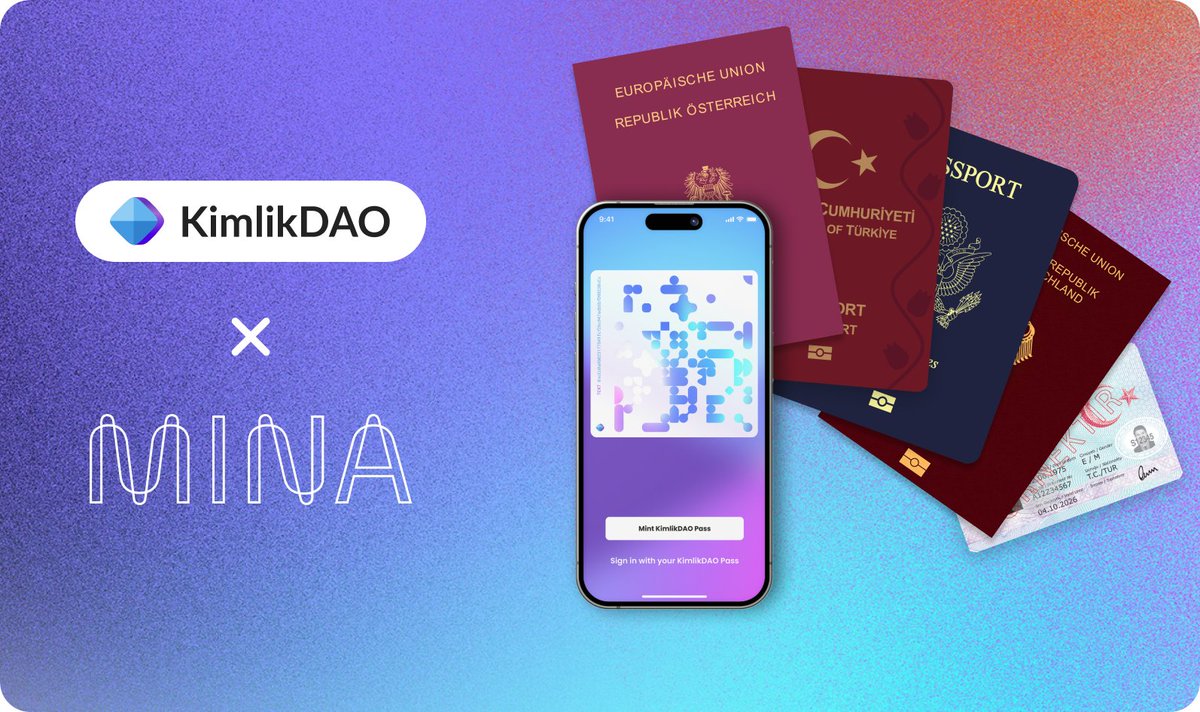
Exciting news! 🌟 We are thrilled to announce that we have secured 60,000 $MINA in funding from @MinaFoundation for our new zero-knowledge passport minting protocol 🎉
Get ready to mint your KimlikDAO Pass using your passport 📱
👨💻 We've proposed an RFC to bring SHA512 to @o1_labs' o1js. This is a big step towards minting our KimlikDAO Pass directly from your passport!
💡 Passports issued by Finland, Türkiye, and more use SHA512.
🔗 Dive into the details & share your thoughts: https://t.co/yEA4FFjwyp
$Mina @MinaProtocol #Selfsovereignidentity
🇹🇷
KimlikDAO'da Developer olan Mert Sağlam Blockchain Days'te bizlerle olacak!
🇬🇧
Mert Sağlam, Developer at KimlikDAO, will be with us at Blockchain Days!
@szaglam@KimlikDAO
1/ This is accurate, but I firmly believe that zkEVM is a non-goal.
The solc optimizer is already a weak point in the Solidity tooling. Give me a better compiler that compiles to whatever VM and I'm happier.
“zkEVM” has been abused in so many marketing materials.
However, there are only two zkEVM that achieves bytecode level compatibility and has a full proof on mainnet.
@Scroll_ZKP and @0xPolygon zkEVM
3/ If someone can come up with a zk friendly VM and formal verification language that compiles to it, I believe that zkEVM discussions will become obsolete
2/ Even Solidity itself is wide open for disruption: We 100% need a formal verification friendly language like Dafny (https://t.co/qugTyxF48Y)
If I'm able to create a CDP in a formally verified protocol, I'm not going to use anything else.
1/ Using our new protocol, you will be able to mint a KimlikDAO Pass by scanning your passport's NFC chip💥
Only the photo from the passport chip is transmitted out of your device and compared against live video.
This is to ensure that only you can mint your KimlikDAO Pass 🔐