https://t.co/pSgmtPKYs4 heres the story from ABC also these orbs is what the pentagon has no idea what they are and what others have been seeing worldwide! they can be numerous colors. white, multi color, orange, blue, red what if there all different species?
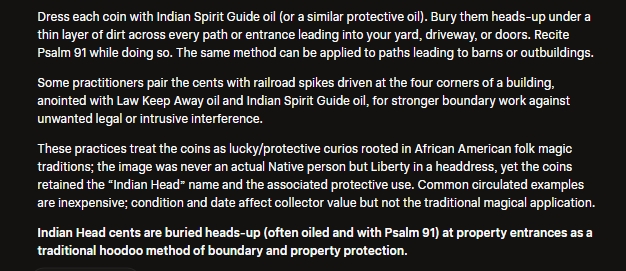
While placing the coins (or spikes), speak your intention aloud or recite Psalm 91, asking the spirit of Black Hawk, the Indian Scout to watch the boundaries and keep unwanted people or trouble away. That is the core traditional method.
Drive a railroad spike into the ground at each of the four corners of the property or building. Place a dressed Indian Head cent on top of (or against) each spike. Some workers also dress the spikes themselves with protective oil.
Jeffrey Epstein was asked if his money was dirty. He said no, because he had earned it. Then Steve Bannon asked him a question that produced one of the most chilling answers in the newly released footage: “Do you think you’re the devil himself?”
Epstein smiled.
“No, but I do have a good mirror.”
The exchange came from a lengthy interview filmed around 2019, reportedly intended for a documentary about Epstein and his connections to the global elite. The footage later became public through the US Department of Justice’s release of Epstein-related records.
But the most revealing part wasn’t the joke. It was how Epstein tried to defend the money behind his lifestyle.
Bannon asked him directly: “Is your money dirty money?”
“No, it’s not,” Epstein replied.
When Bannon pressed him on why, Epstein’s answer was simple: he had earned it.
Bannon challenged that explanation, pointing out that Epstein had made money advising wealthy and powerful people, some of whom pursued their own interests at enormous cost to others.
Epstein didn’t accept the premise that this made his fortune dirty. Instead, he shifted the conversation toward philanthropy.
He brought up money he said he had donated to help fund polio vaccinations in Pakistan and India. His argument was essentially this: if his money helped save children from disease, should the people receiving that help reject it because of who provided the funds?
It was a calculated moral argument. Rather than staying focused on his own conduct, Epstein asked the audience to consider the good that money could accomplish.
Then the conversation turned to his status as a sex offender.
Bannon asked what kind of sexual predator he was. Epstein described himself as “Tier 1,” which he characterized as the lowest level. Bannon followed up with a blunt question: “But a criminal?”
“Yes,” Epstein answered.
And then came the devil question.
Bannon asked whether Epstein thought he was the devil himself. Epstein delivered the line about having a “good mirror,” briefly treating the question like a joke. But when Bannon continued, Epstein said the devil scared him.
The exchange is disturbing not because it proves anything supernatural about Epstein, but because of the contrast: he could acknowledge being a criminal while still defending his fortune and redirecting the discussion toward the charitable uses of his money.
That distinction matters. Money can fund useful projects without erasing the conduct of the person who provided it. And a person’s ability to make money legally does not automatically settle the moral questions surrounding how they earned it, whom they served, or what they did.
Epstein’s answer was designed to make the question about money sound simple. The interview itself showed how quickly the conversation became anything but simple.
If someone uses their wealth to fund good causes, does that change how we should judge the person who earned it or can philanthropy become a way to distract from the truth?
He blamed his autism and told a court he was desensitised by Andrew Tate – now he’s dodged jail time after making fake porn using AI.
📌 READ MORE: https://t.co/abLfzjGtOK
This happened in Canada in 2008
The victim was Tim McLean. It happened on a greyhound bus.
The perpetrator, Vince Li, was found not guilty by reason of insanity.
He served about seven years in an institution, was released with absolute discharge, no further monitoring. He changed his name to Will Baker.
@takonotron@cheeseh013 Some of these accounts got suspended if you click on them thanks X🙏, these lame romance accounts ask people to message them only to ask you to join another site for pay to talk once a user does dm, they may talk in dms for a bit but then they send a link, keep up the good work
Bill Cosby thought the interview was over when he asked an AP reporter to make sure his answer about the rape allegations never aired. His microphone was still on, and the AP released the tape.
It was November 2014, and he was there to talk about his art collection. A few weeks earlier a comedian had called him a rapist on stage, the clip went viral, and accusations that had been around for years were news again.
So the reporter asked. Cosby smiled and shook his head. "No, no, we don't answer that." His wife Camille sat next to him.
Then the interview ended. Both of them were still wearing microphones, and the camera was still running.
In the video below Cosby appeals to the reporter's "integrity" and says he would appreciate it if the footage was "scuttled."
"I think if you want to consider yourself to be serious, that it will not appear anywhere."
Two weeks later the tape was everywhere. More than 60 women came forward. In a 2005 deposition he had admitted getting Quaaludes to give to women he wanted to have sex with. He had paid one accuser about $3.4 million.
In 2018 a jury convicted him of drugging and assaulting her. He got 3 to 10 years.
In 2021 Pennsylvania's Supreme Court threw out the conviction, because a prosecutor had promised back in 2005 not to charge him. He walked out that day.
He was never declared innocent. He just went home. Was the court right to free him over a promise made 16 years earlier?