Why I’m Skeptical of Creator Fee Structures
Personally, I have become increasingly skeptical of the creator fee structures used by recent launchpads.
NOXA
Tokens launched on NOXA, such as CashCat, Tendies, Juggernaut, and others, generate fees whenever trading takes place, and a significant portion of those fees is distributed to the creator.
As far as I understand, the trading fee is around 1%, and creators receive their share in WETH.
The fact that the fees are paid in WETH rather than in the project’s own token is at least somewhat better, because it does not create direct sell pressure on the token itself.
However, as long as trading volume continues, creators can keep earning revenue, while it is not always clear what additional value they are required to provide in return.
Longxyz
I am even more skeptical of Longxyz.
Based on my understanding of its V1 structure, the total trading fee is around 1.5% to 1.7%, and roughly half of the fees generated are distributed to the creator.
What concerns me most is that these rewards are paid in the project’s own token rather than in ETH or WETH.
Of course, I cannot claim that every developer immediately sells all the tokens they receive. Some may hold them, burn them, or use them to fund the project.
However, from an economic perspective, if creators continuously receive rewards in the project’s own token, it seems more likely that they will eventually convert at least part of those rewards into ETH or stablecoins rather than burn the entire amount.
As a result, this structure continuously distributes new token supply to creators whenever trading occurs, which can create ongoing potential sell pressure.
PONS
PONS V1 has a similar issue.
According to the publicly known structure, 70% of the trading fees are distributed to the creator, while the remaining 30% goes to the protocol. PONS has also recently referred to this 70/30 fee split.
However, unlike Longxyz, PONS pays creator fees in WETH or another pairing asset rather than in the project’s own token.
This means that creator rewards do not directly create inflation or sell pressure on the token itself.
Even so, I still believe that allowing creators to continuously receive 70% of all trading fees is an extremely high allocation.
What I See as the Main Problems
I do not believe that creator fees are inherently wrong.
It is reasonable for creators who launch a project and help build its initial liquidity and community to receive some form of compensation.
The problems, in my view, are the following.
First, the percentage allocated to creators is often excessively high.
Second, these fees can continue indefinitely in proportion to trading volume, even though the creator’s ongoing responsibilities or obligations are often unclear.
Third, when fees are paid in the project’s own token, they can create continuous potential sell pressure.
Fourth, it is often difficult to verify whether the fees are actually being used for development, liquidity provision, buybacks, burns, marketing, or other activities that benefit the project.
Ultimately, traders pay substantial fees every time they buy and sell, and a large portion of those fees is continuously transferred to creators.
Meanwhile, the actual value created with that revenue varies significantly from project to project.
If I’ve misunderstood anything, feel free to correct me in the comments.
tldr this is how we build the onchain blackrock.
working with the $AI dev to get this pilot later today.
we should see $NVDA stock (and more..) accumulated in pool to the degree it will be comparable with the LP size
this is pretty cool because it creates interesting "arb" even when pair market goes volatile you can always hedge with "static" stock treasury that is not effected by the market activity and can only grow over time
auto burns we added to the fee split will only accelerate more value accrual(majority of current fees)
more trust as we take a strong community approach.
LONG will help to bootstrap some other areas we want to expand on this is the first step.
not all LONG assets will have to use it but we will roll it out as an option.
LONG.
Rialto is a super cracked team.
I've been building for a long time this is the first time I had to compose with PropAMMs
If you're looking to gain deeper insights recommening contact them. Also happy to provide some insights over DMs
LONG.
Attackers have frontier AI. Defenders need a frontier AI ecosystem—the best open and closed models, force-multiplied by a global community.
During the Hugging Face incident, closed AI blocked essential forensics. An open-weight frontier model helped contain the intrusion.
That’s why we created the Open Secure AI Alliance.
my wallet just got an inbox 📥
@evmdotchat — messaging for every EVM wallet.
one address. every chain. one inbox.
code: EVM-S8HW → https://t.co/fslQd0Nq1k
https://t.co/LLN0yI5qjF
I genuinely don’t fucking understand this.
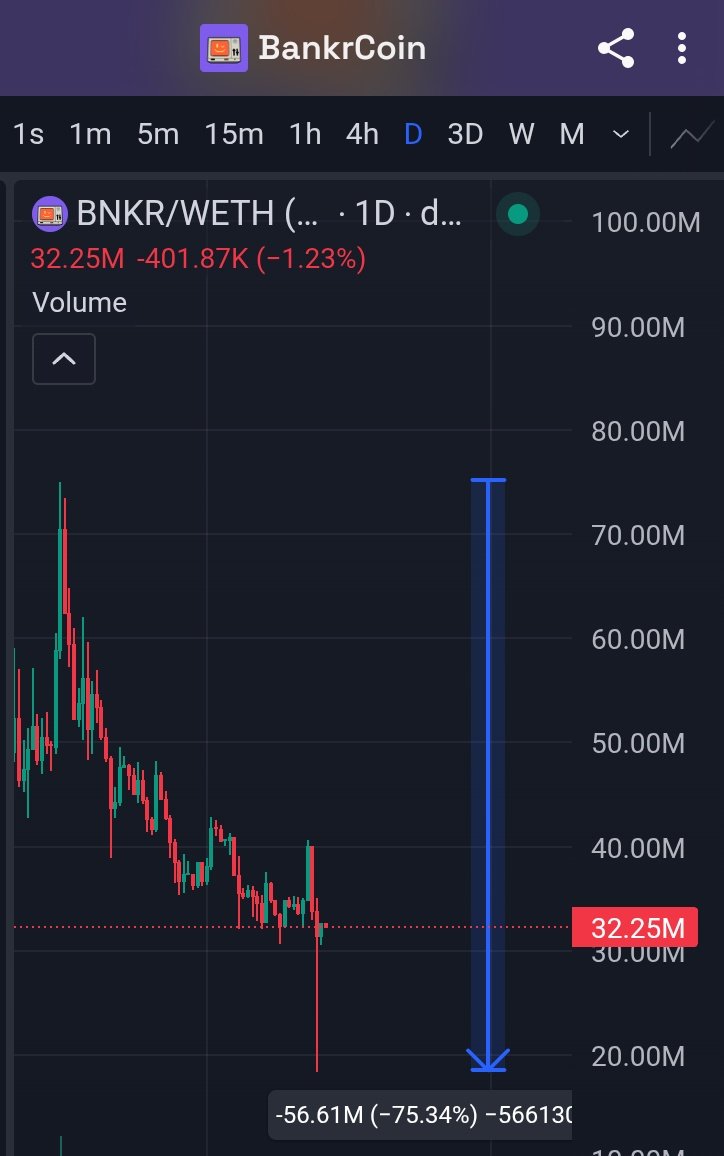
Why does nobody ever talk about the price of $BNKR?
This is obviously a massive problem.
@bankrbot
The token price does nothing but go down.
The project is generating revenue.
The product itself seems to be doing well.
And yet the token keeps bleeding.
But the holders keep saying everything is fine.
They say it’s fine even if the price keeps collapsing.
Are you all genuinely fucking stupid?
Look at Virtuals.
When tokens launch there, $VIRTUAL is required as part of the LP process. That directly creates demand for the token.
Look at $PONS.
They actually give a shit about promoting and supporting their token.
And then look at $BNKR.
Now tell me who the real problem is.
Today we’ve executed a series of gradual buybacks on our top pair, $AI, resulting in the permanent burn of 0.2% of the total supply.
This brings us to more than $30K in total stock distributions and stock dividends delivered so far.
What’s next?
As LONG pairs grow in value and liquidity, an entirely new design space is unlocked. Deflationary mechanisms are one area we’re exploring, as a lower circulating supply gives the community greater ownership over the stock permanently locked in the pool.
We’re working on a series of protocol updates planned to go live next week, enabling automated fee-related actions, greater exposure to stocks, and stronger community ownership.
We remain committed to supporting our early adopters across assets and communities.
We will report both automated and manual burn in our dashboard.
LONG.