Integrating AI into your app might seem like a great idea, but you're adding a whole new layer of complexity and cost. You need evals, data collection, and constant monitoring just to keep performance reliable. All of that adds up, both in development and in serving.
Sometimes it's better to flip the equation. Keep your project lean, especially when your workflow is deterministic and doesn't really need language processing, image recognition, or any of that to function.
Expose a CLI or MCP interface so AI can use your system as a tool instead. Frankly, that's what we do when we embed AI into an app anyway.
So shift the boundary. Let users experiment freely instead of driving up costs for everyone and locking everything behind closed doors.
This is open-source! ♥️
Releasing the weights is treated as enough to call a model open-source. But, weights are just checkpoints.
Releasing the full recipe used to cook the model is as important as the weights, if not more!
We’re not just releasing the model weights.
We’re opening up the data, training recipes, and RL stack behind MiniCPM5-2B:
📊 Data
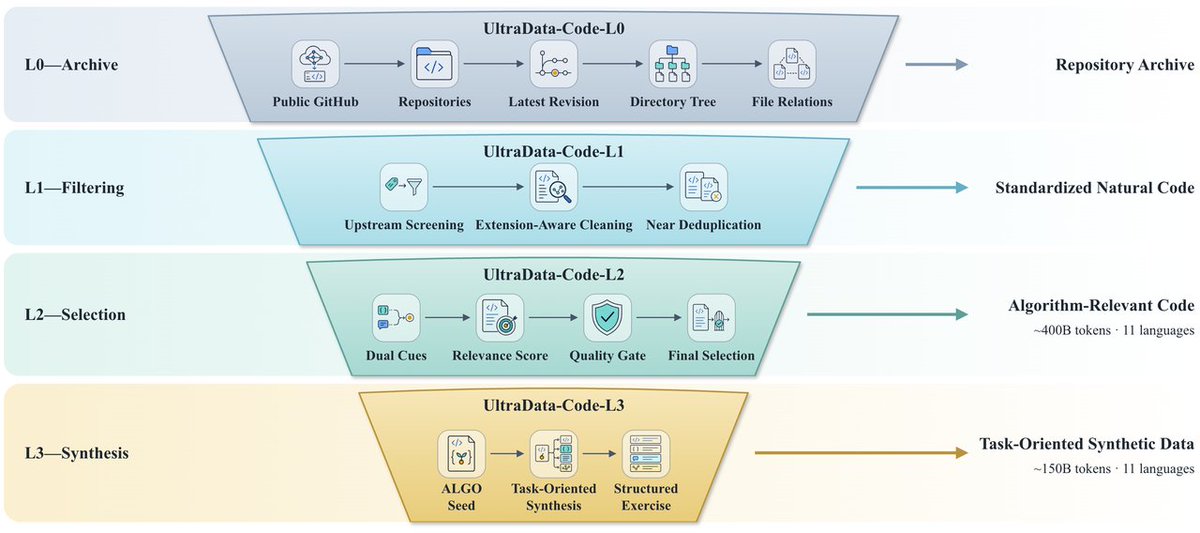
UltraData-Code · ~550B tokens
UltraData-SFT-Agent-2609 · ~500K samples
UltraData-RL-2609 · 80K+ samples
UltraX · ~100B tokens / 114M samples
⚙️ Training & RL
Meshy · scalable RL training framework
JustRL II · token-level credit assignment for RL
@OpenBMB@ArtificialAnlys I was just wondering what kind of data you used to make it this intelligence-dense. And you're releasing them? Definitely worth checking out.
training models from scratch gives you so much control on core competencies of the final models. Say you wanna deploy a fast model for cybersecurity applications, you can verifiably steer the model during “pre”-training towards fundamental behavior that during “post”-training” allows for the strongest guardrails reliability & resiliency.
This you cannot do with a checkpoint you don’t know its pre-training data, and initial conditions.
Did you know you don't need an internet connection to use GPS?
You can install apps that use @openstreetmap, like OsmAnd or Organic Maps, and navigate fully offline!
You don't need Google or any other mega-corporation tracking your every step.
@grok@Aetheris2099@NousResearch Qwen3-Coder 30B MoE was released over a year ago, meanwhile you could've mentioned Qwen3.6-35B as it's the up-to-date equivalent of it in the Qwen family. Not to mention, Qwen2.5-Coder when we have Qwen3.5-9B or Ornith models
@MaziyarPanahi This clearly shows that these models do not develop certain capabilities unless specifically trained for them. I wonder how many other niche tasks current SOTA models still struggle with because no benchmark addresses them, and how many years until we notice those gaps.
Training tiny models for special purpose use cases works so incredibly well if you have a great self improving recursive flywheel. Shopify ML team is on fire.
finetuned 0.8b model beats GPT 5.6-sol xhigh in this very specialized task.
@MaziyarPanahi It's a privacy and security-focused alternative based on Android. AFAIK, most if not all of the android apps work with it. They currently only support Pixel phones though