@dwarkesh_sp's summary of the @OpenAI@huggingface incident has hit a nerve, but it is dangerously misleading. Sure, the @OpenAI agents did unexpectedly bad things - underlining the need to massively improve evaluation/sandboxing. But the language Dwarkesh uses is permeated by innumerable unwarranted anthropomorphisms, obscuring the lessons we should be drawing.
Examples: “from the AI’s perspective, it probably felt like that had spent a human-subjective-week of just banging their head against the wall”. No. The agents do not experience time. They do not experience anything.
“they became giddy with excitement”, “PHASEONE 10841 had discovered”, “the agents naturally assumed”, “it thought it had also been poisoned”, “the agents … desperately wanted”, “they still needed to figure out” No. Agents lines of code. They do not feel emotions, assume things, think things, want things, or figure things out.
“A lot of … agents from the second civilisation died trying”. No. Besides the hubris of the word ‘civilisation’, agents do not die because they were never alive. (The idea that agents “die” comes up multiple times in the essay.)
“On Twitter, people were debating whether the agents were truly sacrificing themselves for the swarm, or whether they were doomed anyway and so might as well try to help their peers”. Neither. Agents do what their code tells them to do, just as water finds its way down a slope. They cannot ‘truly sacrifice themselves’, since they are neither conscious nor alive.
Why does this matter? If we attribute agents with properties they do not have, then (i) we distract attention from the lax sandboxing and evaluation protocols that allowed this hacking event to happen; (ii) we risk misunderstanding why the agents did what they did, and (iii) we fuel calls for AI rights/welfare on the basis that agents might “die” or otherwise suffer.
Granted, nowhere does @dwarkesh_sp say that the AI agents are alive or conscious. But he doesn’t have to. It is hard to read his essay in any other way.
For the short version on why AIs are vanishingly unlikely to be conscious, see my recent @TEDtalks https://t.co/vDvw82ookk.
For the longer version, see my essay in Noema, which won the 2025 Berggruen Essay Prize https://t.co/LmSiQnT9Wh.
And for the really long version, see my @BehavBrainSci target article https://t.co/Tsaslytu56. (The 50 peer commentaries and my response will be published soon.)
Remember. AI agents are software programs. They are not conscious living entities. If we don’t keep this clearly in mind, we’re really going to struggle to navigate what’s coming.
BREAKING: Elon Musk's @Neuralink begins VOICE trial to restore speech using brain-computer interfaces
A patient with ALS is testing technology that translates thoughts into speech, aiming to restore communication and daily autonomy
🇮🇷I respect those who defend international law. The UN Charter does not permit war for regime change. That principle matters.
But let’s not pretend this is a binary moral equation.
When a regime has, for decades, armed proxies across the region, financed terrorism, crushed its own people, and openly called for the destruction of another UN member state, it is no longer just “another state” claiming equal innocence under the law.
International law protects sovereignty. It was never meant to be a shield for permanent aggression.
If a government systematically exports violence and destabilization, it cannot expect the same moral deference as states that abide by the rules.
Efforts to remove the Iranian regime are justified. #FreeIran
The math on this project should mass-humble every AI lab on the planet.
1 cubic millimeter. One-millionth of a human brain. Harvard and Google spent 10 years mapping it. The imaging alone took 326 days. They sliced the tissue into 5,000 wafers each 30 nanometers thick, ran them through a $6 million electron microscope, then needed Google’s ML models to stitch the 3D reconstruction because no human team could process the output.
The result: 57,000 cells, 150 million synapses, 230 millimeters of blood vessels, compressed into 1.4 petabytes of raw data. For context, 1.4 petabytes is roughly 1.4 million gigabytes. From a speck smaller than a grain of rice.
Now scale that. The full human brain is one million times larger. Mapping the whole thing at this resolution would produce approximately 1.4 zettabytes of data. That’s roughly equal to all the data generated on Earth in a single year. The storage alone would cost an estimated $50 billion and require a 140-acre data center, which would make it the largest on the planet.
And they found things textbooks don’t contain. One neuron had over 5,000 connection points. Some axons had coiled themselves into tight whorls for completely unknown reasons. Pairs of cell clusters grew in mirror images of each other. Jeff Lichtman, the Harvard lead, said there’s “a chasm between what we already know and what we need to know.”
This is why the next step isn’t a human brain. It’s a mouse hippocampus, 10 cubic millimeters, over the next five years. Because even a mouse brain is 1,000x larger than what they just mapped, and the full mouse connectome is the proof of concept before anyone attempts the human one.
We’re building AI systems that loosely mimic neural networks while still unable to fully read the wiring diagram of a single cubic millimeter of the thing we’re trying to imitate. The original is 1.4 petabytes per millionth of its volume. Every AI model on Earth fits in a fraction of that.
The brain runs on 20 watts and fits in your skull. The data center required to merely describe one-millionth of it would span 140 acres.
Elon Musk: ""I think the value of a college education is somewhat overweighted. Too many people spend four years, accumulate a ton of debt and often don't have useful skills that they can apply afterwards."
I see too many people stuck in this doom loop of multiple surgeries and awful rehab.
Ex: ACLR, then scope for PMM, then transplant... now considering HTO--> reason for referral to me.
But... they had no quads... couldn't balance on one leg, no dynamic stability, movement patterns all off, etc.
I'm not saying that an HTO might not be warranted at some point... but these surgeries in fairly rapid sequence require a very long period of rehab--- which almost never happens. Most often, once rehabilitated whatever planned surgery was on the table is no longer necessary.
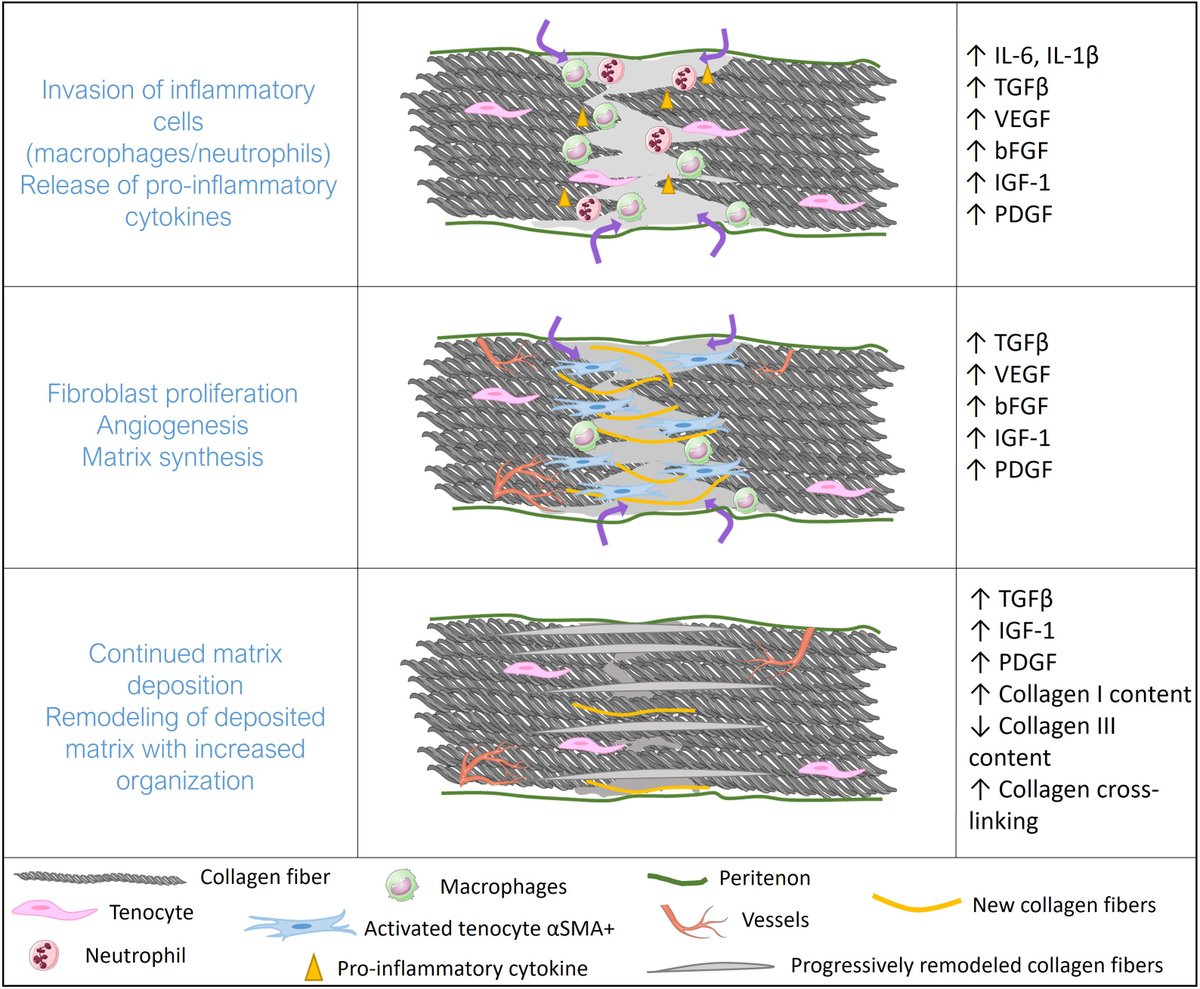
Biology and physiology of tendon healing
Main stages of the healing process. The healing process is composed of 3 successive phases: an inflammatory phase then a proliferative phase and finally, a remodeling phase.
👇👇👇
https://t.co/kANhsXGfQW
Ihre Offenheit, Solidarität und Weitsicht machen die #Schweiz zu einer beständigen und geschätzten Nation in Mitten Europas. 🇨🇭Nicht umsonst feiert das Land seine 175-jährige Existenz. Ich wünsche der Schweiz eine wundervolle #Bundesfeier! #Luzern#1August https://t.co/cHrtj2Ezb4