@NbergWX What larger-scale signals are the AI models picking up on that influence the track eastward that our old school models aren’t budging on? Stronger ridging/warming?
“Wisdom of the crowd” effect proven on daily weather markets. Goes to show how powerful these prediction markets can be on something that remains unpredictable!
Now can we assimilate these probabilities into the global ensembles..?
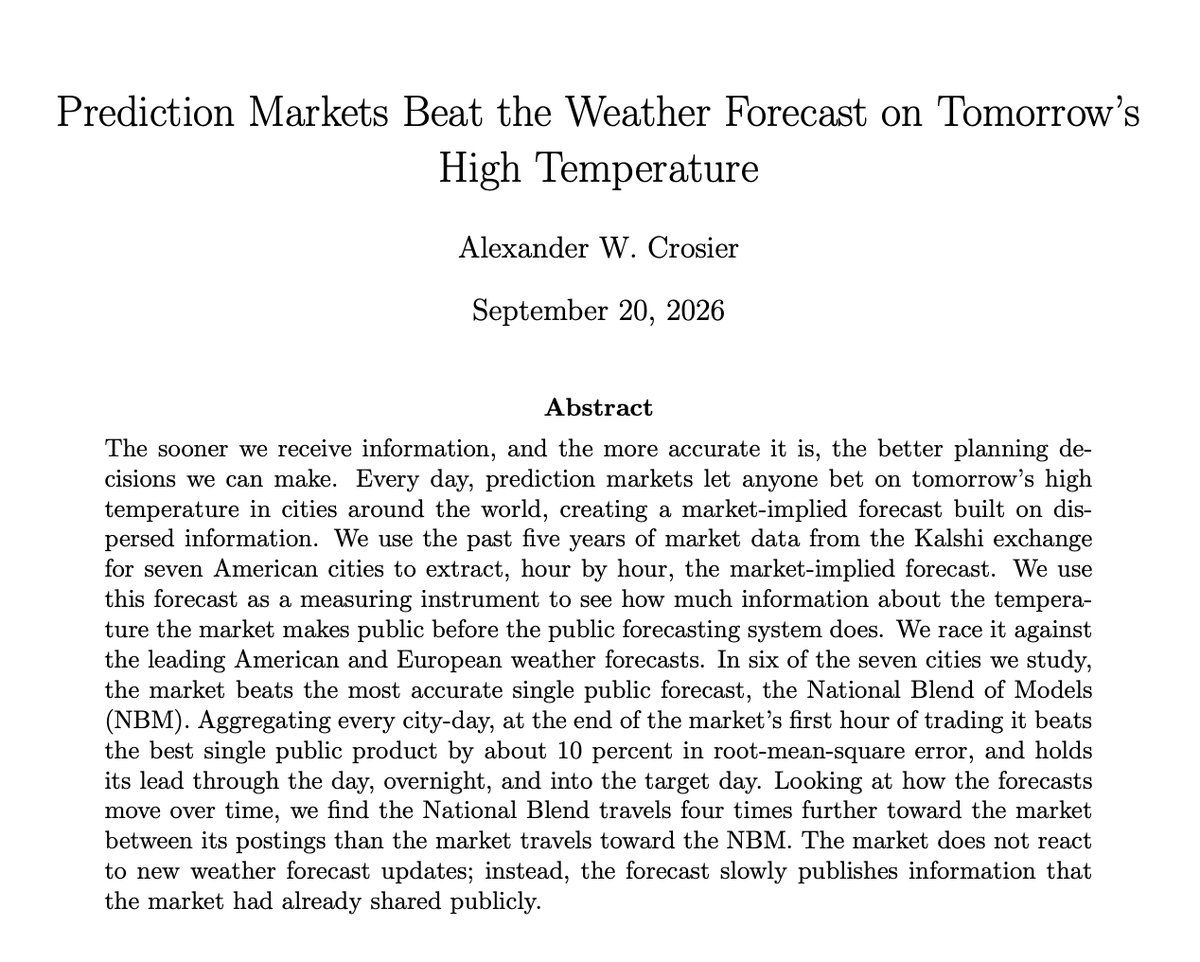
A new paper from Alexander W. Crosier examines Kalshi’s next-day weather markets.
The findings:
• Kalshi beats the most accurate public forecast, the National Blend of Models (NBM), in six of seven cities studied.
• Kalshi outperforms NBM by 10% a day ahead.
• Kalshi beats a weighted blend of public forecasts at every horizon tested: day ahead, evening before, and morning of.
From daily plans to decisions about flights, farming, and energy supply, better weather forecasts help people make better decisions.
That’s the value of price discovery on an open exchange: trading produces useful information for everyone.
How do traders improve on forecasts built by meteorologists? The paper explains:
“Traders do not need to make a better weather model than the meteorologists. They only need to start from what has been published and add anything that the weather guidance missed.”
Markets give people a financial incentive to be right. Traders build sophisticated models, analyze public forecasts, and seek out information others have missed. They compete to identify and offer better prices, incorporating that information into the market’s forecast.
The benefits extend to everyone: the resulting forecast is available to people who never place a trade. ~75% of people who use Kalshi come for the forecasts, not to trade.
The Weather Company, Fox Weather, and thousands of everyday people are using Kalshi’s weather data: markets turn competing analyses into information people can use.
Read the full paper here: https://t.co/fszY72EIPG