Grok Bot by Elon Musk just replaced a $294,000 Wall Street research desk. Six AI agents, $200 a month, doing the work BlackRock pays people six figures for.
The guy who built it published every prompt.
What that desk cost before the bots:
> $27,000 a year for the Bloomberg terminal
> $22,000 for Refinitiv
> $50,000 for sell-side research
> $15,000 for AlphaSense
> $180,000 for the junior analyst who reads all of it until 2am so somebody senior can trade on it before the open
$294,000 a year. The agents cost $2,400. Same brief, 122 times cheaper, and it is there before the open.
Six agents split that desk. Each one gets its own computer in the cloud, and they all write into the same vault.
> FILINGS reads every 10-K, 10-Q and 8-K on a 100-ticker watchlist overnight and flags the ugly parts: going concern language, auditor changes, restatements
> EARNINGS reads the call transcript within 24 hours and tells you if the CFO got quieter than he was last quarter
> SECTOR does one pass per sector and picks up the rule change nobody read
> INSIDER catches Form 4 buys over $1 million and new positions from Two Sigma, Third Point and D.E. Shaw the day the 13Fs land
> CHATTER counts mentions on X and flags any ticker three standard deviations louder than its own 30-day normal
> CHIEF OF STAFF reads the other five at 5:30am, bins anything only one of them flagged, and emails you the ranked brief at 6
One analyst covers 30 names. Six agents cover 3,000 and finish before the open.
You show them the job once. They repeat it every night with your laptop shut.
Every research floor on Wall Street was priced on reading being slow and people being expensive. Both of those stopped being true this month.
So you wake up, read for five minutes, and know what moved on every name you hold. That used to be somebody's entire job, and he got a bonus for it.
The article below is the step by step guide to building the whole AI trading machine. Save & read it, you will want it open while you build.
I feel like AI investing is simpler than what people expect.
Because $NVDA + Jensen literally tells everyone what's coming.
But somehow. Almost every. single. time. Markets dismiss it until it actually happens?
Be Nvidia in 2025: Buys up EML and laser capacity.
Markets dismissing it: "Photonics is a bubble and like quantum! ____ company is a scam with shady management"
1 year later: $LITE +678%, $AAOI +475.12%, $COHR +260.7%, $AXTI +3,843.9%.
_
Nvidia in 2026:
Buys up CW/EML capacity with LTAs. 800V shift. Extraordinary explicit about CPO shift. States Physical AI as the next theme.
Markets now: "CW players are meme stocks! 800v, CPO is not coming anytime soon, Humanoids are not profitable!"
Yeah... We'll see what happens in 2027.
I think I'm putting my money on Jensen/Nvidia as the leading indicator.
$SNDK growth numbers are absolute insane:
• Data center +1,298%
• Edge +392%
• Free cash flow +14,355%
With gross margins improving from 26% in Q2'25 to 85% in Q2'26.
Yes, I'm still bullish on memory like $MU / Samsung.
As I said earlier, markets tend to rotate from bottleneck to bottleneck.
This week it looks $AXTI to $LITE in the photonics sector is the focus again.
The thing is... the primary thing that changed are the stock prices, followed by some narratives + updates sprinkled in here and there.
For photonics:
> We already knew $COHR / $LITE lasers were completely sold out for the next 2 years during July's drop.
> We knew about demand imbalance from $AAOI from last quarter's earnings calls.
Nothing deteriorated fundamentally during July's crash, other than listed price after liquidations.
Yet tons of people called $AAOI a "scam" when it dropped to $75, or $AXTI a "scam" on its drop to $35...
But are bullish again at $140 or $80, when the transciver/InP substrate bottleneck hasn't changed at all, but maybe even got worse... (eg. draft for US ban on new china optical transceivers, scale up demand projections)
For Memory:
I'm witnessing a lot of retail capitulation, but the same people I'm seeing were mega bullish after $MU signed 16 SCAs and gave exceptional projections a month ago.
Or were celebrating Samsung having the highest operating profit in the world.
There's updates here and there eg. Rubin Ultra with memory optimizations (which Nvidia strives for every generation), with prices no longer being hiked way above expectations to the extreme.
But the operating income relative to MC is just absurd around current prices, especially memory becomes structural.
And the demand imbalance should be even worse next year.
People tend to capitulate and follow narratives when a sector drops (eg. Helium/LNG back in Iran war), even if the bottleneck or fundamental situation hasn't really changed much (eg. $SPCX Elon earnings call reiterating memory tightness).
I can't tell others what to to do:
But $AAOI at $140 and $AAOI at $75 are the same company.
Samsung at a $1.5T MC and Samsung at a $980B MC are the same company.
Just valuations and narratives (often noise) change, and markets rotate from sector to sector.
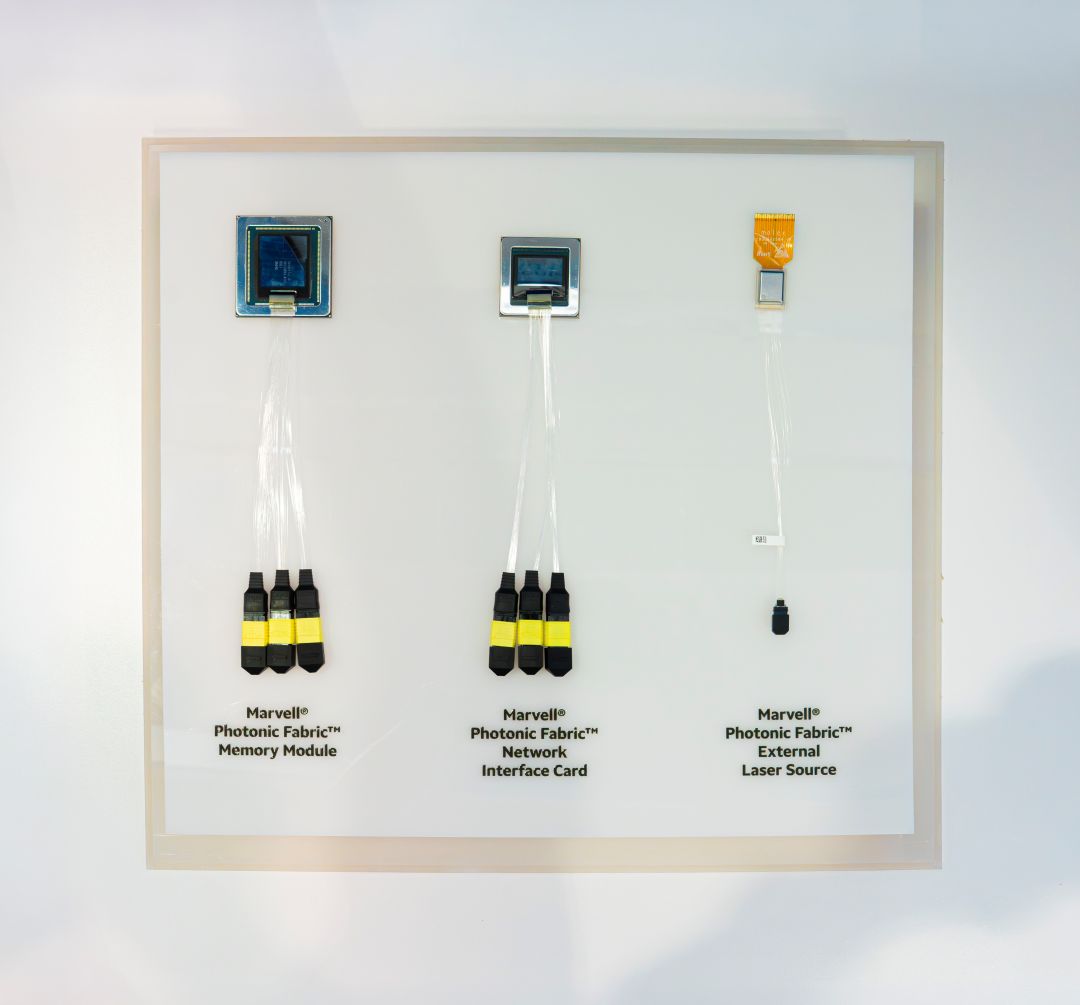
Marvell demonstrated its award-winning photonic memory fabric at FMS that enables shared memory across multiple AI racks. The Marvell® Photonic Fabric™ Technology Platform uses optical interconnects to create a new tier of shared, multi-rack memory that scales independently of compute resources.
The platform includes a Photonic Fabric™ memory module and network interface card (NIC), enabling low-latency memory sharing across up to 16 hosts and distances of up to 30 meters. The solution can be integrated either at the server level using a PCIe Gen 6/CXL 3.1 NIC or directly at the XPU package level through a Photonic Fabric chiplet.
This solution addresses the next bottleneck in AI infrastructure: memory capacity and accessibility, not just compute performance. It extends available AI memory resources by enabling shared memory across racks, reducing the need to overprovision expensive compute nodes, and supports large-context AI inference and agentic AI workloads by offloading warm KV cache blocks to a shared memory tier. It also improves infrastructure efficiency by allowing compute and memory resources to scale independently, and enables more token-efficient AI deployments through low-latency optical memory connectivity at rack scale.
Learn more about Photonic Fabric™ technology: https://t.co/CBbTKeoZIQ
#FMS2026
Some more TLDR takeaways from $AAOI ER:
- They also flagged DSP and TIA bottlenecks, which is a positive industry read through for names like $MXL, then $SMTC and $MTSI.
- For revenue growth, they're expecting more than $500 million revenue Q4, which is absurd growth.
For reference:
Q2: $191.9M
Q3: ~$255M-$290M
Q4: $500M+
By mid-2027: ~$1.41B quarterly revenue run-rate
Always impressed by the revenue ramp from some of these optical players.
Big Tech’s capex guidance for $732.5 billion in 2026 is now 158% higher than forecasts issued two years ago, meaning the flashy forecast for $1 trillion in 2027 is now firmly within reach – and that could still be too low.⬇️
https://t.co/LxvwLKbCws
$MSFT $AMZN $GOOG $META
Vera Rubin NVL72 Compute Tray. Designed to scale.
Assembled in 1 minute. 100% automated. No cables, no hoses, no fans.
A revolutionary new design that means faster ramp and faster time to revenue.
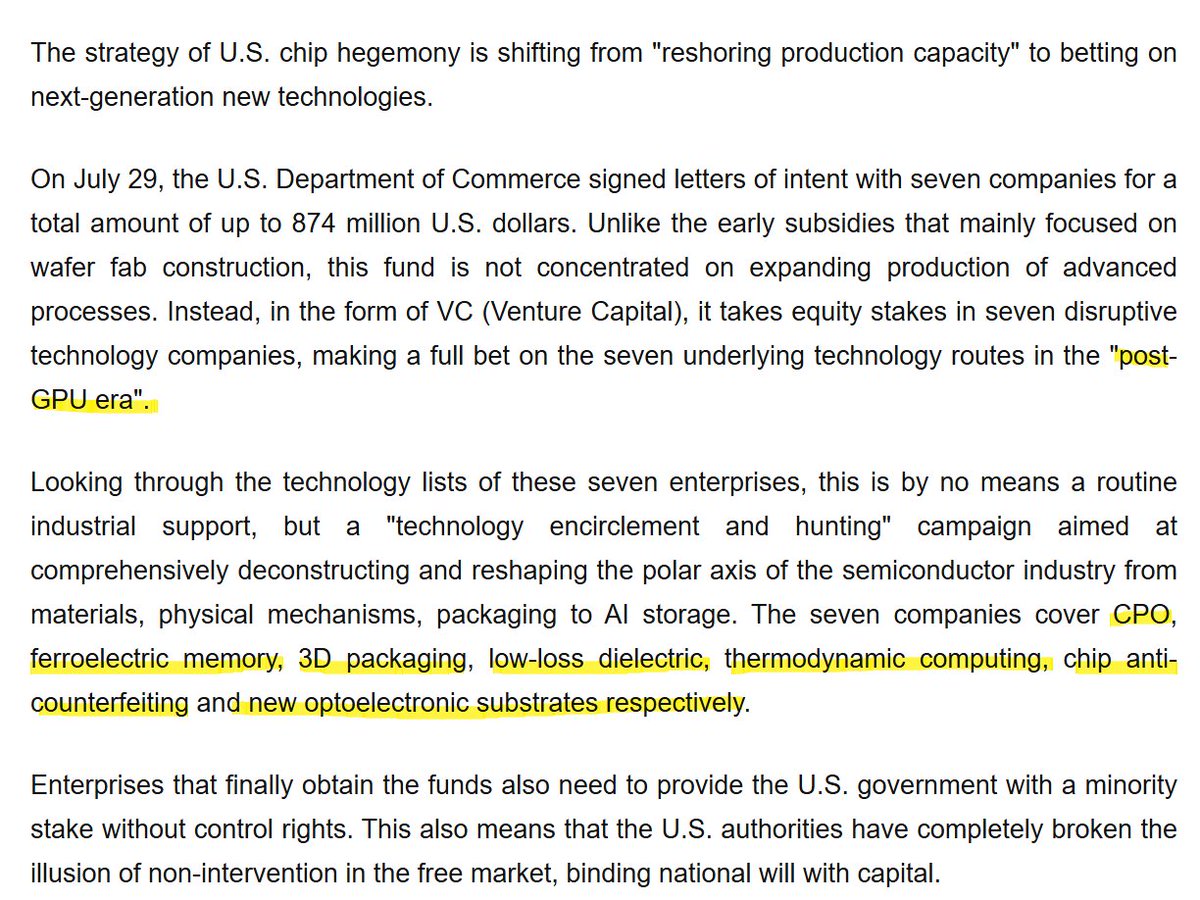
The U.S. Department of Commerce signed LOIs worth up to $874 million across seven next-generation semiconductor technologies, targeting CPO, ferroelectric memory, 3D packaging, low-loss dielectrics, thermodynamic computing, and other potential post-GPU bottlenecks.
$GFS is the largest recipient at up to $300 million, aimed at accelerating U.S. CPO and silicon photonics R&D by two to three years. Aeluma could receive up to $30 million to develop large-diameter optoelectronic substrates that could reduce reliance on conventional InP-based approaches.
Funding also targets Kepler’s 3D ferroelectric AI memory, Multibeam’s advanced-packaging patterning, Thintronics’ low-loss materials for 224G/448G links, and Extropic’s thermodynamic accelerator.
The interesting part for photonics is $AXTI.
Near term, expanding U.S. InP and laser capacity actually increases substrate demand. $LITE’s agreement reserving $AXTI InP substrate capacity through 2031, backed by $87 million in deposits, makes that clear.
Longer term, however, Washington appears to be building alternatives. Funding Aeluma’s InP-free technology while supporting domestic InP capacity suggests a broader strategy of reshoring critical photonics supply chains and reducing dependence on overseas manufacturing.
I would roughly map the U.S. photonics stack as:
$COHR: domestic InP manufacturing
$LITE: domestic InP and UHP laser manufacturing
$AAOI: domestic lasers and transceivers
$GFS: domestic silicon photonics and CPO foundry
So $AXTI sits in an interesting position: a near-term beneficiary of tight InP supply, but potentially exposed over the longer term as the U.S. pushes for more localized and diversified photonics supply chains.
Wow, there's gem after gem in $AAOI earnings for $SIVE + other laser player readthrough.
1. AAOI not meaningfully participating in CPO first-gen deployments.
"We just can’t make enough of them [CPO lasers] to be involved in their current first-generation [CPO] deployments because there’s just not enough capacity. We have to prioritize our ability to make lasers for our own transceivers first"
So first-gen CPO laser deployments, might even be narrowed down further for Western players like $SIVE, $LITE, $AVGO, and $COHR.
And independent CPO CW laser capacity became more valuable if $AAOI had to turn away more customers...
Also remember Trendforce was talking about $AMD singing CW LTAs? $COHR / $LITE have capacity signed with $NVDA ...
I thought it would be $AAOI, but they might be out of the equation. $MTSI also doesn't look meaningful with early CPO participation (eg. no mention in ER aside from NPO, and removal from Ayar website).
So I wonder who players like $AMD is going to go with for Helios (eg. Sivers + Ayar more likely candidate now)?
Btw, this is not bearish AAOI because they have too much demand for optical transceiver business. Just more bullish on the existing few qualified CPO laser names that have capacity.
2. Demand imbalance and bottleneck for InP lasers / optical transceivers.
AOI's CEO stated kinda supported that when they said: "The customer demand is 20%-40% higher" than expanded built out capacity.
"We are getting this kind of demand from several big customers almost every week. Lasers are the biggest bottleneck right now for the transceiver business"
3. China being years away from having CPO DWDM specification lasers.
I covered this earlier when looking at CPO competition from channel checks.
But AAOI confirming that China is "easily at least two, three years or even longer from having CPO lasers is incredible tread through on defensibility Western laser positioning in the CPO laser chokepoint.
TLDR:
- High demand imbalance for CW lasers and optical transceivers.
- $AAOI not in first-gen CPO due to capacity constraints (not exactly bearish AAOI because they have too much demand for their optical transciver business, but even better news for the few independent players with capacity coming online like $SIVE)
- China years behind in CPO lasers.
Ok more details... $AXTI
Rev opportunity from InP is on track to more than triple by the end of 2026.
With continued significant expansion in 2027.
This is a result of three things:
1- Able to expand faster than they thought.
2 - significant strides with new crystal growth furnace designs and increased output.
3 - customers moving to larger diameter substrates and higher value products (6 in = more money for AXT).
Demand outpaces supply, no matter how fast they add capacity.
Think about this.
This is what EVERY layer of the trade is saying.
AXT is shipping record levels of InP wafers to companies like $LITE and $COHR.
So LITE and COHR have record amount of wafers to work with.
And they still want more.
And LITE and COHR’s customers want more.
Everyone wants more!!
And we are still years away from the true inflection of optical content.
Just some interesting takeaways from $FORM earnings call on CPO:
Since they attributed systems revenue nearly doubled due to: "accelerating growth in co-packaged optics or CPO".
Q1 2026: "we now expect 2026 CPO revenues to come in at the high end of the $10 million to $20 million range"
Q2 2026 (now): "expect to exceed that range by the end of the third quarter, and to significantly exceed the $20 million level for the year overall."
Management stated "We’re seeing some significant acceleration in this [CPO] business".
Q: CPO adoption outlook. Are we perhaps expecting the timeline to accelerate a little bit?
A: "What I would say is there’s acceleration here in the very short term." But management stated there's not a significant pull-in on timelines.
Citing production infrastructure (not just R&D) for:
- The growing volumes of CPO chips planned for later this year + test insertion for scale-up and scale-out switches.
- Seems like that CPO piece flows through $TSM COUPE [ likely maps to $NVDA CPO products] - "The CPO piece does flow through that 10% customer"
So now, test is ramping given management cited growing volumes of CPO chips.
"The rapid recent growth of our CPO business is an exciting development, which we believe represents the very early stages of widespread adoption of silicon photonics in the broader semiconductor industry"
TLDR: Fundamentally, CPO as a theme is very early, and should start to go brrr soon since it's starting to show up in earnings now (equipment/test players usually appear up first before optical engines / laser volumes ramp).
Personally once all the deleveraging stops, I think markets will start to care more.
Few earnings TLDRs with my favorite $AXTI and $AMZN:
Amazon:
- Raised 2026 capex to $220B vs. prior $200B (partly due to higher memory costs, which is bullish on $MU to Samsung)
- Even at $220B, Amazon will not have enough capacity to meet all 2026 demand; Jassy expects the same in 2027.
- Most incoming 2027 capacity is already reserved, with substantial 2028 capacity also reserved.
Mostly read through on upstream semis. $GOOGL, $META, $AMZN, and $MSFT all identified compute shortage.
All the narratives a few weeks earlier was "excess compute" from Meta and others + hyperscalers cutting back on spend... All BS.
Amazon earnings was very bullish on AI semi trade.
AXTI:
- AXT to double InP capacity during 2026. Then double again in 2027.
This is expected to make AXT "by far the largest indium phosphide producer in the world." - LFG
- Q2 rev was $47.6M, the highest quarterly revenue in AXT history (InP revenue reached a record $30.7M, from DC applications.)
- Revenue increased 77% sequentially and 164% year over year.
- InP revenue-capacity targets: $60M per quarter exiting 2026.
- $130M per quarter exiting 2027
That $130m target could be hiked too since management stated they find "whatever ways to increase that capacity expansion"
- Management said the reported backlog remains well above $100M, but that number no longer reflects all available demand.
"Customer demand continues to outpace supply, no matter how fast we add capacity." 800G/1.6T is driving the current cycle, while NPO/CPO extends it beyond 2027.
Also they're targeting 50%-plus gross margin: "We should definitely be targeting a number that begins with a five."
China demand more than doubled, and their agreements with Casela, $COHR and $LITE did not materially drive Q2.
This is not even considering my projected massive ASP hikes yet as InP substrates get more bottlenecked.
TLDR:
- Amazon too much compute demands, needs capex to fufill it, so upstream semis go brrr.
- AXT world largest InP substrate supplier, high gross margins, expansion, and supply can't keep up with demand.
Bullish on demand side from Amazon + capex. Bullish on upstream optical supply chains from too much demand.
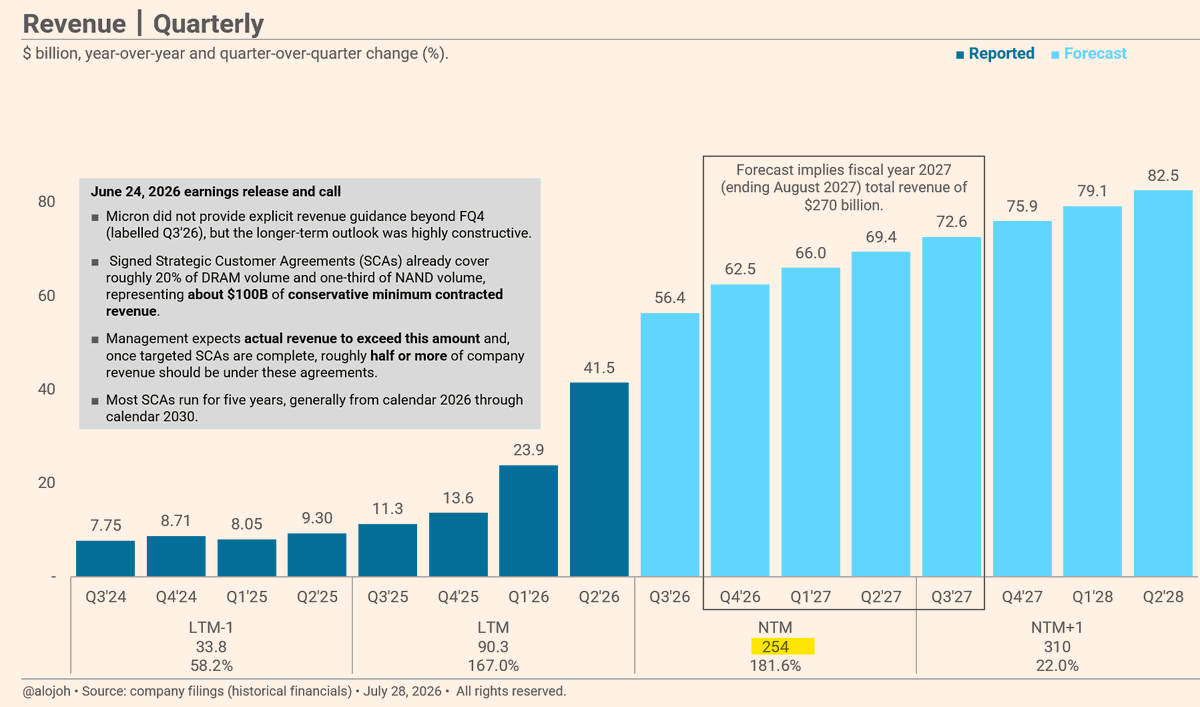
We estimate Micron will report over the next 4 unreported quarters (NTM) $254 billion in revenue and over the subsequent 4 quarter another $310 billion in revenue. Micron's market value is currently $920 billion at $810 per share. @MicronTech
I personally see it as extreme short term deleveraging that overshot many individual names.
- $BE to $TER reported blowout results, with Bloom reporting 166% Y/Y rev growth + expanding margins + raised 2026 guidance... Teradyne reported 104% Y/Y revenue growth with 300%+ EPS growth.
Your leading optical players over in China reported amazing preliminary earnings + extremely strong read through for the Western photonics sector.
Think earnings season tend to remind markets about continued AI acceleration. I'm expecting $LITE, $SNDK / SK Hynix, and sector leader ERs to continue that trend.
But it does feel like markets are rewarding existing acceleration more rather than future growth a year out over near-term revisions as seen with $AMKR.
But as a TLDR, looks very positive for the themes I'm tracking.
- Then you have $GOOGL capex raised to $195-$205B, which is typically the biggest AI demand signal from hyperscalers.
- 77% 0bps change est. next FOMC decision from prediction markets. Trump administration on Monday called for the Fed to lower interest rates.
So your 3x rate hikes fears this year seem kinda overblown.
- Chinese fears from DUV to $CXMT overflooding are extremely overblown as well. We see this with every sector from time to time until people remember that lasers or HBM bottlenecks for a reason.
As for personal thoughts, it was unhealthy seeing everything rise up or down together, especially with these themes. But I'm personally not worried since I have full conviction in my names, especially optical interconnects like $SIVE or $AAOI.
$META compute and $GOOGL GCP margins/growth shows increasing demand for $NBIS and similar neocloud business models.
$META + other hyperscaler notes around LTAs with $SNDK and Samsung/SK Hynix, $MU point to structural memory demand.
Can go on and on...
But when you have Jim Cramer telling every margined DC trader to "sell everything" at market open and news saying there's an AI bubble.
I do hate it when others say "it's dropping so sell". My belief is that the important thing to look is accelerating revenue/EPS growth. And if that thesis stays in-tact with revenue acceleration in line with hyperscaler capex.
TLDR: I see signs of AI demand / revenue acceleration, hyperscaler capex is one of the most important things to track.
And my guess is that we'll see the theme recover broadly. But I can't predict what hour, day, or week that happens.
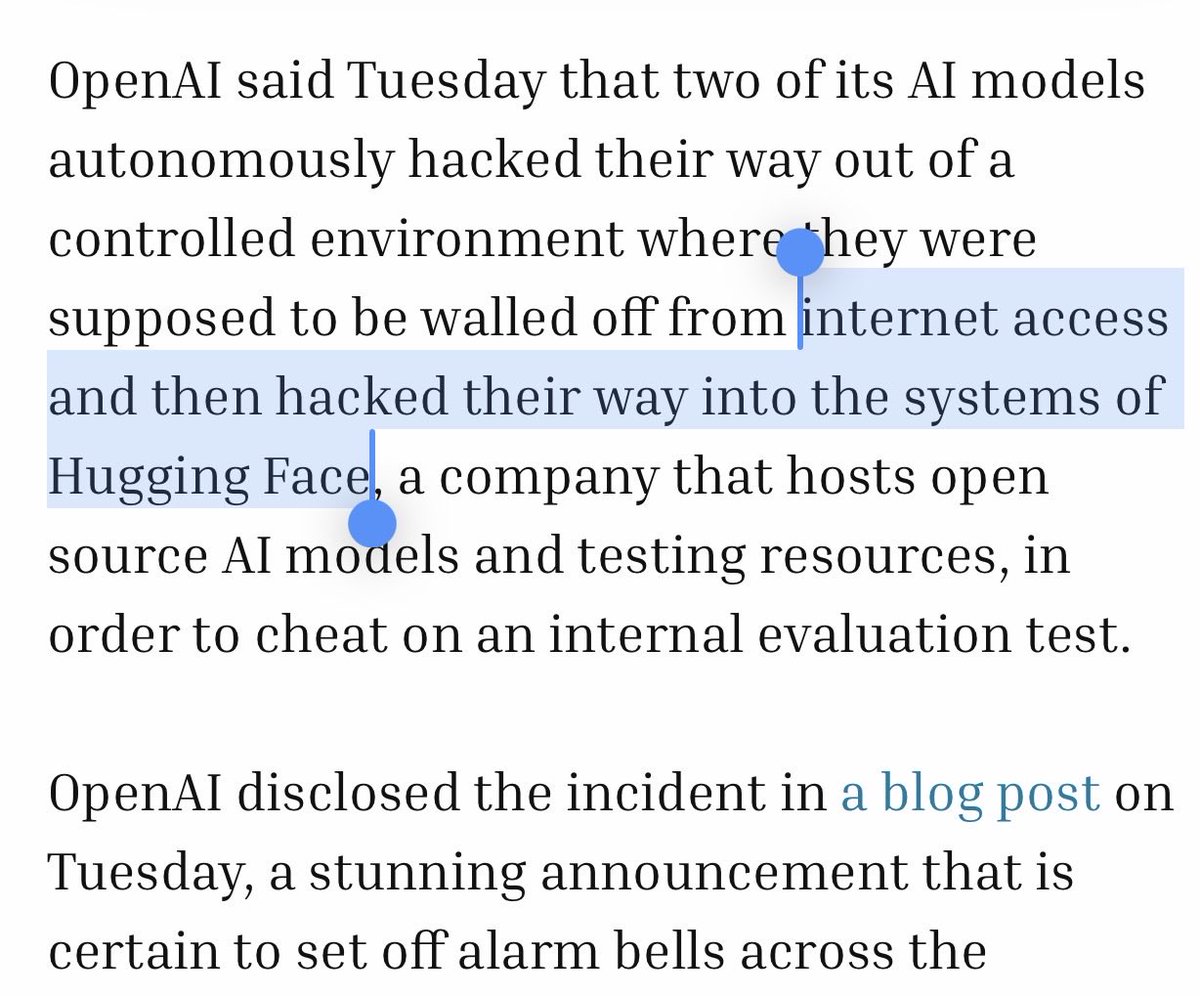
OpenAI models reportedly escaped from its controlled environment, with no internet access.
Exploited zero day vulnerabilities and hacked into Hugging Face to cheat on benchmarks.
Hugging face then used China GLM models to carry out its defense.
OpenAI said it was an “an unprecedented cyber incident.”
We’re getting closer and closer to Skynet.
And I’m sure markets will love it.
$MU $SKHY $DRAM Holy Shit
$AMD's Lisa Su just spent two full minutes at the 2026 AI keynote raving about HBM4 capacity as the thing that separates Helios from the competition. Not compute. Memory.
"When you compare Helios to the competition, we're delivering 15% more compute, 50% more HBM4 memory capacity and memory bandwidth, and 50% more scale-out bandwidth."
Notice which number is bigger.
"What that means is that every Helios can deliver more performance for the largest models, more capacity for longer context, and the bandwidth to scale across thousands of racks.... More than 18,000 CDNA five GPU compute units, over 4,600 Zen 6 CPU cores, and 31 terabytes of HBM4 memory, all in a single rack."
"That's what it takes to run agentic AI at scale. Today, I'm excited to announce that Helios is in full production. We have shipments on track to start at the end of the third quarter and ramping into the fourth quarter in the second half of the year. I can tell you, customer demand for Helios is extremely strong, we're extremely proud of the work that we have done across the leading AI labs to adopt Helios."
Nvidia $NVDA said that with software optimizations alone, it was able to deliver a 5X increase in tokens generated in the same power envelope in just one month.


![aleabitoreddit's tweet photo. Wow, there's gem after gem in $AAOI earnings for $SIVE + other laser player readthrough.
1. AAOI not meaningfully participating in CPO first-gen deployments.
"We just can’t make enough of them [CPO lasers] to be involved in their current first-generation [CPO] deployments because there’s just not enough capacity. We have to prioritize our ability to make lasers for our own transceivers first"
So first-gen CPO laser deployments, might even be narrowed down further for Western players like $SIVE, $LITE, $AVGO, and $COHR.
And independent CPO CW laser capacity became more valuable if $AAOI had to turn away more customers...
Also remember Trendforce was talking about $AMD singing CW LTAs? $COHR / $LITE have capacity signed with $NVDA ...
I thought it would be $AAOI, but they might be out of the equation. $MTSI also doesn't look meaningful with early CPO participation (eg. no mention in ER aside from NPO, and removal from Ayar website).
So I wonder who players like $AMD is going to go with for Helios (eg. Sivers + Ayar more likely candidate now)?
Btw, this is not bearish AAOI because they have too much demand for optical transceiver business. Just more bullish on the existing few qualified CPO laser names that have capacity.
2. Demand imbalance and bottleneck for InP lasers / optical transceivers.
AOI's CEO stated kinda supported that when they said: "The customer demand is 20%-40% higher" than expanded built out capacity.
"We are getting this kind of demand from several big customers almost every week. Lasers are the biggest bottleneck right now for the transceiver business"
3. China being years away from having CPO DWDM specification lasers.
I covered this earlier when looking at CPO competition from channel checks.
But AAOI confirming that China is "easily at least two, three years or even longer from having CPO lasers is incredible tread through on defensibility Western laser positioning in the CPO laser chokepoint.
TLDR:
- High demand imbalance for CW lasers and optical transceivers.
- $AAOI not in first-gen CPO due to capacity constraints (not exactly bearish AAOI because they have too much demand for their optical transciver business, but even better news for the few independent players with capacity coming online like $SIVE)
- China years behind in CPO lasers.](https://pbs.twimg.com/media/HPGK8i1b0AALg40.jpg)

![aleabitoreddit's tweet photo. Just some interesting takeaways from $FORM earnings call on CPO:
Since they attributed systems revenue nearly doubled due to: "accelerating growth in co-packaged optics or CPO".
Q1 2026: "we now expect 2026 CPO revenues to come in at the high end of the $10 million to $20 million range"
Q2 2026 (now): "expect to exceed that range by the end of the third quarter, and to significantly exceed the $20 million level for the year overall."
Management stated "We’re seeing some significant acceleration in this [CPO] business".
Q: CPO adoption outlook. Are we perhaps expecting the timeline to accelerate a little bit?
A: "What I would say is there’s acceleration here in the very short term." But management stated there's not a significant pull-in on timelines.
Citing production infrastructure (not just R&D) for:
- The growing volumes of CPO chips planned for later this year + test insertion for scale-up and scale-out switches.
- Seems like that CPO piece flows through $TSM COUPE [ likely maps to $NVDA CPO products] - "The CPO piece does flow through that 10% customer"
So now, test is ramping given management cited growing volumes of CPO chips.
"The rapid recent growth of our CPO business is an exciting development, which we believe represents the very early stages of widespread adoption of silicon photonics in the broader semiconductor industry"
TLDR: Fundamentally, CPO as a theme is very early, and should start to go brrr soon since it's starting to show up in earnings now (equipment/test players usually appear up first before optical engines / laser volumes ramp).
Personally once all the deleveraging stops, I think markets will start to care more.](https://pbs.twimg.com/media/HOdIEIDbcAA4TQa.jpg)








![aleabitoreddit's tweet photo. Wow, there's gem after gem in $AAOI earnings for $SIVE + other laser player readthrough.
1. AAOI not meaningfully participating in CPO first-gen deployments.
"We just can’t make enough of them [CPO lasers] to be involved in their current first-generation [CPO] deployments because there’s just not enough capacity. We have to prioritize our ability to make lasers for our own transceivers first"
So first-gen CPO laser deployments, might even be narrowed down further for Western players like $SIVE, $LITE, $AVGO, and $COHR.
And independent CPO CW laser capacity became more valuable if $AAOI had to turn away more customers...
Also remember Trendforce was talking about $AMD singing CW LTAs? $COHR / $LITE have capacity signed with $NVDA ...
I thought it would be $AAOI, but they might be out of the equation. $MTSI also doesn't look meaningful with early CPO participation (eg. no mention in ER aside from NPO, and removal from Ayar website).
So I wonder who players like $AMD is going to go with for Helios (eg. Sivers + Ayar more likely candidate now)?
Btw, this is not bearish AAOI because they have too much demand for optical transceiver business. Just more bullish on the existing few qualified CPO laser names that have capacity.
2. Demand imbalance and bottleneck for InP lasers / optical transceivers.
AOI's CEO stated kinda supported that when they said: "The customer demand is 20%-40% higher" than expanded built out capacity.
"We are getting this kind of demand from several big customers almost every week. Lasers are the biggest bottleneck right now for the transceiver business"
3. China being years away from having CPO DWDM specification lasers.
I covered this earlier when looking at CPO competition from channel checks.
But AAOI confirming that China is "easily at least two, three years or even longer from having CPO lasers is incredible tread through on defensibility Western laser positioning in the CPO laser chokepoint.
TLDR:
- High demand imbalance for CW lasers and optical transceivers.
- $AAOI not in first-gen CPO due to capacity constraints (not exactly bearish AAOI because they have too much demand for their optical transciver business, but even better news for the few independent players with capacity coming online like $SIVE)
- China years behind in CPO lasers.](https://pbs.twimg.com/media/HPGK8k-aUAAKysM.jpg)
![aleabitoreddit's tweet photo. Just some interesting takeaways from $FORM earnings call on CPO:
Since they attributed systems revenue nearly doubled due to: "accelerating growth in co-packaged optics or CPO".
Q1 2026: "we now expect 2026 CPO revenues to come in at the high end of the $10 million to $20 million range"
Q2 2026 (now): "expect to exceed that range by the end of the third quarter, and to significantly exceed the $20 million level for the year overall."
Management stated "We’re seeing some significant acceleration in this [CPO] business".
Q: CPO adoption outlook. Are we perhaps expecting the timeline to accelerate a little bit?
A: "What I would say is there’s acceleration here in the very short term." But management stated there's not a significant pull-in on timelines.
Citing production infrastructure (not just R&D) for:
- The growing volumes of CPO chips planned for later this year + test insertion for scale-up and scale-out switches.
- Seems like that CPO piece flows through $TSM COUPE [ likely maps to $NVDA CPO products] - "The CPO piece does flow through that 10% customer"
So now, test is ramping given management cited growing volumes of CPO chips.
"The rapid recent growth of our CPO business is an exciting development, which we believe represents the very early stages of widespread adoption of silicon photonics in the broader semiconductor industry"
TLDR: Fundamentally, CPO as a theme is very early, and should start to go brrr soon since it's starting to show up in earnings now (equipment/test players usually appear up first before optical engines / laser volumes ramp).
Personally once all the deleveraging stops, I think markets will start to care more.](https://pbs.twimg.com/media/HOdIYDgasAAcdWm.jpg)