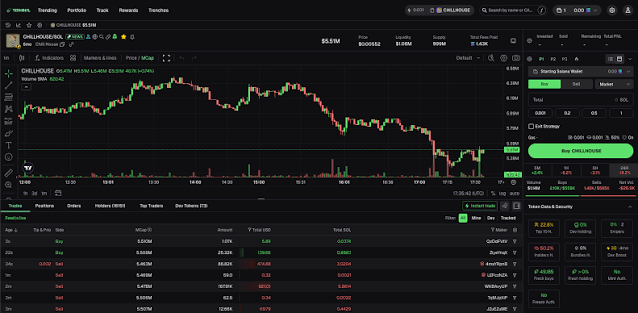
🐋 Wallet Watch Recap: SOL testing resistance near $85, sector-wide pullback of ~6.5% with pockets of inflow (TROLL), and whale accumulation patterns still active.
What did YOUR watchlist do this week?
🔎 Solana's edge for this whole category: 400ms block times and sub-$0.01 fees. That's what makes rapid-fire memecoin trading even possible at this volume.
Does chain speed factor into which memecoins you touch?
🐋 Wallet Watch Discipline Check: experienced traders keep total memecoin exposure to roughly 1-5% of portfolio.
Not because memecoins can't pay — because 95% of them go to zero and you need to still be standing when the 5% hits.
📊 Political memecoins (TRUMP, PNUT-style tokens) tend to move on event catalysts — inaugurations, elections, policy news — more than technicals.
With 2026 elections approaching, expect this category to get more attention. Event-driven ≠ predictable.
📊 Fartcoin posting ~30% weekly gains, trading purely on social momentum with zero product behind it.
⚠️ "Runs on mood alone" is the exact phrase used to describe it in market coverage. Mood reverses fast — size your position like it will.
⚽️Most rug pulls aren't complicated code — they're structural. A dev holding 40% of supply doesn't need a malicious function. They just need to sell.
Contract audits check for exploits. They don't check for "will the dev dump on you." That's on you to verify via wallet concentration.
📊 PENGU sits near a $2.6B market cap, with Canary Capital having filed for a PENGU ETF.
Context: an ETF filing is a multi-month regulatory process, not a guarantee of approval. Price often reacts to the filing news, then goes quiet for months during review.
👁️Lesson: a "treasury buyback" in crypto isn't the same guarantee it is in equities. There's no regulatory obligation forcing continued support — it can stop anytime.
Read the mechanism before the headline convinces you it's a floor.
Lesson: memecoins rarely move independently of the broader market. When BTC finds a bid, capital rotates outward into higher-beta assets — memecoins being the highest beta of all.
That's why "BONK is pumping" often really means "risk appetite is back," not "BONK has new fundamentals."
Why do whales split large buys into smaller trades over hours instead of one order?
Slippage control. A single $16M market buy on a thin pair moves price against you badly. Breaking it into pieces over 3 hours protects the entry price.
This is basic execution strategy — works the same whether you're moving $500 or $16M, just scaled.
@blknoiz06@met_lparmy LP as a strategy for capital that doesn’t want directional exposure makes way more sense than people give it credit for. You capture fees, improve ecosystem liquidity, and don’t depend on the token going up. It’s the quiet trade that the people who know are making.
30% in two weeks on $300k via LP is the kind of return people don’t talk about because it sounds too good but impermanent loss risk on volatile pairs can eat that gain fast if the token moves hard in one direction. Timing your entry and exit from the pool matters just as much as the APY.
Lesson in market structure: when a sector pulls back 6-7% but individual tokens post net inflows, that's called internal rotation.
Money isn't leaving the space — it's moving between winners and losers inside it.
This is why "the market is down" isn't the same as "my bag is doomed."
@coldtrz The number is real, but what’s not mentioned is how many wallets put $39 in the same token and walked away with $0. A 1,000,000x exists the probability of being you in that trade doesn’t.
Solana is trading near $76.67, testing a resistance band where roughly 105M SOL changed hands historically.
That's a dense supply zone — a lot of holders are sitting near breakeven there, which usually means more sellers show up on the way through.
Above $85 clears the way toward $100+. Below it, expect chop.
This is chart-reading, not a signal to buy.
Data point every degen should tape to their monitor: average memecoin lifespan on Solana launchpads is 3-7 days. Most go to zero.
Common failure patterns:
- Insider sniping (devs buy up to 40% of supply before the contract goes public)
- Hidden mint authority or freeze function
- Top 10 wallets holding 30-50% of supply
Check these BEFORE you ape, not after.
A token name is easy to copy, but the contract address is what actually identifies the asset. Scammers rely on users recognizing the token name and skipping the one detail that matters most. Before swapping, approving or accepting any token.
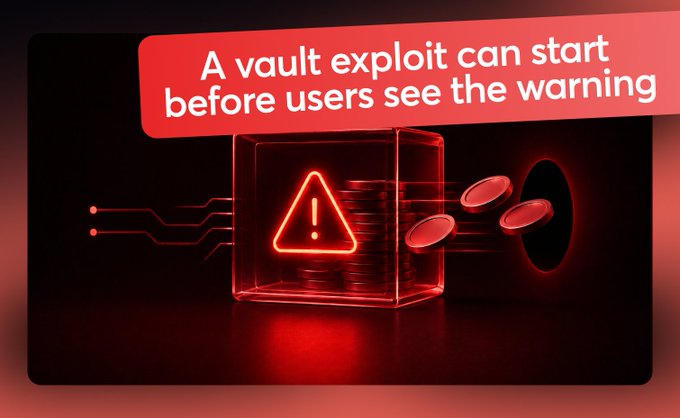
https://t.co/ll3GbRdvMl is dealing with an active exploit. The reported drain was around $6M. A full technical post-mortem wasn't available yet, so the exact root cause still needs confirmation.
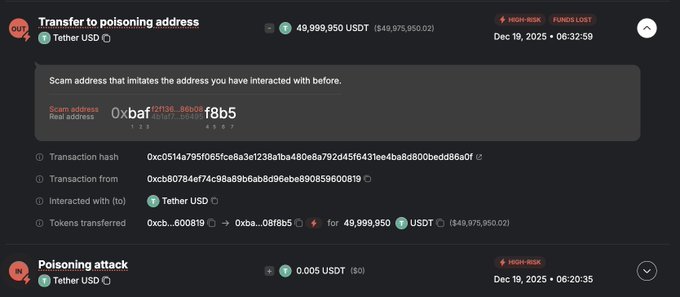
to an address poisoning scam. The funds had arrived less than 1h earlier. The user first sent a small test tx to the correct address.
Mins later, $50M was sent to a poisoned address copied from transaction history. How to lose $50M in under an hour.