🎉 Excited to share that BuildArena has been accepted to #ICML2026@icmlconf!
BuildArena studies whether LLM agents can go beyond generating text or code, to design and build functional machines in a physics simulator @spiderlinggames.
Given natural language goals, LLM agents construct rockets, bridges, vehicles, and other 3D mechanisms from scratch. Success requires spatial reasoning, physical understanding, stability analysis, and iterative building.
This project started from a bold vision: future AI agents should be able to build general-purpose machines for open-ended environments, from Earth to the Moon and Mars.
For more information:
💻Project Website: https://t.co/ojaNqxXzeW
📚paper: https://t.co/Esx1cVxlX0
📦code: https://t.co/L6tBkLRfzS
#ICML2026 #BuildArena #AIforEngineering #AgenticEngineering #LLMAgents
Exciting News🚨! Our #ICLR2026 Oral paper RealPDEBench, the first benchmark for scientific ML that integrates real-world measurements with paired numerical simulations, will be presented at Room 201 C, April 25th 3:15 PM – 3:25 PM BRT. Poster session is at Pavilion 3 P3-#1225, April 25rd 10:30 AM - 1:00 PM BRT. @Peiyan_Hu will be there, feel free to stop by and chat!
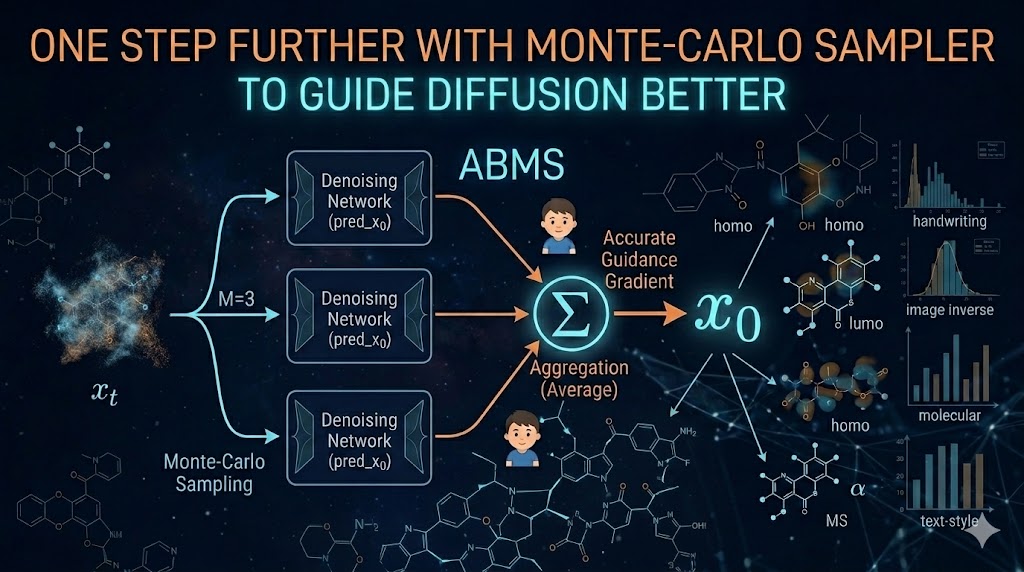
🎉 Excited to share our latest work, “One Step Further With Monte-Carlo Sampler To Guide Diffusion Better”, accepted to #ICLR2026@iclr_conf!
ABMS is a training-free diffusion guidance method based on DPS. We propose an additional backward denoising step combined with Monte-Carlo sampling to mitigate the severe estimation error in vanilla DPS. ABMS explores more than one plausible denoising trajectories, naturally capturing the multi-modal characteristics of the posterior distribution. As a plug-and-play strategy, ABMS requires no retraining or modification of pretrained diffusion models and consistently boosts generation quality.
For more information, please view our paper and code at:
📦 Code Repo:https://t.co/q2ofGZX8xj
📚 Paper Link : https://t.co/NheFdqJy1D
🧾 OpenReview : https://t.co/pT2wsn9jAK
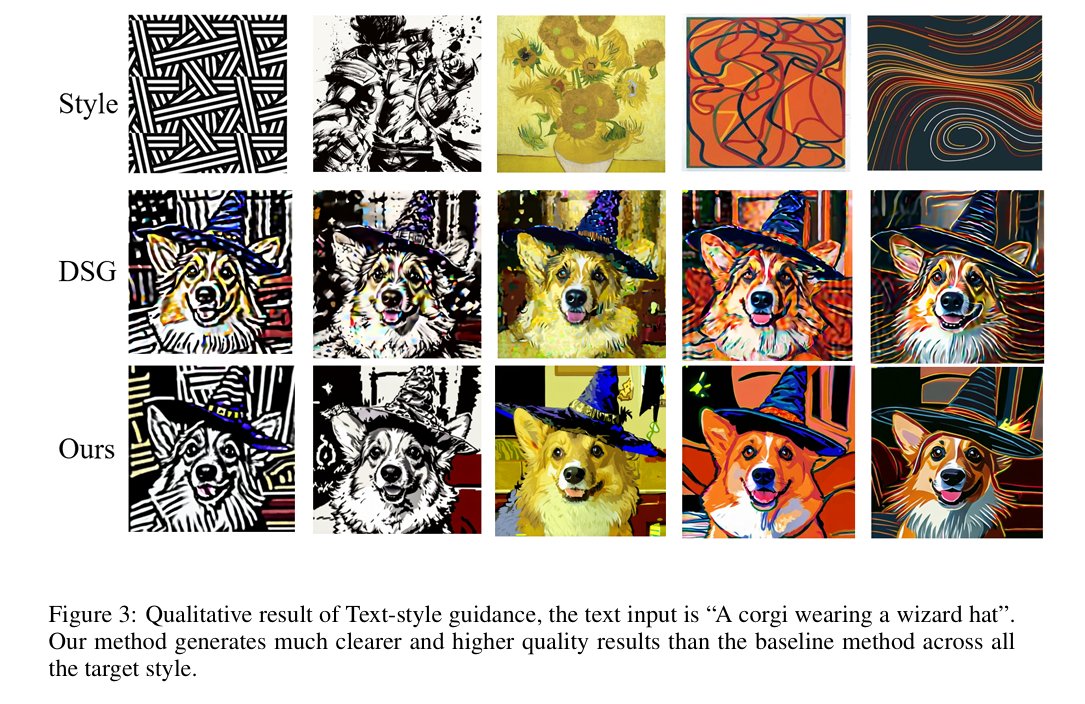
We also evaluate ABMS on current more advanced flow-matching based models, with Stable Diffusion 3.5 as the generative prior. It shows seamless compatibility with flow-matching training paradigms on text-style guidance tasks, performing well even on these large parameter models. This fully demonstrates the strong generality of our plug-and-play ABMS strategy across different diffusion model frameworks.
Beyond better prediction accuracy, scDFM offers a new modeling paradigm for single-cell biology: from "predicting how each cell changes" to "generating the post-perturbation cell population distribution." This aligns better with the biological reality where perturbations cause population-level distributional shifts.
We hope this perspective will be useful for unseen perturbation generalization, in silico screening, and future efforts toward digital twin models of cellular systems.
🎉 Excited to share our latest work, “scDFM: Towards Distributional Flow Matching for Single-Cell Perturbation Prediction”, accepted to ICLR 2026 @iclr_conf
scDFM is a generative framework for single-cell perturbation prediction. Instead of relying on the impractical one-to-one cell correspondence assumption, it models perturbation effects as distribution-level generation. Concretely, we combine Conditional Flow Matching with MMD-based distribution alignment to capture population-level shifts without paired cell labels.
For more information:
📦 Code Repository: https://t.co/nBba3LqwqB
📚 Paper Link: https://t.co/F3g8TbG0vH
🧾 OpenReview: https://t.co/GH9MYUMKJu
Ablation studies on the Norman holdout setting show that scDFM’s strong performance arises from the combination of distribution alignment and architecture design.
Removing cross-attention causes the largest drop in reconstruction-related metrics (L2 +19.6%, PearsonΔ -7.2%). Removing MMD alignment leads to the largest decrease in DE-Spearman (-20.9%), highlighting the importance of distribution-level supervision for capturing perturbation-induced population shifts.
The gene graph prior and differential attention also both contribute, supporting the value of structure-aware and noise-robust design for single-cell modeling.
🎉 Excited to share our latest work, “GenCP: Towards Generative Modeling Paradigm of Coupled Physics”, accepted to ICLR 2026 @iclr_conf !
GenCP is a generative framework for coupled multiphysics simulation. Instead of relying on expensive coupled data for training, it explores a new setting: can we train on decoupled data, yet infer coupled physics at sampling time? The key idea is to formulate coupled-physics modeling as a probability modeling problem and bridge decoupled training with coupled inference.
Looking forward to your attention and follow-up research based on our work!
For more information:
📦 Code Repository: https://t.co/kelvbzo4zz
📚 Paper Link: https://t.co/hmPWJABieS
We evaluate GenCP on 1 synthetic setting + 3 challenging multiphysics scenarios: Turek-Hron, Double Cylinder, and NT Coupling. Across these tasks, GenCP demonstrates both improved accuracy and higher inference efficiency. The paper reports error reductions ranging from 12.54% to 42.85%, and the framework only needs 10 sampling steps to generate accurate coupled solutions (largely accelerated!). We hope this work can offer a useful new perspective for multiphysics learning: using generative modeling to connect decoupled learning and coupled inference.