Apparently, in Kenya, you must first spend 30 years disappointing people before you're qualified to lead them. A newcomer with fresh ideas is considered inexperienced, while a veteran with a record of failure is called a statesman. What a system! 😂
If you're one of the Ngubus in the comment section telling this guy to mind his business
Then you're a thief as well, you have this Ngubu mindset which is to fleece your employer.
The guy has to be concerned, what if akuwe food poisoned?
Watu wanapenda ukora sana hii town.
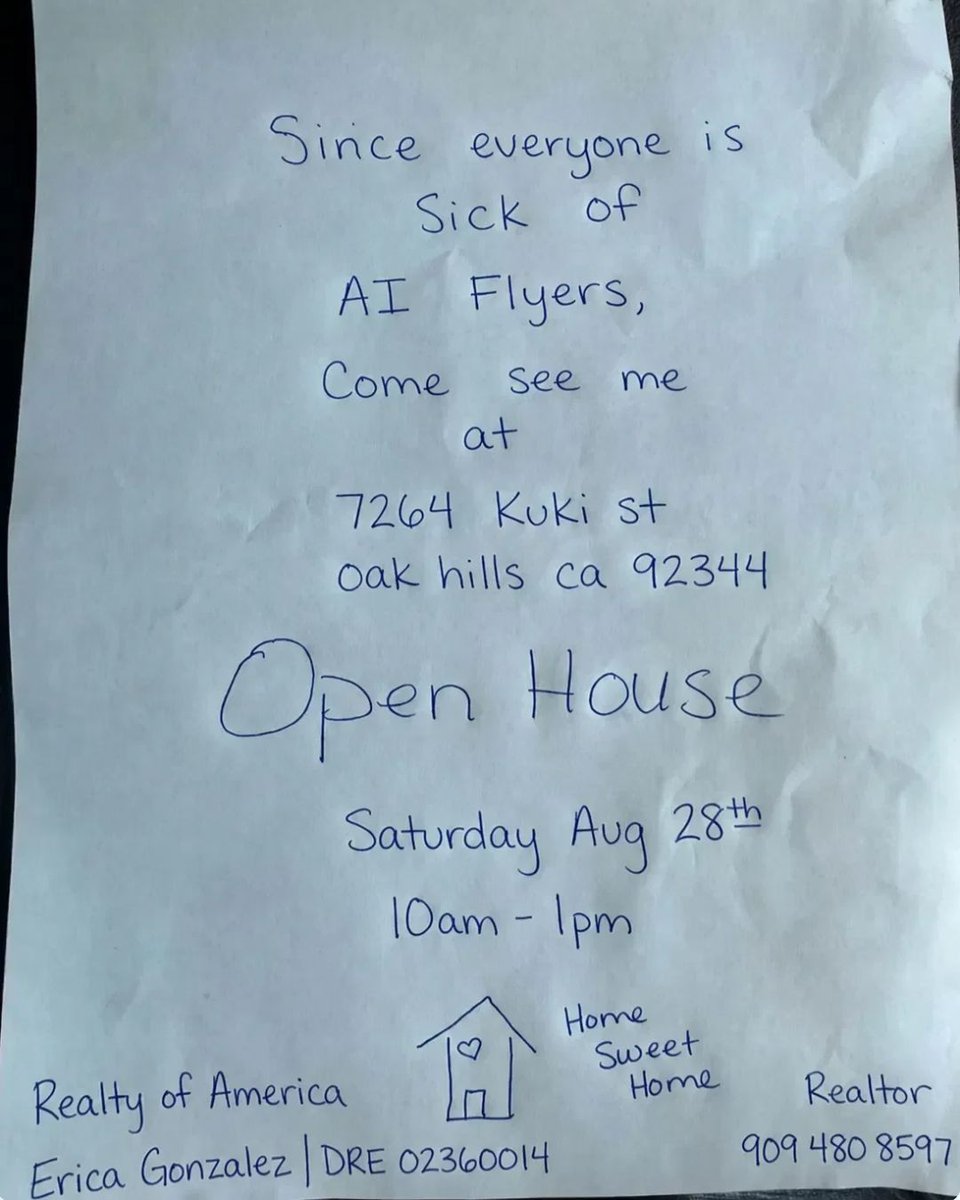
My theory about corporate AI psychosis is that AI is most appealing to people who aren’t good at their jobs. AI slop looks incredible to them because they’re so incompetent they don’t even know what good work looks like in the first place.
Social media loves romanticizing elderly Japanese labor as heartwarming content.
The reality? Japan's rigid system forces its aging population into lifelong labor under the false guise of dignity.
No community, no support—just a bleak mandate to work until you drop. 💔
🎙️humotti
As a Ghanaian , I have no idea of what the reason for the fight between Kenya and SA is, but like they say, an enemy of my enemy is my friend. My duty is to like, comment, share and retweet in support of Kenyans.
Shazam could name any song back in 2002, on flip phones, with zero AI. You dialed the number 2580, held your phone up to the speaker, and hung up. 15 seconds later, a text came back with the song name. That same core trick still runs the app today.
The inventor was Avery Wang, a Stanford PhD in audio signal processing. His problem was brutal. Match a short clip recorded on a 2002 cell phone mic, in a noisy bar, against a database of a million songs, in seconds, over a phone call.
His solution treated music as geometry instead of sound.
The algorithm converts audio into a spectrogram, a picture of the song, then throws almost all of it away. It keeps only the peaks, the loudest frequency points at each moment in time. Bar chatter and blown-out speakers can wreck most of a recording. The peaks survive. Shazam only ever needed the peaks.
Those surviving points form what Wang called a constellation map, because it looks like a star field. Pairs of peaks get converted into hash numbers, and identifying a song becomes a dictionary lookup rather than an audio comparison. That made it fast enough to search a million tracks on 2002 hardware.
Wang published the full method openly in 2003 in a paper called "An Industrial-Strength Audio Search Algorithm." Anyone could read exactly how the magic worked. The moat was the database and the deals with carriers, never the secret.
Apple bought the company in 2018 for a reported $400 million. People have tagged over 100 billion songs since the very first one, Jeepster by T. Rex, during the beta in April 2002.
One deterministic signal-processing trick, written before most people had heard the phrase machine learning, and it's still so good that in 2026 everyone assumes it must be AI.
Twitter is best institute of research now. I never learned so many things so profoundly before. Unknown people without any prejudice creating basic concepts, learning physics once again.
I'm reading the history of British elitism, its connection to examinations, the civil service and the colonies, and I'm wondering if Kenya will ever get out of it. We are really neck deep in the thing. 😢
I just saw the video of the Garissa ICU during the blackout. 💔Watching life-saving machines literally shut down with ZERO backup power is haunting.
How are human lives being treated as optional in 2026? Who is actually going to be held accountable for this?
That's why I was so against "parental involvement" in CBC. I was saying that it undermines parental authority and infiltrates the intimacy of the family.
But Kenyans didn't understand what I was saying. That's because we don't see human beings as having an internal life, a soul, with emotion, thought and spirit. We don't understand that it's our job as parents and families to nurture this side of our children. We think the only thing for children to become is workers for empire. So Kenyan parents wait for GoK, pastors and American psychologists to tell them what to do with their kids. And we detach. We did two discussions of this with @m_ogada on #MaishaKazini.
This thing worries me alot. Kenyans are soulless people. We hate intimacy, love and care, and our children need that more than resources. We think that is weakness. We look at each other not as people to care about, but as people to exploit. That's why, despite shouting at the politicians, we still haven't understood philosophically what is wrong with them.
Her journey is making me know so much things that i didn't.
In Kenya, the whole of Kenya, there's only 2 PET scans!!! In Aga Khan and KU!!! How is this possible buana???
Na Ruto was busy talking about chapati machines, mara sijui affordable housing. The dad stayed in KU jana all day coz people even from Msa were there. Like ilikuwa mfuriko wa watu. And it's like that everyday.
Health CS Mko busy kuleta facility ya Ebola while hamna capacity ya kuhandle things @HonAdenDuale wth...do we need to be complaining and reminding you daily what you are supposed to do..na kama wewe una support hii government wewe ni mbwa...@WilliamsRuto kazi nikutishia innocent citizen kama halima juu "ameonyesha "vile unarandaranda..mafala nyinyi
The diaspora is not treating investment like charity. It is literally replacing the state. That $100 billion is not going to consumption out of a lack of financial vision. It is keeping families alive because African governments have abdicated every responsibility they were supposed to carry. School fees, hospital bills, housing, food: the diaspora is subsidising what governance failed to provide, mostly while barely surviving themselves in expensive cities abroad.
At some point, we will have to graduate from talking about what the government is doing wrong to why the government cannot do differently from what it's doing now. This problem goes to the colonial foundations of the state. No Kenyan president has actually expanded the economy. We just didn't see it before, because we were cushioned by foreign capital during the cold war and after that through the NGO industrial complex. Now the West has no money to splurge on us, and most of all, they don't care to. That's why we're now noticing the rotten foundations, and that's why the president is running all over the world like a glorified hawker trying to find out what the West will buy from us.
Kenya has never been productive, especially of things beyond raw materials. This habit is entrenched in the logic of GoK and the school system. Our elites are aristocratic, and a productive economy threatens their status. GoK is not dysfunctional. It's functioning exactly as it was designed to do. This is what Kenyans need to understand. The people have to change their expectations of the state. We have to stop asking politicians for, and celebrating "development" projects. We have to ask instead for a better economic environment and a different political logic. That takes intellectual work.
I told you, @KICDKenya, that pathways below tertiary level are such a bad idea. At a time when we should have been integrating philosophy and humanities into medical training, you told parents that being a doctor requires people who are solution oriented and being a nurse requires people who care. In other words, doctors don't need to care.
So now the pathway for medicine is strict biology and chemistry. But patients are not just biological.
It's things like this that make me bitter about what you people did to Kenya in 2018. It was immoral.
#CBCisheretostay
If you study Politics, the Bretton Woods systems are taught as infallible, unquestionable institutions. The damage they cause are always to be analysed as a failure of domestic policy. To see the very Act of 1963 challenged in court? My God! Whether this works or not, it matters.