Pakistan was created in 1947, but Pakistanis did not appear in 1947. The people who built Pakistan were descendants of the civilizations and communities that inhabited the Indus region, including those who lived in and around Taxila.
By your logic, modern Egypt cannot claim the pyramids because the Egyptian state is recent; modern Italy cannot regard Rome as part of its heritage because the Roman Empire vanished centuries ago; and modern Iran cannot celebrate Persepolis because the Islamic Republic was founded only in 1979.
“Detailed 🧵 on AJK's situation and JAAC's charter of demand”
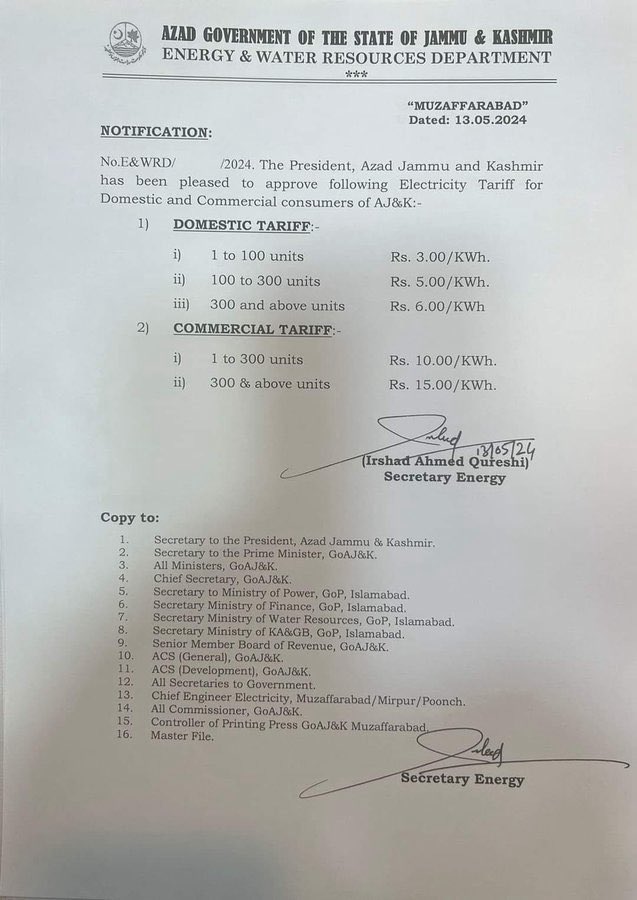
It was back in May 2024 when the govt. of 🇵🇰 announced budgetary support for the AJK govt to subsequently provide subsidized electricity, as low as Rs 3/unit flat, to the people of AJK responding to the demand of JAAC.
1/
Petrol at Rs 30/litre in Pakistan sounds crazy. It is not. What is crazy is the policy failure that prevents it.
Petrol is around Rs 300/litre today, excluding government levy, here's how it can effectively be Rs 30/litre.
People do not consume petrol for its own sake; they use it to travel. The average Pakistani rides a motorbike. A fuel-efficient motorbike can travel about 60 km on one litre. An efficient electric scooter can travel about 30 km per kWh, so it needs only 2 kWh to cover the same 60 km.
What should 2 kWh cost in Pakistan? Pakistan is one of the best places in the world for solar, with an all-in LCOE cost of around 5 cents per kWh. The electricity cost is 10 cents, or Rs 30/litre of distance travelled! The Rs 30/litre calculation remains the same for cars.
The 300-versus-30 gap is the cost of bad policy. It reflects billions of dollars of saving that could instead finance EV infrastructure: charging, distribution, battery swapping, and smart pricing software etc. - boosting much-needed domestic investment.
Since solar is highly modular. You do not need massive scale to get reasonable efficiency. That creates business and employment opportunities for small domestic power producers. Instead, Pakistan leaned into large fossil-fuel plants financed by dollar-denominated borrowing and guaranteed returns.
Local firms face credit constraints, but solar creates a natural collateralizable cash flow through electricity sales to the grid. With the right regulatory framework, this could have unlocked large private domestic investment, and employment.
Battery swapping is another area where small local businesses could have emerged and scaled.
Electricity enables smart pricing. When solar supply is abundant, prices can fall, and poor households and firms can shift usage to cheaper hours - automatic demand stabilization
Better air quality would mean longer, healthier lives and higher productivity. That is a growth multiplier
Green technology industries could be developed domestically with the right industrial policy, easing balance-of-payments pressure while raising employment and investment.
Instead, Pakistan chose imported-fuel power plants, protected a backward-looking domestic auto sector, and raised electricity prices by burdening them with the fixed costs of those plants and heavy taxation, slowing EV adoption. Then came the net-metering fiasco, all to keep zombie power plants alive.
Pakistan’s energy policy may be the clearest example of a broken nervous system. I hope someone fixes it, because people are paying the price, 300-versus-30
Human evolution has remained dependent on new experiences .
Fresh ideas , breakthroughs in knowledge and transformative innovations in technology benchmark the forward movement on timeline of history . In nutshell , collective human achievements shape history . One reality , however, has remained consistent ; issues don’t get resolved without talking to each other, if India succeeds in pursuit of its current policy towards Pakistan , it will be a new experience for mankind . ‘ Thinking Out ‘, or foreign policy option of total disengagement from a foe never resolved issues . One doesn’t find an example particularly from post Westphalian Treaty era, where such an option succeeded. Even when war of choice becomes the only policy option , realisation of political objectives of war ultimately depends on engagement / negotiations .
It is time Pakistan and India draw relevant lessons from ongoing war and rely on political / diplomatic resources to resolve historical disputes . For this to happen -first, India needs to review BJP’s policy towards Pakistan. Leaders on both sides owe it to 1.75 billion people. Needless to say, big number of these 1.75 billion people on both sides continue to live below the poverty line - not only but significantly because of ever growing defence expenditures.
It will be a tragedy if our bilateral equation continues on the trajectory of last eight decades . Let us all hope that shrinking constituencies for peaceful coexistence in India dissuade PM Modi and his close aides from hostility , hate and hubris.
“The ceasefire is holding and ceasefire timeline is 21st April – so there are days available,” says retired Pakistani General Muhammad Saeed. Now Pakistan’s field marshal is in Tehran and “I’m very confident that he has some message from the White House… We have great hopes.”
Maria Sultan, South Asian Strategic Stability Institute (SASSI) University chief, discusses Pakistan’s role in mediating regional talks, its strategic ties and cautious optimism negotiations could help prevent further escalation.
Just IN: Pakistani fighter jets spotted over Bandar Abbas, Iran, to escort the Iranian delegation to Pakistan safely.
— Pakistan Air Force has established a "protective shield" across Iran and Persian Gulf supported by fighter jets & AWACS to protect Iranian delegation from any misadventure by Israel.
— The Iranian delegation, likely led by speaker of Iran's parliament, will arrive in Islamabad tonight for talks with US.
🇺🇸🇮🇱🇮🇷 The inside story of how the war started is more damning than anyone imagined
The New York Times just published the most detailed account yet of Trump's decision to attack Iran.
Every American should read it.
February 11th. Netanyahu arrives at the White House for a classified Situation Room briefing. Mossad on the screens behind him.
He plays Trump a video montage of potential new Iranian leaders, including the exiled son of the Shah.
He tells Trump regime change is within reach.
The missile program can be destroyed in weeks. Iran won't be able to close Hormuz.
Retaliation against U.S. interests would be "minimal."
Trump's response: "Sounds good to me."
Every single one of those assurances turned out to be wrong. Iran closed Hormuz.
Retaliation hit six countries. The missile program survived underground.
The regime consolidated power instead of collapsing. And 44 days later, Trump accepted a ceasefire on Iranian terms.
February 26th.
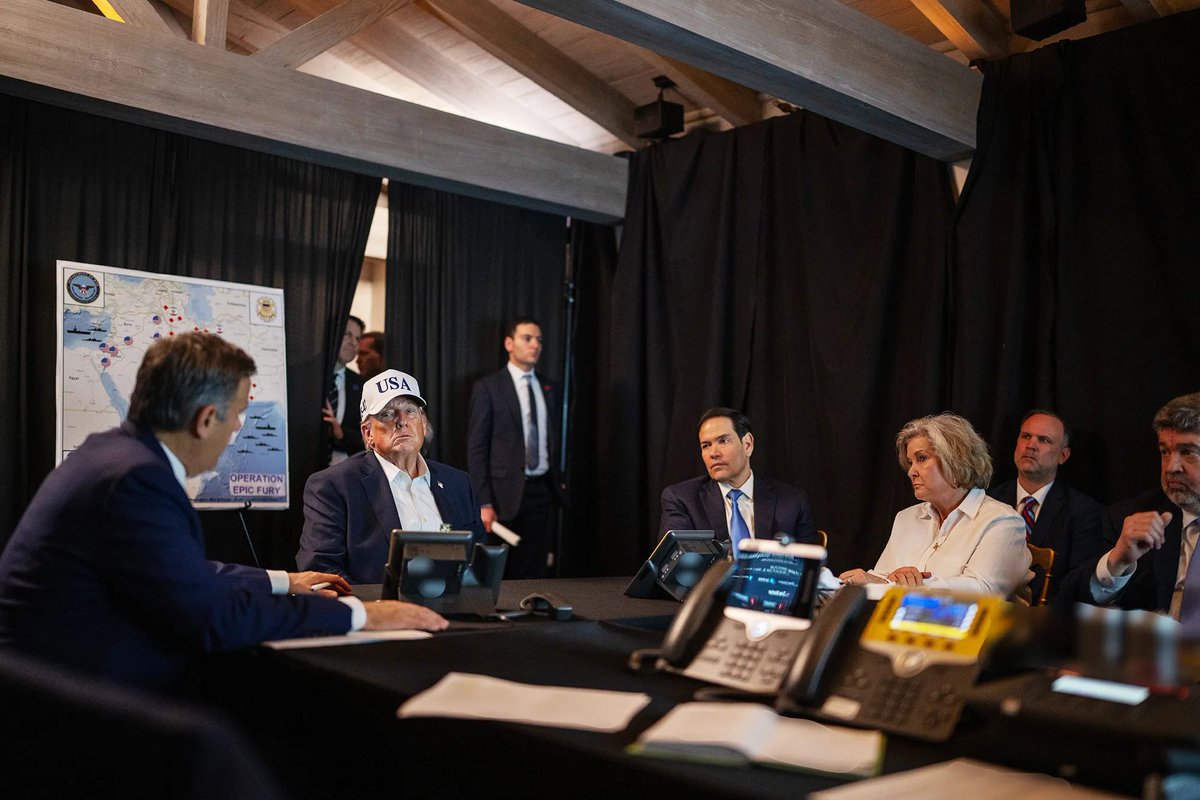
The final Situation Room meeting. Trump goes around the table.
Vance: "You know I think this is a bad idea, but if you want to do it, I'll support you."
Rubio: "If the goal is regime change, we shouldn't do it."
Cheung, the comms director, warned it contradicted everything they'd said for eight months about Iranian nuclear facilities being destroyed.
The CIA director said regime change was possible "if we just mean killing the supreme leader."
Nobody said no.
Everyone deferred to the president's instincts.
The Treasury Secretary and Energy Secretary, the two people who would need to manage the largest oil supply disruption in history, weren't even in the room.
Neither was the Director of National Intelligence.
The next day, aboard Air Force One, 22 minutes before the military deadline, Trump sent six words:
"Operation Epic Fury is approved. No aborts. Good luck."
Source: New York Times
Not too early to try and draw some broad lessons from Gulf War 3;
You need to focus on the political end state before launching any war.
The adversary has a say in any conflict, don't discount wargame outcomes that are inconvenient.
Missiles and drones with satellite imagery 1/3
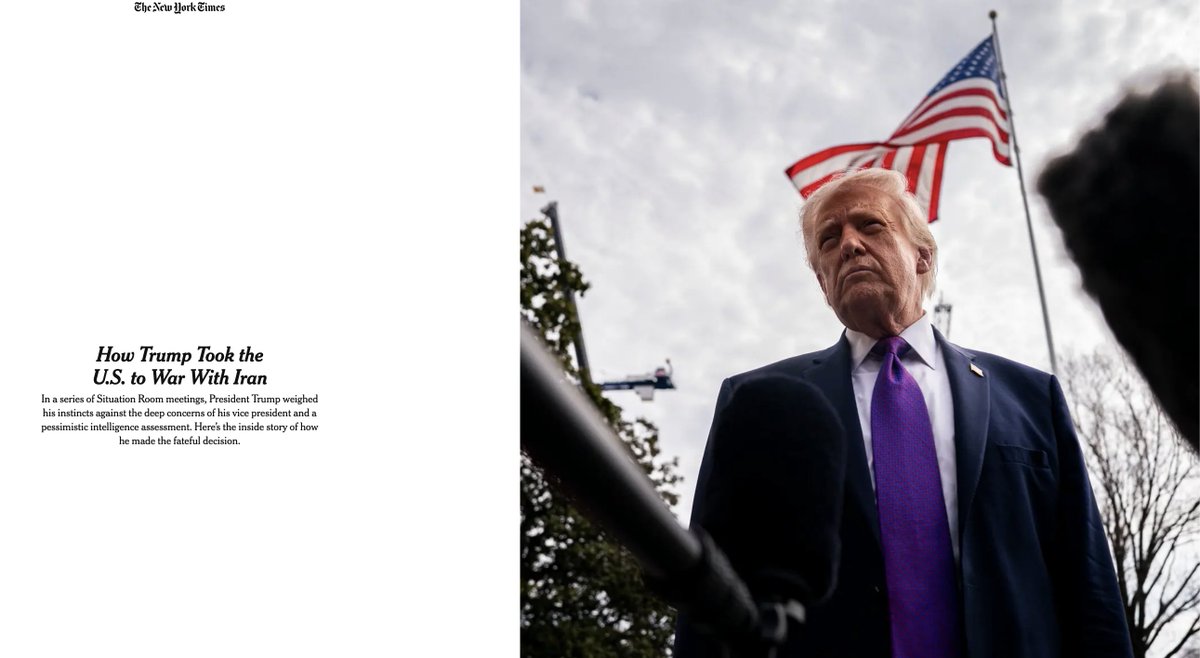
How Trump Took the U.S. to War With Iran
Before Iran War, Netanyahu privately briefed Trump in the White House Situation Room.
He presented a bold, “quick win” plan to strike Iran, destroy missiles, avoid retaliation, and even trigger regime change.
Trump liked it immediately: “Sounds good to me.”
But U.S. intelligence pushed back hard:
Military strikes = doable.
Regime change = “farcical” (CIA).
Advisers warned Israel was overselling, but Trump brushed off concerns:
“Regime change… that’s their problem.”
He focused on killing leadership + crushing Iran’s military, believing it would be fast and decisive.
Trump asked each adviser for input:
Vance: “Bad idea, but I’ll support you”.
Rubio: Only support if goal = military, not regime change.
Military: outlined risks, but didn’t oppose.
Legal: said it was permissible.
Political team: warned of backlash, but deferred.
No one firmly blocked the decision.
And here we are.
Source: NYT
🇮🇷🇺🇸 Per a senior Iranian source:
-Iran will close Bab al-Mandab if situation escalates
-U.S. has not changed its tone
-No negotiations with the Americans
-Iran will strike power plants in response to attacks on energy
-Entire region will be plunged into darkness, including Saudi Arabia
The U.S. and Iran are playing a very dangerous game of chicken right now.
Source: Reuters
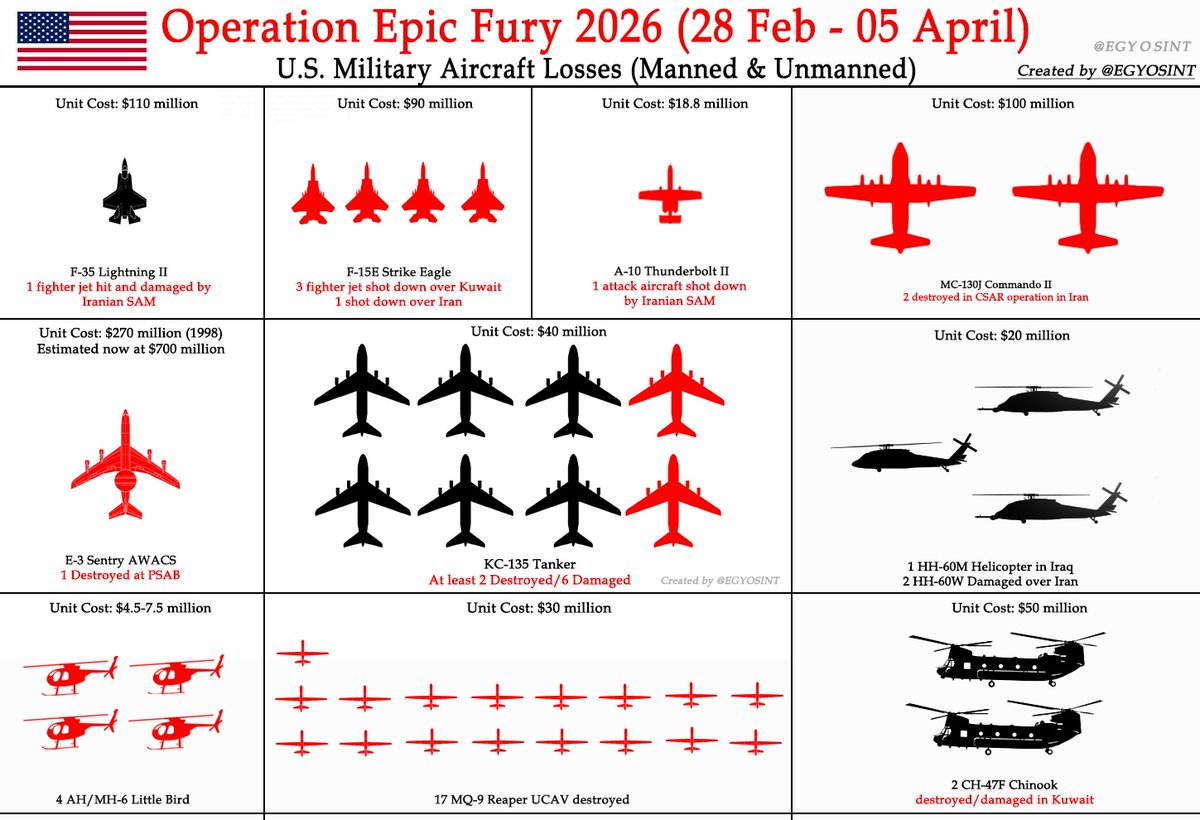
Update on U.S. Air Force losses in the Iran War — Operation Epic Fury (April 5, 2026):
Total losses are now estimated to exceed $2.3 billion, with actual replacement costs likely to climb even higher.
— Four F-15E Strike Eagles have been lost, one over Iran and three downed by friendly fire over Kuwait.
— An A-10 Warthog was shot down while providing close air support (CAS) for combat search and rescue (CSAR) operations.
— An F-35 Lightning II fighter aircraft was damaged by an Iranian surface-to-air missile (SAM).
— An E-3 Sentry AWACS aircraft was completely destroyed at Prince Sultan Air Base in Saudi Arabia.
— Two KC-135R aerial refueling aircraft have crashed, including one destroyed at Prince Sultan Air Base.
— Six additional tankers were damaged, one in an incident over Iraq and five at Prince Sultan Air Base.
— 17 MQ-9 Reaper drones have crashed or been shot down by Iranian forces since February 28.
— One HH-60M helicopter was damaged in an FPV drone attack on Camp Victory in Iraq.
— Two HH-60W helicopters were damaged during CSAR operation in Iran.
— Two MC-130J Commando II aircraft were destroyed during a combat search and rescue (CSAR) mission in Iran.
— Four AH-6 Little Bird helicopters were lost in the same operation.
— Two CH-47F Chinook heavy-lift helicopters were destroyed in Iranian strikes on Camp Buehring, Kuwait.
F-15E WSO CSAR Operation - South Isfahan
We have a background in operating aircraft from all sorts of weird places, so here's our take on what occurred:
Two MC-130 aircraft inserted via landing at an abandoned agricultural strip southeast of Isfahan, each carrying ~50 personnel along with two AH-6 Little Bird helicopters. Upon landing, forces established a perimeter while the AH-6s launched to recover the downed WSO and provide immediate close cover. Overhead assets maintained continuous air support throughout the operation.
However, the strip likely proved very unsuited for heavy aircraft. The fully laden MC-130s had likely caused their landing gear to sink into the soft surface after they had stopped moving for a while, rendering both aircraft immobile. (The reported mechanical issue!)
With recovery of the aircraft no longer feasible, the decision was made to deny them to the enemy. Demolition charges were placed to prepare both airframes and the helicopters for destruction.
A secondary extraction package, using more lightly laden aircraft better suited to the terrain, inserted to recover the CSAR teams and the WSO. The AH-6s were left behind for detonation too - likely due to time constraints and payload limitations. All personnel were successfully extracted before the site was abandoned.
Mission Accomplished
The rescue mission in Iran was almost derailed after two MC-130 special operations aircraft used in the infiltration “suffered a mechanical failure and were unable to take off.”
That left part of the rescue force suddenly at risk of being stranded inside Iranian territory, creating what one U.S. official described as the mission’s real “holy shit” moment.
With time running out and exposure risk rising, U.S. commanders made the decision to send in additional aircraft to extract the force in waves.
The rescue team reportedly had to wait for several tense hours before the backup plan succeeded.
Once extraction was completed, U.S. forces reportedly destroyed the disabled aircraft on the ground rather than leave sensitive equipment behind.
According to Reuters, the U.S. destroyed:
•2 disabled MC-130 aircraft
•4 additional helicopters
Source: Reuters
🇨🇳🇮🇷 Chinese civilians are crowd-sourcing Iran's air war — and it may be working.
On March 14, a Chinese engineer known as "Laohu Talks World" posted a viral tutorial — subtitled in Persian — detailing how Iran could use low-cost systems to shoot down a US F-35. It racked up tens of millions of views.
Five days later, Iran said it struck an F-35.
The creator is an alumnus of Northwestern Polytechnical University (under US sanctions), and is one of many Chinese STEM civilians voluntarily sharing military expertise online to aid Iran's war effort — with no payment or official backing.
Content ranges from F-35 targeting tactics to coordinates of US bases in the region.
Source: South China Morning Post