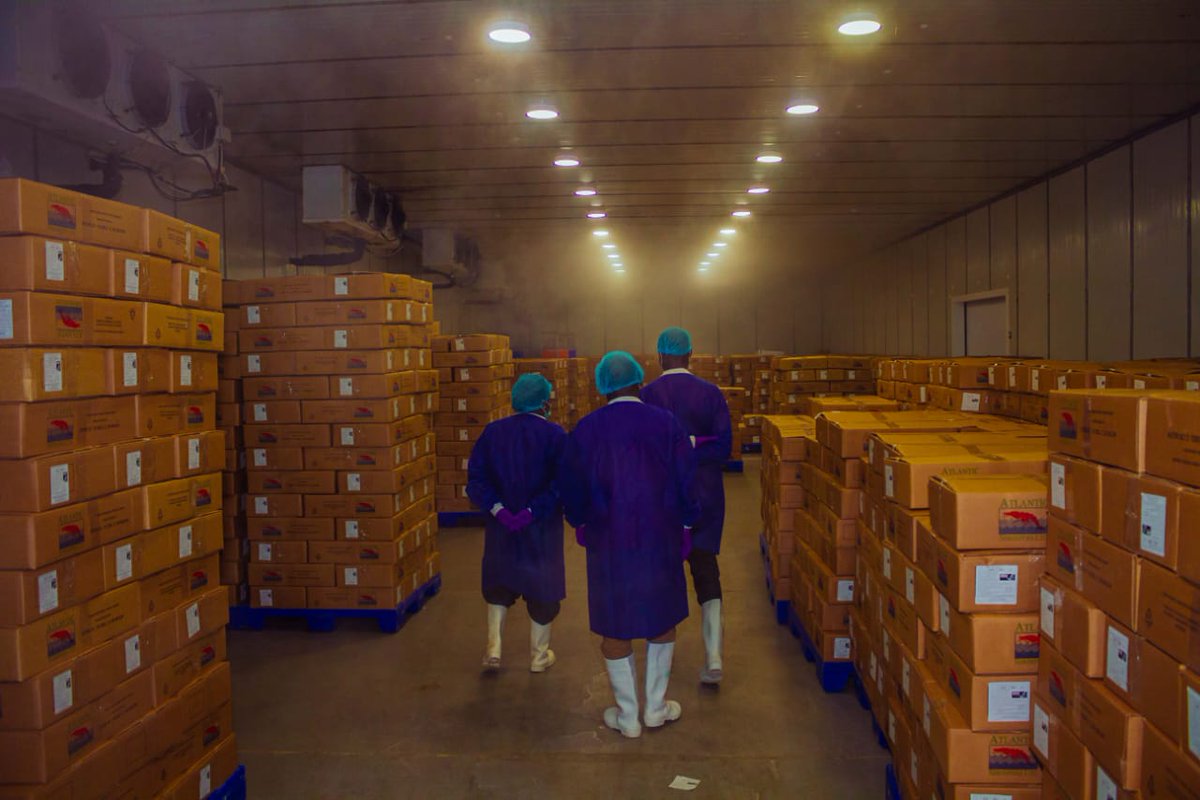
Cold chain - a major determinant of the future of food security in Nigeria
A few years ago, I was travelling through one of Nigeria's major food producing belts during harvest season. The roads were busy with trucks loaded with tomatoes, tricycles carrying vegetables stacked high, and traders sitting beside baskets of fresh produce waiting for buyers. At first glance, it was difficult not to feel optimistic. Everywhere I looked, there was evidence of hard work, productivity and abundance.
As the journey continued, however, I began to notice a different story unfolding alongside the one that was immediately visible. Some of the tomatoes had already begun to soften, while some of the vegetables had lost their freshness. A number of the baskets had clearly spent hours under the sun. Everyone in the value chain appeared to be doing their best, from the farmer who had produced the crop, to the transporter moving it, and the trader trying to get it to market. Yet it was obvious that a portion of that food would never reach consumers in the same condition in which it had been harvested.
That experience stayed with me because it forced me to think differently about the way we talk about food security.
Most dialogue in Nigeria about food security almost always begins with production. We discuss yields, hectares cultivated, irrigation, improved seeds and mechanization. These are important conversations and they should continue because no food system can function without production. At the same time, I have increasingly found myself asking whether, as government, we spend enough time thinking about what happens after food leaves the farm and whether we are directing enough investment towards that part of the value chain.
After all, a tomato harvested in Kano does not automatically become food security for a family in Lagos. A basket of vegetables harvested in Plateau State does not become food security simply because it exists. Food only fulfils its purpose when it successfully reaches the people who need it, in a condition that allows it to be consumed.
For a city like Lagos, this distinction is particularly important. Most of the food consumed in the state is produced elsewhere and travels hundreds of kilometres before it reaches markets, restaurants, hotels, processors and households. The journey from farm to consumer is therefore not a small part of the food system. It is a critical part of the food system.
This is where cold chain becomes important.
Cold chain often sounds like the kind of phrase reserved for conferences, technical reports and industry discussions. In reality, it simply refers to the systems that keep food at the appropriate temperature as it moves from where it is produced to where it is consumed. It is not a particularly complicated concept, but it has profound implications for food quality, food availability and food loss.
The more I study food systems around the world, the more convinced I become that cold chain infrastructure will play a defining role in Nigeria's food future. During visits to other countries, what stood out was not only the scale of production but also the level of attention given to protecting food after harvest. Food moved through networks of cold rooms, refrigerated transport systems, logistics hubs, distribution centres and retail channels that had been designed to preserve quality and minimize losses along the way.
Underlying all of this was a simple understanding that the work of feeding people does not end when food leaves the farm. In many respects, that is when some of the most important work begins.
That perspective has significant implications for Nigeria. As our cities continue to grow, food will inevitably travel longer distances before reaching consumers. Lagos already offers a glimpse into that future. Feeding a city of more than twenty-four million people requires productive farms, but it also requires efficient systems that can move food safely, reliably and efficiently from where it is produced to where it is consumed.
For many years, much of our attention has been directed towards increasing production, and rightly so. Yet the longer I work within food systems, the more convinced I become that the next chapter of our food story will not be defined solely by what happens on the farm, but by our ability to preserve, move and deliver what has already been produced.
Perhaps the question before us is no longer whether Nigeria can produce enough food. Perhaps the more important question is how much of that food successfully completes the journey from farm to plate.
This life is so unpredictable. I bought a car headlight from a young lady last week, and today I went back there only to hear that she's gone.
What happened to her? She closed her shop, was heading home, and a drunk driver hit her while she was standing and waiting for a cab.
I've come to understand that one of the most important parts of my job as a founder is to infuse energy into everything, into every interaction. Yeah, the dream is in my head, but my energy must ignite the spirits of those around me.