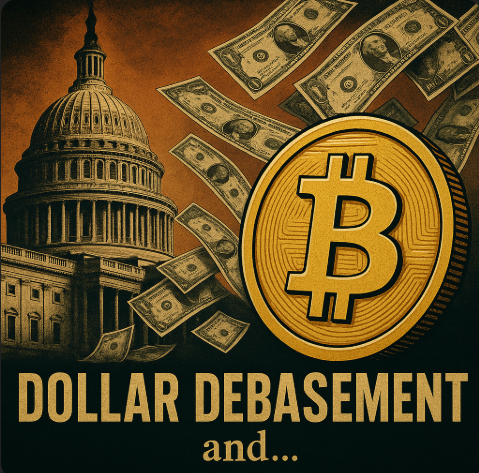
What if the next big boom isn’t an escape from the system… but a disguised rescue of the system itself?
Across modern economic history, whenever the dominant power faced a threat to its monetary supremacy, it responded not with retreat, but with a new story.
Gold. Oil. Tech. Real estate.
Each time, a fresh narrative — a promise of safety, innovation, or liberation.
And each time, it served a purpose: securing global demand for the dollar and the debt that underpins it.
The pattern is returning, only this time it wears a different mask — decentralized, encrypted, positioned as anti-establishment.
But the core mechanism remains unchanged.
U.S. national debt has now crossed the $37 trillion mark.
Federal spending continues to climb. Interest payments consume a growing share of the budget.
And the usual buyers — foreign central banks like China and Japan — are stepping back.
So who steps in to absorb the next wave of Treasuries?
The answer won’t come from Capitol Hill. It’s unfolding in the digital sphere.
To understand what’s ahead, it’s worth revisiting the past.
This isn’t the first time the dollar has faced a crisis of credibility.
Instead of OPEC, it’s ETFs, stablecoins, and DeFi protocols.
What presents itself as a rebellion against the system is, in truth, a quiet merger.
Crypto isn’t being rejected by the existing order — it’s being folded in.
Endorsed. Positioned as part of the solution.
Why?
Because the system needs a fresh story — and a new way to channel retail money into the machinery of sovereign debt.
And here lies the irony: what’s marketed as an escape from fiat is gradually becoming one of its main support pillars.
Just as oil once propped up dollar supremacy, crypto is now being repurposed to serve a similar function:
Generating organic and artificial demand for dollars under the guise of decentralization, speculation, and financial independence.
Stablecoins appear, at first, to be a clever workaround
A bridge between traditional finance and the digital future.
They promise fast transactions, no middlemen, borderless utility.
But underneath that utility lies a much larger function: they’re engines of dollar demand.
Tether, Circle, and their counterparts back their tokens with U.S. Treasuries.
The more stablecoins are adopted, the more Treasury securities must be purchased to maintain those reserves.
In effect, every minted token deepens the global reach of the dollar.
So who’s buying?
It’s the issuers themselves — using the dollars collected from users stepping into the crypto space.
The flow is deceptively simple:
➢Someone wants exposure to BTC or ETH.
➢They trade euros, reais, won, or rupiah for USDT.
➢Tether receives those dollars and purchases U.S. Treasuries.
The yield goes to the issuer; the user receives a stable token that unlocks access to the crypto economy.
In the middle, U.S. debt finds a new class of buyers — not central banks, not sovereign wealth funds.
But venture capitalists, crypto funds, startups chasing liquidity — and millions of everyday users.
Anyone stepping through the gateway into crypto.
(Even a teenager with a smartphone.)
Stablecoins have turned dollar demand into code.
They’ve extended the reach of the American monetary system to anyone with internet access.
Today, millions in developing economies rely on USDT as a store of value — even though it’s backed by debt from a country they have no stake in.
And that’s the illusion: the dollar is no longer just a national currency.
It functions like a protocol.
And stablecoins? They’re its APIs.
ETFs operate in much the same way.
Beneath the story of institutional adoption lies a financial logic as old as markets themselves:
Channeling capital into dollar-denominated, regulated, and traceable instruments.
It’s no coincidence that, as the Fed struggles to sustain demand for its bonds, Wall Street starts championing Bitcoin — but strictly through ETFs.
Because every buy flows through official rails, every entry is logged.
Every exposure becomes a net long position on the dollar.
Crypto as a revolution? Perhaps.
But also as the latest mechanism to push more dollars through the system — faster, cleaner, and with a fresh coat of innovation.
–The system depends on demand to survive.
–Demand generates a need for assets.
–In an increasingly financialized world, every asset becomes more than a simple investment.
–Assets serve as collateral, leverage tools, and integral components that amplify exposure within the system.
Bitcoin has evolved into a full-fledged financial instrument.
Not just in narrative, but in structure: today, it can be bought, held, and lent by institutional actors through regulated channels.
ETFs act as the entry point. Swaps, futures, and lending desks drive the machinery.
But it’s capital — and its unending search for yield that powers the entire system.
In this environment, even modest shifts in demand can lead to oversized market reactions.
Why?
Because crypto markets are still a fraction of traditional finance.
Imagine a pension fund putting just 0.5% of its money into Bitcoin.
Or a sovereign wealth fund looking for a way to protect against global inflation by investing in a kind of digital asset.
These might seem like small moves, but they can have a big impact.
At the same time, it’s the smart investors
The heavy hitters — who are starting the cycle.
https://t.co/p27txjjtkp
These are the players with the insight and resources to move markets, setting the stage for the next wave.
Their activity creates a momentum, a growing euphoria that eventually draws in everyday retail investors.
Not driven by ideology or rebellion, but by the undeniable pattern they’ve observed: each cycle surpasses the last.
And every time the system appears exhausted, it finds a new conduit for renewal.
This time, that conduit is crypto.
🔸Stablecoins to sustain dollar demand.
🔸ETFs to legitimize the narrative for fiduciaries.
🔸Memecoins to reignite retail’s speculative energy.
Dollar Debasement: The Triggering Factor
In conclusion, U.S. public debt has exceeded every reasonable threshold
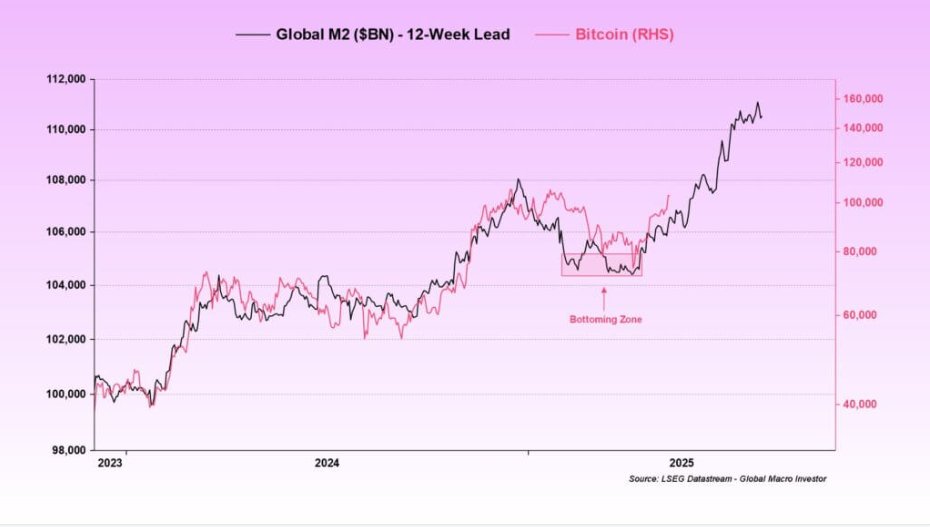
And the system’s recurring response remains unchanged: expand the money supply.
This is not a miscalculation, but a structural necessity.
Currency debasement is the mechanism that sustains an economy weighed down by excessive debt.
As more dollars are created, their purchasing power erodes — fueling inflation and monetary devaluation.
At this junction, a less discussed but pivotal factor emerges: Bitcoin halvings — the scheduled reductions in BTC issuance
Tend to align with the cycles of U.S. debt refinancing and expiration.
(Halving and cyclicality as causal and non-causal factors.)
This alignment isn’t just a technical coincidence, but a quiet correlation that reveals a deeper link between:
-Sovereign debt
- Dollar weakening
-The rising demand for alternative stores of value.
Bitcoin, with its fixed and programmed supply, becomes the natural refuge in a context of continuous fiat currency devaluation.
But the effect is paradoxical: the increased demand for BTC pushes for a greater need for dollars to buy it, thus further fueling the spiral of debasement.
It is a vicious circle where debt, the dollar, and crypto feed each other, keeping alive a system that seems unable to escape its own fragility.
This Scenario Can Makes An Growth in the Value of Cryptocurrencies in the Next 6–9 Months Likely.
Or in the long term
This is not merely a speculative boom, but a structural phenomenon
Where traditional finance and decentralized finance intertwine in an increasingly complex game of supply and demand
With dollar debasement as the triggering force and the blockchain as the arena for this new chapter.
I got a feeling $EWT will have it's time to shine this bull cycle.
Everything is lining up perfectly
• Linux adopted Digital ID
• WEF ranks SAFc as top 2024 tech
• Bitcoin ESG will trend again
• BlackRock backing & BTC ETFs
• MiCA regulations Dec 2024
EWX worker nodes are already locking in ~2 million EWT tokens (2% total supply).
With names like Shell, SABA, WEF, IREC & more all behind the vision... It's hard for most in crypto to compete.
This time around Energy Web has developed further and proven more utility in the growing renewable energy space with various solutions, many of which are focused around digital IDs.
This is one of the most essential topics and points of focus of DLT use today.
With crypto soon to be a focal point in MSM again, it's only a matter of time before we see the ESG concerns return once again.
When that happens, Energy Web's ready.
@AP_Abacus Green proofs for bitcoin by @energywebx is in private launch, public launch is still not live in ewx. It will be in a month. Waiting for that before offering "rat poison" to people?
🧵 Thread time!👇
Energy Web's Next Leap: Boosting EWT Adoption Through Innovative Solutions
Let's dive into how @energywebx upcoming solutions could drive EWT's adoption and appreciation.
For the crypto-savvy community members of Energy Web, the burning question is always about the future of $EWT, the native token.
While transactions play a role, the real game-changer lies in the adoption of Worker Nodes, and the staking requirements they bring.
Worker Nodes: The $EWT Powerhouses
Worker Nodes are not just technical components; they're the backbone of the Energy Web ecosystem. Each Worker Node requires a significant amount of $EWT to be staked.
Now, imagine multiple nodes operating within a single network, and you begin to see the potential for $EWT's demand to skyrocket.
📌 Example: Consider a large energy company that wants to deploy a network of nodes for 24/7 energy matching. Here's a breakdown of the potential $EWT requirements:
* The company needs to stake 10,000 $EWT to deploy the network.
* They aim to have 50 nodes running, with each node operator (or staker) required to stake 2,500 $EWT.
* To incentivize these node operators, each should earn about 1,000 EWT annually for their services.
In this scenario, the total $EWT staked and used would amount to approximately 185,000 tokens initially, with an ongoing annual expenditure of 50,000 tokens to reward the node operators.
Please note that the subscription amounts in the screenshot are just as fictional as Lorem ipsum placeholders.
The Optimistic Outlook
Given the current staking of ~7.5 million $EWT, and considering each worker node network requires roughly 125k $EWT staked from retail holders, there's potential for around 60 such projects. This means an additional demand of 600k $EWT staked from customers.
Moreover, channel partners would need to purchase 3 million $EWT annually off exchanges to reward the worker nodes.
With multiple channel partners and their numerous end-customers, the demand for worker node networks could surge. This paints a promising picture for $EWT's future demand and value appreciation.
Channel Partners: The Catalysts for Adoption
Channel partners, such as Deutsche Telekom, Vodafone, and Deloitte, are essentially the resellers of the EW tech stack. These giants can request networks on the marketplace, and both they and the community can add their Worker Nodes to these networks. The more these partners integrate EW solutions, the more nodes are required, and consequently, more $EWT gets staked.
📌 Example: Deloitte decides to implement an EW solution for its green energy initiative. They request a network on the marketplace, leading to the creation of, say, 50 Worker Nodes. If each node requires a staking of 10,000 $EWT, that's 500,000 $EWT locked in just for this single initiative.
EW Software-as-a-Service (SaaS) Platform
While the SaaS platform is designed to facilitate the deployment of EW solutions, from a crypto perspective, it's a gateway for enterprises to enter the EW ecosystem. The more companies use the platform, the more Worker Nodes are likely to be set up, and the cycle of $EWT staking continues.
📌 Example: A startup in the e-mobility sector wants to leverage EW's Green Proofs for its clean energy project. They use the SaaS platform to deploy their solution, leading to the creation of several Worker Nodes, each requiring EWT staking.
Open Charging Network (OCN) 2.0
OCN 2.0 is more than just an upgrade; it's a vision of decentralized e-mobility. With Worker Node networks at its core, OCN 2.0 could be a significant driver for EWT staking.
📌 Example: An electric vehicle (EV) charging company adopts OCN 2.0 to streamline its operations. The system requires multiple Worker Nodes to manage the vast number of EV charging stations. As these nodes are set up, EWT is staked, driving demand.
In Summary
For the EWT holders and enthusiasts, the future looks promising. Energy Web's focus on Worker Nodes and the involvement of major channel partners could lead to a surge in EWT staking.
As these solutions are adopted more widely, especially by giants in the energy sector, the demand for EWT could see a significant uptick.
🤝 The key takeaway? Energy Web's innovations are not just reshaping the energy sector; they're setting the stage for $EWT's potential meteoric rise.
Thanks for following along!
If you're as excited about #EnergyWeb and $EWT as I am, drop a ❤️, repost and tag anyone who needs to read this. Spread the word! Let's grow together!
Sources:
Latest update from @energywebx
https://t.co/EvDGMjvbbR
EW-DOS overview
https://t.co/pTsyJFiZeV
E-Mobility Management
https://t.co/68pOhthiWR
OCN 2.0
https://t.co/sY8S77nFDY
Worker Node Conceptual Architecture (new)
https://t.co/9unZT7aK2G
Hosting worker nodes (too watch)
https://t.co/getpaUCy2w
Previous posts
https://t.co/LvXEitK7xp
And if you like to be on top of alpha, join @GreenAltCrypto's Green Crypto Club. Big thanks to everybody there sharing knowledge. Get educated!
@haiguardian still has an outstanding promise to share a little bit more on the topic of E-Mobility Management ;)
Narratives need to be simple.
Everyone can understand that AI revolution is happening in front of our eyes. This is where $RNDR steps in.
The AI revolution demands more computational power than traditional systems can handle.
With @RenderToken decentralized GPU network, $RNDR can fuel this growth with unparalleled power and efficiency.
This is why all the major players are trying to get a piece of @OTOY and @RenderToken!
🔥 Last call to load on $RNDR
🤑 U are about to miss one of the biggest opportunity #crypto has offered since $ETH ICO
🤯 $RNDR is about to become the default GPU network for #rendering, LLM & more for largest cinema studios & tech companies.
💰Do u have a bag? Google is in🚀
Our last “BTN” of 2022 is a year-in review that covers #RenderNetwork’s achievements from the past year and provides a sneak peak into what lies on the horizon in 2023!✨
Cheers to a new year!!🥂🎊
https://t.co/GVtHZZFnLc
The main title sequence for the feature film "Gala" on Netflix was rendered on #RNDR! 🦾🔥#RenderNetwork
More of Nikon Basu’s work:
https://t.co/TNH3tMW4BV
How good of a BERT can one get in ONE DAY on ONE GPU?
With all the recent studies about scaling compute up, this paper takes a refreshing turn and does a deep dive into scaling down compute.
It's well written, stock full of insights. Here is my summary and my opinions.
🧶 1/N
During an unprecedented period of macroeconomic turbulence in the crypto market, the #RenderNetwork has continued to see growth!🦾
Our "BTN" this week is a Data Deep-Dive (Q1-Q3 of 2022).
Here’s a glimpse into some stats showing growth & consistent usage from users globally:🧵
The #metaverse is inevitable and it's going to be worth TRILLIONS
BUT there’s one huge problem – our current infrastructure can’t support it
Protocols such as @RenderToken aim to fix this and, as such, have the potential to increase in value by 30x – 80x
Here’s how
👇
🧵