Kip, calling me a hypocrite is simply wrong.
I've publicly criticized peaq myself. I've invited you and other Krest supporters to explain your concerns, discussed those concerns openly, and even spoken directly with the peaq team about Krest. Some of those discussions also received public responses from peaq.
That doesn't mean every issue has been resolved. I've never claimed that.
But criticizing MapMetrics for its lack of communication is not the same as repeatedly declaring an entire team incompetent under practically every peaq-related post.
And about my so-called essay: Yes, it was long. But it didn't come out of nowhere.
@pewealo called my posts "AI slop", while you questioned my neutrality. I've spent months trying to have constructive conversations about Krest, including with you. At some point, I got tired of having my credibility questioned simply because I didn't share your conclusions.
Was my response harsh? Absolutely. But there's a history behind it, and you know that.
You have every right to criticize peaq and how Krest was handled. I've never disputed that. But I also have the right to disagree with you, without being accused of hypocrisy or dishonesty.
I've listened to your arguments, acknowledged legitimate concerns and tried to get answers.
Disagree with me all you want. But don't pretend I've spent all this time blindly defending peaq. You know better.
Exactly one year ago, I received 34,000 $PEAQ in rewards from Season 2 of @peaq's Get Real campaign.
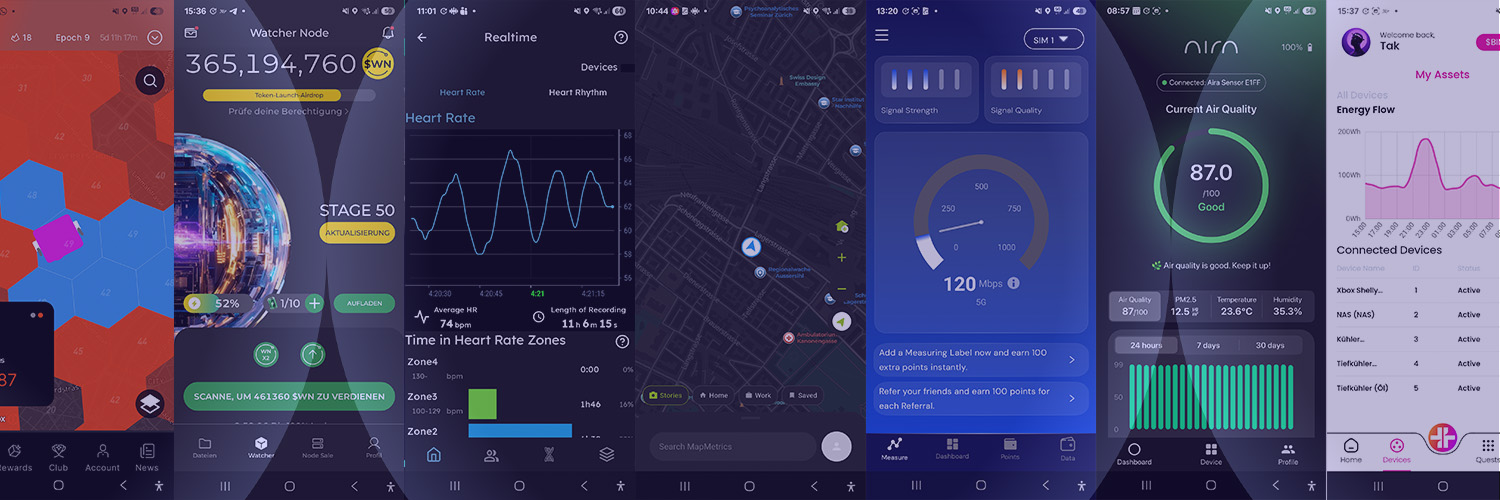
Worth more than $1,500 at the time. The rewards came from using DePIN apps like @silencioNetwork, @MapMetrics, @DATSProject , @DeNetPro and many others.
I loved Get Real. And yeah, I know. Some of you hated it and some people lost their job because of the campaign.
It got me genuinely interested in #DePIN and turned me into someone who didn't just read about these projects but actually used them. I reinvested some of my rewards into hardware and kept trying new projects long after the campaign ended.
Of course, I hoped to earn more money along the way. But I also knew that not every project would succeed.
Now, two years after I started, things look rather different.
Take MapMetrics. I bought two SPT devices for around $300. Total earnings so far: $0. The app hasn't been working properly for quite some time, support requests have gone unanswered, and as far as I can tell, the team hasn't provided a meaningful community update in over six months.
Other projects, including @charge_xyz and @roam_network, have shut down. @ScannitNetwork has disappeared. And I've spent countless hours collecting data, completing quests and maintaining hardware for projects that never generated a cent for me.
I can accept that projects fail. That's the risk of getting involved early.
What I find much harder to accept is teams simply going silent while users continue investing their time, money and trust. If things aren't going well, say so. You don't owe your community success, but you do owe them some honesty.
And I don't blame @peaq for the failures of independent projects. In fact, I find it impressive how peaq itself has evolved since Get Real, moving toward the infrastructure needed to make the Machine Economy work.
But my experiences have changed the way I approach DePIN. I'm much more cautious now. I'm no longer willing to spend hundreds of dollars on hardware just because a project has a promising whitepaper, an app and an ambitious roadmap.
I want to know whether there's a real market for the service. Whether there are paying customers, or at least a realistic path toward finding them. And whether the team understands that building a community also means communicating with it when things get difficult.
I still believe in DePIN. I still enjoy discovering new projects, and I certainly don't regret everything I did back in 2024.
Get Real was fun, I learned a lot, and those rewards were very real. But I have become a lot more selective about where I invest my time and money.
Which leaves me with one question:
If @peaq announced Get Real Season 3 tomorrow, featuring 15 new DePIN projects, would I join?
Who am I kidding? Of course I'd take a look. I'd probably even end up climbing the leaderboard again.
But this time, I'd like to know who's paying for the data before I pay for the hardware.
Kip, we've had this discussion countless times. And I've never had a problem with legitimate criticism of peaq. I've criticized plenty of things myself.
But I'll be direct: I stopped taking you seriously a while ago.
You show up under practically every peaq-related post to tell everyone how incompetent the team is. At this point, it's not constructive criticism anymore. It's becoming an obsession, and frankly, it's getting pathetic.
I've raised concerns myself, and I've always received answers. That doesn't mean peaq is above criticism. But it also doesn't mean the team has to spend 24/7 responding to your latest rant.
There's a difference between holding people accountable and turning your dislike of a project into a full-time job.
And if you're going to keep accusing people of incompetence, perhaps you should take a look at how you communicate your own criticism.
We get it, Kip. You think the peaq team is incompetent.
Message received. Several hundred times. I happen to disagree.
And somehow, there's exactly one account that's managed to be even more tiresome about peaq than you: @DOGE_Kingdom_.
I'm fully aware that mentioning him will probably summon him into these replies to explain, once again, how the entire peaq team is supposedly scamming everyone.
I'll take that risk.
Definitely! Silencio and Acurast have become part of my routine, and I earn rewards from both. I also discovered @AnyoneFDN through peaq, and my router now earns around 4–5 $ANYONE a day.
I'm still using @DeNetPro, too. And I'd happily keep running @DATS if I could get the desktop app working on my MacBook again after the latest update...
So yes, quite a few projects stuck around long after Get Real ended. And that's probably the best outcome of the campaign for me.
I won't defend the bugs. Get Real certainly had its share of problems, and I understand your frustration if your reports weren't taken seriously.
But our experiences were clearly different. I earned over $2,000 across the campaigns, so I can't honestly call the whole thing a disaster.
The bugs were real. So were my rewards. 😁
I can definitely see where you're coming from. What frustrated me most was that some projects weren't particularly transparent about their progress or financial situation. Sometimes you'd go weeks without hearing anything at all.
That said, I have to admit that the early adopter angle was part of the appeal for me two years ago. I was willing to take risks in the hope of earning more rewards later. And with Get Real, that actually worked out pretty well, even though it was an ecosystem-wide campaign rather than rewards from individual projects.
I don't think taking that risk was necessarily pointless. But I've become a lot more selective about which projects are worth taking it for.
That sounds perfectly reasonable. And I had to go through those experiences myself first. Of course, looking back, it was a bit naive. But for me, everything related to @peaq was interesting, and I wanted to be familiar with as many projects as possible so I’d be prepared for future seasons of the Get Real campaign.
So @MapMetrics can update its Terms & Conditions and serve ads again. But answering its users? Apparently, that's a different story.
Seriously, what the hell is going on?
Today, I opened MapMetrics and, for the first time in ages, a rewarded ad actually loaded.
Sounds like good news? Well, there's a catch.
For quite some time, rewarded ads weren't loading properly, which meant users couldn't restore their streaks. People lost weeks or months of progress because a feature they depended on simply didn't work.
Meanwhile, questions on X and by email have gone unanswered, as far as I've seen. No meaningful explanation, no clear update about the project's future.
But apparently, the Terms & Conditions were updated on October 28, 2026. And now the ads are working again, at least for me.
So someone is clearly maintaining parts of the operation. Or at the very least, something is still running.
I've used MapMetrics for more than a year and a half, bought two SPT devices and earned exactly zero dollars from the project. I can live with an investment not working out. That's part of getting involved in early-stage #DePIN.
What I find much harder to accept is being left in the dark.
When a working advertisement starts to feel like the biggest update in months, something has gone seriously wrong with your communication.
@MapMetrics, your users deserve some answers.
If you only looked at crypto charts right now, you'd think the entire industry had stopped moving.
My portfolio isn't giving me much reason to celebrate either.
But away from all those red candles, some pretty interesting things are happening. And @machinedotfun, backed by @peaq, just delivered a good example.
In its first two weeks, the platform recorded $5.96 million in trading volume and generated $80,900 in trading fees.
$29,200 was allocated to the project creators behind the projects listed on https://t.co/NzkQRBmnxR. That's money the teams can actually claim and use to fund development, without having to sell additional tokens.
Another $11,500 went into community reward reserves, while $40,200 went to the platform for operations, project support and other activities, including planned buybacks of solana:69LjZUUzxj3Cb3Fxeo1X4QpYEQTboApkhXTysPpbpump and $PEAQ.
Of course, $29,200 spread across multiple projects won't suddenly put thousands of robots into people's homes. Trading fees aren't product sales, and a popular token doesn't guarantee a successful machine.
But there's something encouraging about seeing at least part of all that speculation turn into actual operating capital for people building physical products.
And if some of those projects eventually make it into mass production and adopt peaqOS, that's where the connection to the wider Machine Economy becomes even more interesting.
The crypto market may be having a terrible time right now. But that doesn't mean the people building things have stopped working.
Now let's see how many of those machines actually make it off the workbench.
There it is. The official clarification from @peaq.
Exactly the distinction I tried to explain in my post earlier this week: continuous vesting is real, but a monthly vesting total is not a one-day cliff unlock.
Good to see this addressed directly by the team. Hopefully, the token trackers @DefiLlama@TokenomicsCOM and @coingecko will follow.
IMPORTANT❗️
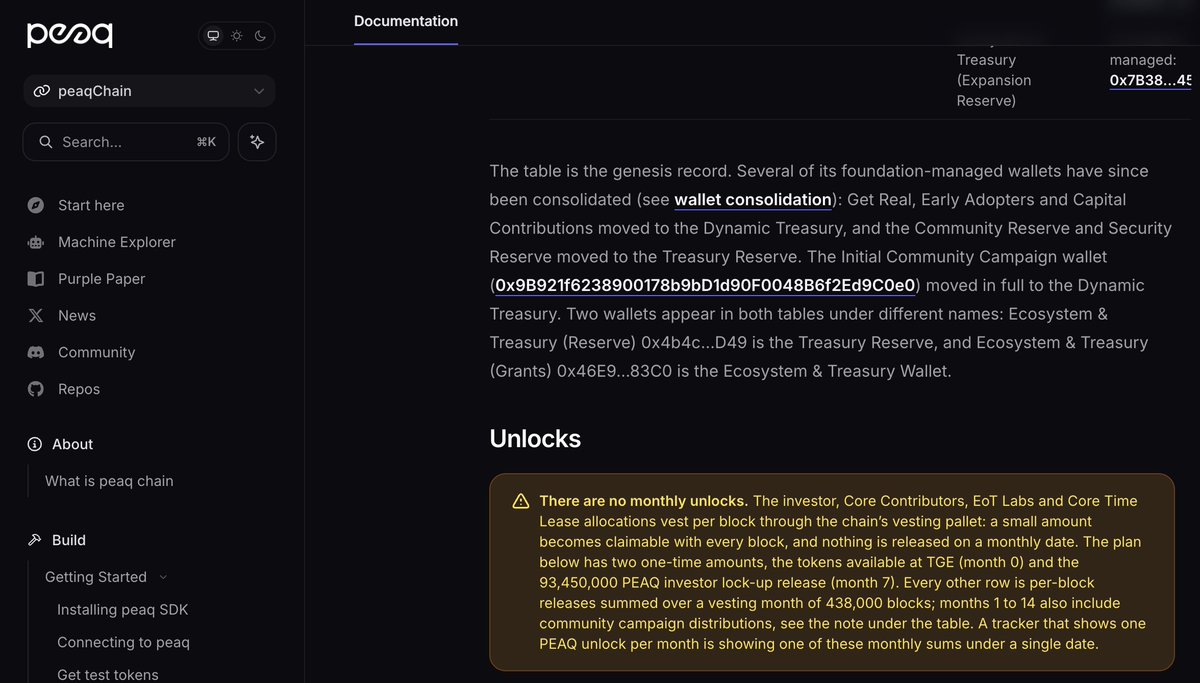
$PEAQ vests every block, not in batches
There are no periodic unlocks. Vesting allocations release per block through the chain’s vesting pallet.
A small amount becomes claimable with every block. Nothing is released on a weekly or monthly date
Some trackers are showing 56M, 82M or even 96M $PEAQ unlocking in one day. That’s a mistake, and we’ve already contacted their teams to fix it
Here’s where it comes from ↓
The crypto market sucks right now. No point sugarcoating it.
And $SLC is getting dragged down with it, despite @silencioNetwork having delivered some pretty significant updates lately.
Silencio recently confirmed that @ElevenLabs is using its voice data for AI. That's a major name on the customer side. And on top of that, $SLC has expanded from @peaq to @solana.
And according to @AlexM_SLC, more big announcements are planned for this week.
In a different market, news like this might have sparked a lot more excitement. Right now, it seems like everything gets swallowed by the sea of red candles.
But here's the thing: A bad market doesn't mean good projects have stopped making progress.
Prices can fall while businesses keep growing. Announcements don't guarantee green candles, of course, but neither do red candles mean nothing good is happening.
So if the market is getting you down, don't forget to look beyond the charts once in a while.
Some projects are still delivering. Even when everything is red.
And @silencioNetwork is giving us some pretty good examples of that.
Guess this is my Monday morning motivation. ☕
Stop. Spreading. Misinformation.
No, there is no massive scheduled ethereum:0x1eef208926667594e5136e89d0e9dd6907959197 cliff unlock on November 12. And no regular monthly unlock event either.
So why are token trackers showing 56 million, 82 million or even 96 million PEAQ supposedly unlocking on that day?
@DefiLlama's unlock overview has listed ethereum:0x1eef208926667594e5136e89d0e9dd6907959197 as a "Cliff Unlock" involving roughly 2.17% of the circulating supply, while its detailed PEAQ page now describes a weekly unlock rate and explains per-block vesting. @CoinGecko and @TokenomicsCOM have also displayed large monthly unlock figures.
No wonder people are confused.
After @WendlerTill raised the issue, I went through @peaq's official tokenomics documentation.
The explanation is straightforward: Remaining investor and team allocations vest continuously, block by block. Tokens gradually become claimable rather than being released in one big monthly batch.
Some tracking platforms present these amounts as if they were suddenly unlocking on a specific date.
Now, let's be clear: The vesting is real. Additional tokens are becoming available over time, and they can eventually become transferable. But a month's worth of continuous vesting is not the same as a massive one-day cliff unlock.
Till also confirmed that peaq has already contacted some of these platforms to correct the information.
And honestly, I can't blame people for being confused. When established data providers present the same kind of event, why wouldn't you believe them?
Apparently, even ChatGPT has been repeating those numbers.
Credit to @WendlerTill for addressing this and continuing to clarify the situation.
A monthly vesting total is not a monthly unlock event. Time to get those calendars right.
The crypto market is bleeding. Meanwhile, @silencioNetwork just reported 113% quarterly revenue growth.
Revenue more than doubled from $300K in Q2 to $640K in Q3. Total revenue received so far in 2026: $1.04 million.
Silencio now reports four enterprise clients, including @ElevenLabs and a Tier 1 AI lab that signed the largest contract in the project's history. The other two operate in AI agents and AI data services.
According to Silencio, all four clients have already placed repeat orders.
That tells me more about the potential of this business than any token chart.
But there's also news for $SLC holders. The $1 million revenue threshold has been crossed, and the first $30K in revenue-funded token buybacks is now scheduled for Q4. Not executed yet, but finally a concrete amount attached to the mechanism.
Silencio also expects more than $1 million in additional revenue during Q4 alone.
And what did $SLC do after the update? It briefly climbed to around $0.00036 before pulling back, while much of the broader market was still struggling.
Yesterday, I wrote that red candles don't mean nothing good is happening.
Today we have another reminder that there's a business behind those candles. And in Silencio's case, that business appears to be growing rather quickly.
Guess my Monday morning motivation aged pretty well. 😁
The robot is still on the workbench. Its token is already trading on @solana.
Sounds backwards? Maybe. But this could be how the next generation of robots gets funded.
I took a closer look at @orbie_robot on @machinedotfun: a real prototype, an ambitious price target below $500, and a new way for hardware startups to finance the journey to mass production.
And there's a reason @peaq is backing this idea.
Meet Orbie, a small, wheeled home robot being developed by @jaiswalashok and his team.
The idea is to make home robotics affordable. Instead of building another $20,000 humanoid, Ashok wants to create a robot that ordinary households can actually buy.
They're starting with pets. Orbie is intended to move around your home, check on your animals, observe their behavior and eventually recognize when something seems unusual.
I'm fairly sure my cats would immediately declare war on Orbie. But I guess that's part of testing a robot in the real world. 🤖 ❌ 🐈⬛
The team has already built working prototypes, published open-source code and shared videos of the development process.
And now they've launched solana:HEb2dwDNbBhnrCusoNXXvba9MymYTTmMQcHKaptxmfun on https://t.co/NzkQRBmnxR.
Building hardware is expensive. You need components, prototypes, testing and eventually manufacturing. All of that costs money long before you can sell your first finished product.
https://t.co/NzkQRBmnxR offers a different approach. Builders can launch a token, build a community around their project and receive a share of the trading fees to help fund development.
The token is already trading. The robot, meanwhile, is still being developed.
And that's an important distinction. A successful token launch doesn't mean a finished product, and market cap isn't the same as money raised for manufacturing.
But imagine Orbie actually making it into thousands of homes. Those machines could eventually run peaqOS, giving them digital identities and access to the wider Machine Economy.
That's the bigger idea behind @peaq supporting https://t.co/NzkQRBmnxR: help hardware builders get started, then provide infrastructure as their machines become real products and, hopefully, growing fleets.
Of course, there's still a long road from a prototype on someone's desk to a robot you can buy for your living room.
But I find it fascinating that we can now watch that journey unfold in public. And perhaps even help finance it.
Now let's see whether Orbie can make the jump from the workbench to mass production.
@RanginuiVenture@silencioNetwork@ElevenLabs No worries! I was referring to the recent pullback, not SLC's overall performance. I've been pretty impressed by that myself. 😁
https://t.co/tuJTrn18kI
And I'll definitely catch the quarterly update!
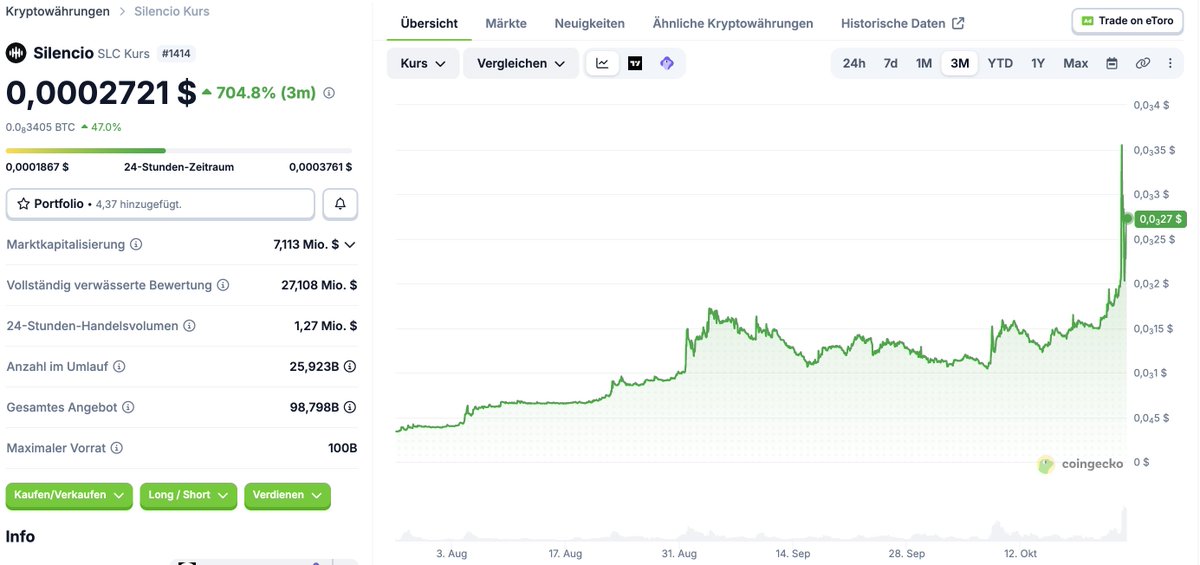
$SLC: +700% in three months!
I know this sounds like an "I told you so" post, but I don't predict prices. I judge projects by their business model, their execution and whether people are actually willing to pay for what they build.
So forget the price for a moment and look at the numbers behind @silencioNetwork:
✅ 2.5M+ contributors across 180+ countries
✅ 1M+ hours of off-the-shelf voice data
✅ $250,000 contract with one of the world's leading Voice AI companies
✅ Biggest deal in Silencio's history signed with a frontier AI lab for African voice data
✅ 2026 revenue expected to cross $1M
✅ $40M+ active enterprise pipeline across 50+ leads
✅ 5 of the world's top 10 AI companies have already inquired about Silencio's data
And there could be much more ahead. AI models are still hungry for voice data, especially across languages, dialects, accents and regions where high-quality datasets are difficult to find.
Once Silencio reaches a $1M+ cash reserve, the company has committed 75% of data-sale revenue to the BlockSound Foundation, which will use it to buy $SLC on the open market and burn it.
So if the business grows, there is a direct mechanism designed to turn part of that revenue into buy pressure and permanently reduce supply.
AI company needs data → Silencio mobilizes contributors → contributors get paid → Silencio generates revenue → revenue can eventually fund $SLC buybacks and burns.
That's a #DePIN model I understand.
And judging by the growing commercial interest and the recent price action, it looks like more and more people are starting to understand it too.
@AlexM_SLC@silencioNetwork@ElevenLabs That's the kind of conviction we like to see! 🦾 Build the business, let the results speak for themselves, and the charts will catch up.
@RanginuiVenture@silencioNetwork@ElevenLabs $SLC has performed remarkably well over the past few months. I was referring to the recent pullback and the broader market sentiment, not dismissing that performance. If anything, it makes Silencio's progress even more interesting.
Wait...@peaq x @Samsung ? 👀
Now THAT would be something.
I've been Team @SamsungMobile for well over a decade. And I've been Team @peaq for quite a while, too. So you can imagine my reaction when I saw both names appearing in the same announcement.
Not the big partnership announcement I might have hoped for, but pretty interesting in its own right.
Machines running peaqOS can now interact with devices connected through Samsung's SmartThings ecosystem.
With this integration, an authorized robot can unlock a door under its own digital identity, without borrowing someone's login.
Or imagine an office cleaning robot switching lights on as it works and off again when it leaves. Or several delivery robots sharing a charging depot, each with its own access permissions instead of one shared PIN.
peaqOS handles the identity, permissions and a traceable record of the commands. SmartThings handles the connected devices.
We talk about robots changing the world. But sometimes, the next big step is solving a rather ordinary problem.
@peaq keeps opening doors for the Machine Economy. This time, quite literally.