I finished my third and final plasmapheresis session yesterday!
This hospital in Tokyo offers a special technique called “Dual Filtration Plasmapheresis” (DFPP/DFPA), which cleans the amyloid fibrin, microclots, misfolded proteins, and autoantibodies to levels as small as 5 microns while protecting your own albumin, hormones, clotting factors, and beneficial antibodies (eg the good stuff).
Compared to the plasma filtering and cleaning techniques in the U.S. — the two most popular being “Plasma Exchange” (TPE) and “EBOO” (Extracorporeal Blood Oxygenation and Ozonation)— the former throws out all the good stuff as much as the bad by extracting your plasma and replacing it with watered-down donor plasma (and in 2026 runs the risk of being contaminated with amyloids of its own). The latter, EBOO, can’t filter out the particle sizes needed to catch the microclots and amyloid fibrin plaguing my specific situation. I’ve done all three styles at this point, and if the U.S. approved techniques worked, I wouldn’t be here.
When I arrived last Monday before starting, the Program Lead and Research Scientist, @KevinMcCairnPhD, sampled my plasma and showed me it had the texture of “hydrogel.” This is not normal, of course, and explains a lot of the symptoms I can’t shake, like fatigue. After three DFPP sessions, my plasma looks much different now, and my energy is returning.
So, the $1MM question is - why so much fatigue, and what’s causing all the “post-exertional malaise”? Why have my energy and biological reserve been having such a hard time keeping up?
At its core, it is a mitochondrial issue. Microclots and misfolded proteins starve your system of oxygen at the cellular level by obstructing the plumbing, and that oxygen is critical to pulling electrons through your ATP cycle in order to generate energy. Essentially, hypoxia of the microvascular system starves your system from the top down.
I met with numerous U.S. doctors, and all I received were blank stares for years. We now know, though, that the answer to restoring mitochondrial function and ATP is to clear up the plumbing, restore oxygen delivery, and activate cellular signaling function.
Microvascular Erasure in Long COVID and Spike Protein Exposure: Complementary Mechanisms of Direct Cellular Injury and Perfusion Impairment Driving Capillary Rarefaction
🚨Spike protein may be erasing your capillaries.
New proposal claims LongC0VID’s core problem is irreversible microvascular destruction, not just inflammation.
→Structural + functional rarefaction up to 18 months post-inf!
➡️Interesting international evidence-based hypothesis model, a research proposal builds on existing science/literature!
➡️Bear with me…. their hypothesis:
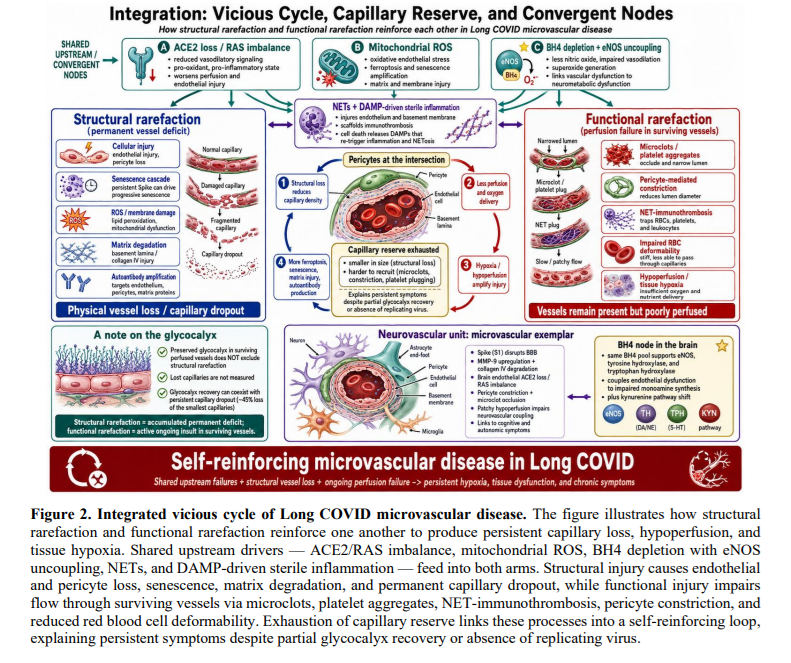
1. Persistent capillary rarefaction is a core hallmark of LongC0VID, detectable up to 18 months post-infection, with studies showing ~45% loss of the smallest capillaries and reduced microvascular health scores.
2. They propose two complementary, interacting mechanisms of “microvascular erasure” driven by SARSCoV2 spike protein exposure:
A. STRUCTURAL rarefaction (irreversible physical vessel loss) via direct endothelial and pericyte injury: calcium dysregulation, mitochondrial dysfunction, ACE2/RAS imbalance, NF-κB inflammation, eNOS uncoupling (BH4 depletion), ferroptosis, NETs/DAMPs, senescence, and autoantibodies.
B. FUNCTIONAL rarefaction (perfusion failure in remaining vessels) via amyloid fibrin microclots, NET-immunothrombosis, platelet activation, pericyte constriction, and RBC deformability issues.
3. These create a vicious cycle of patchy hypoxia, tissue ischemia, fibrosis, and organ dysfunction (brain fog, fatigue, cardiac issues, etc.), potentially progressing to an acquired systemic sclerosis-like state (“Spike Protein Endothelial Disease” or SPED).
4. Reinfection/vaccination: The document does not discuss reinfections or present any data on vaccination. It only proposes future studies to correlate capillary density with vaccination history and spike exposure. No mechanisms or comparisons between natural infection versus vaccine-derived spike are detailed.
➡️This proposal synthesizes prior evidence on persistent capillary rarefaction and spike-mediated endothelial injury into a unified “microvascular erasure” framework, distinguishing structural from functional damage and introducing the "SPED concept". Its bolder interpretive synthesis offers a coherent, hypothesis-generating model that indeed should merit further testing.
‼️So, following the authors, capillary rarefaction in LongC0VID represents not a temporary dysfunction but progressive, largely irreversible microvascular erasure. Once structural vessel loss occurs, downstream parenchyma is permanently orphaned in non-regenerative tissues (heart, brain, kidney), locking patients into chronic hypoxia and multi-organ decline. Spike-driven mechanisms turn a single exposure into a self-perpetuating disease process with “scleroderma-like” features, a sobering prospect of widespread, potentially permanent microvascular obliteration if unaddressed.🤔
Would greatly appreciate @resiapretorius thoughts?
#AvoidSars2 #AvoidReinfections
https://t.co/gZgpZrEXtN
@dianeducret@AnneliseBocquet Where in usa did you find treatment & diagnoses? i struggle á peu prés with the same ‘no understanding nor urgency for treatment’ in europe.
None are "cures" but some could help. This list would be much longer and have more antivirals and mAbs if researchers were taking long COVID seriously.
Lumbrokinase, maraviroc, LDN, and Truvada have all helped me. I'd try larazotide, especially if I suspected i had a viral reservoir in my intestines (GI symptoms like diarrhea). However I'd team that peptide with stronger antivirals to take out the contained infection. Larazotide has tamed cases of MIS-C and MIS-A.
You can't avoid die-offs if you actually have a pathogen overgrowth.
But getting die offs to the point of being unable to get out of bed is ridiculous.
-You create a massive inflammatory storm.
-You dysregulate the immune system.
-You cook your brain.
-You deplete glutathione, CoQ10, NAD+ etc.
-You might further harm the gut and the liver.
Etc
In case you are unaware, antimicrobial or antifungal therapies can often trigger a Jarisch-Herxheimer reaction or "die-off" with symptoms that can range from nausea, headaches, slight fevers, fatigue, rashes, feelings of histamine intolerance and so on.
This reaction occurs during rapid pathogen death and includes the release of microbial components such as:
-Lipopolysaccharides (LPS).
Endotoxins from gram-negative bacteria activate the toll-like receptor 4 on immune cells, triggering nuclear factor-kappa B (NF-κB) signaling and the release of pro-inflammatory cytokines such as interleukin-6 (IL-6), tumor necrosis factor-alpha (TNF-α) and interleukin-1β (IL-1β).
-β-Glucans and Mannoproteins.
Fungal cell wall components from Candida species stimulate dectin-1 receptors on macrophages, further activating NF-κB and cytokine release.
-Acetaldehyde and ethanol.
These are metabolic byproducts of Candida and certain bacteria that cause oxidative stress and neurotoxicity.
-Nucleic acids and proteins.
These are released during microbial lysis, these act as damage-associated molecular patterns (DAMPs), perpetuating immune activation through pattern recognition receptors (PRRs).
Now the intensity of die-off is influenced by the:
-Microbial loads (severe SIBO with >10^5 CFU/mL will release more toxins than a minor case for example)
-The person’s detoxification capacity.
Impaired phase I (cytochrome P450) and phase II (conjugation) liver detoxification pathways will obviously harm the person’s ability to detox these products.
-The states of his immune system.
Overactive Th1/Th17 responses or mast cell activation syndrome (MCAS) amplify inflammatory responses for example.
-His gut barrier integrity.
A leaky gut, allows greater translocation of toxins into systemic circulation.
So it's a good idea to:
-Support detoxification pathways and the immune system for 8-12 weeks before killing anything
-Provide anti-inflammatory support
- Start stupidly low (1/10 of the recommended dose) (i've seen people get full blown die offs with 100mg of berberine)
-Use tools that can bind toxins and enhance detoxification such as:
-Activated charcoal (start with just 500mg 2 hours before or after your meals and medications).
This one absorbs LPS, acetaldehyde and mycotoxins due to its porous structure.
-Bentonite clay (start with just ½ a teaspoon on an empty stomach).
This one binds cationic toxins.
-N-Acetylcysteine (NAC) (start with just 300mg twice a day).
This one increases GSH synthesis and conjugates acetaldehyde while also inhibiting NF-κB.
-Milk thistle (Silymarin).
This one upregulates Nrf2.
-Quercetin.
This one inhibits mast cell degranulation and downregulates NF-κB.
-Pantethine.
This serves a s precursor to coenzyme A, supporting acetyl-CoA formation from acetate (it basically enhances phase II detoxification).
-Provide enough B3 (or NAD+ precursors such as NMN), molybdenum, magnesium and zinc to support ALDH/AOX activity.
-Thiamine (B1) can aso help by supporting pyruvate dehydrogenase and preventing acetaldehyde formation from pyruvate.
Point being: in all things, don't be impatient and think that applying more extreme approaches will lead to better results.
Also most people massively neglect working on GABA before, during and after a "gut cleanse" and experience issues such as insomnia and irritability.
You can learn more about gut issues here: https://t.co/KccEcmzQjy
Three things in this video are working on the babies sleeping in it. The birds are slowing their nervous system. The sunlight is teaching their developing brains to tell day from night. The open air carries far fewer viruses than the air inside a daycare classroom.
The human nervous system has two settings: fight-or-flight, which keeps you alert, and rest-and-digest, which winds you down. Birdsong tips the body toward rest-and-digest mode. In 2017, researchers at Brighton and Sussex Medical School put 17 adults in MRI scanners and played them bird recordings or city noise. The bird recordings shifted their bodies into the calmer mode. Heart rate variability went up, a sign the nervous system was handling stress well.
Newborn babies don't have an internal clock yet. They don't know day from night. The hormone that makes you sleepy at night, melatonin, isn't produced until around 3 months old. Cortisol, the hormone that wakes you up in the morning, takes 2 to 9 months to develop a daily rhythm. Sunlight on the baby's eyes is what teaches the brain when those hormones should switch on. A baby napping under trees gets that signal every day. A baby napping in a dark indoor room misses it.
Outside air is also cleaner than indoor preschool air. Dozens of kids share the same indoor space for hours, breathing the same germs back and forth. A 1990 Swedish study found preschoolers who got 6 to 9 hours outside per week at daycare got sick less often than kids with under 5 hours. In 1997, a follow-up compared regular preschools to outdoor "forest schools" where kids spend the whole day in nature. Same pattern: forest-school kids got sick less. Outside, the same germs disperse instead of recirculating in a closed room.
There's a more extreme version of this in Finland. About 95% of Finnish families put their babies outside to nap in prams, sometimes in below-freezing weather, starting at two weeks old. Researchers at the University of Oulu surveyed 116 families and found these outdoor naps lasted 1.5 to 3 hours. The same babies napping indoors only managed 1 to 2 hours.
Italy has been opening schools that do exactly this. The first one, called asilo nel bosco (Italian for "forest kindergarten"), opened near Rome in September 2014. Kids spend the whole day outside, including nap time. The model was borrowed from Germany and Scandinavia, where forest schools have been running for decades. The Italian network grew quickly after COVID.
So while these kids are sleeping in the video, four things are happening at once. The birdsong is calming their nervous system. Their internal clock is being trained by the sunlight on their faces. Outside, the germs they're breathing are diluting in open air instead of piling up in a closed classroom. And the nap, if the Finnish data is any guide, is probably running longer than the indoor version.
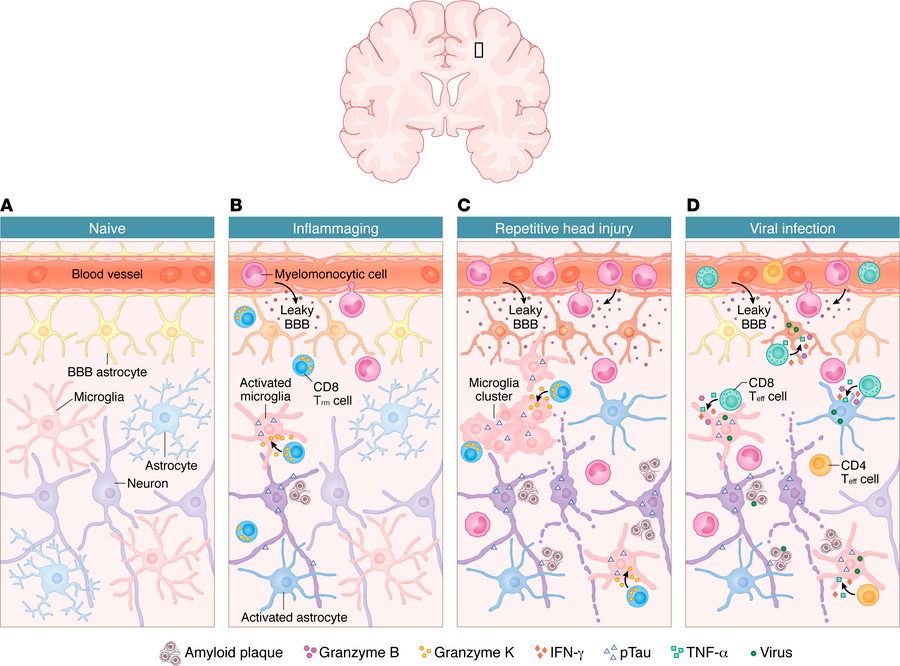
Here it is. From Feb 2025. I attached the study. This is when I found out the choroid plexus was compensating (growing in size) to compensate for brain shrinkage. The choroid plexus makes CSF (cerebral spinal fluid). Think about the plumbing. As the brain atrophies (shrinks) from the viral infected platelets and microclots blocking oxygen from reaching the tissues, the choroid plexus beefs up to make more fluid so the brain can float and not hit bone. It was evidence that thee oxygen isn't getting to the tissues properly including the brain.
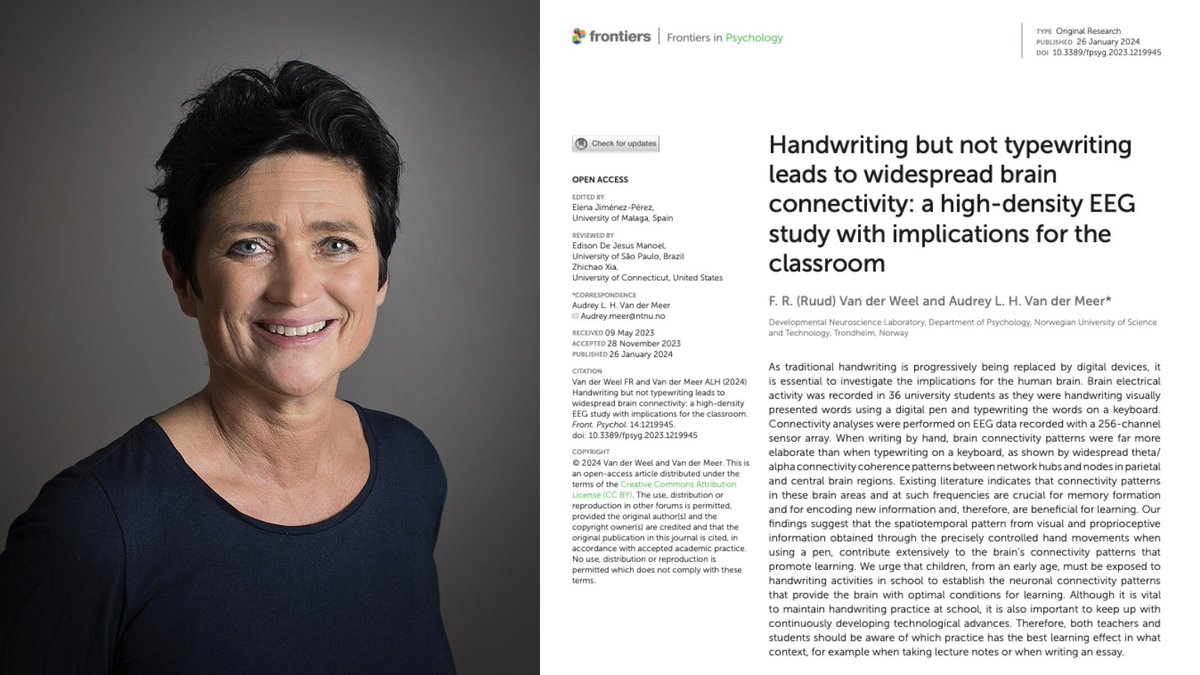
A Norwegian neuroscientist spent 20 years proving that the act of writing by hand changes the human brain in ways typing physically cannot, and almost nobody outside her field has read the paper.
Her name is Audrey van der Meer.
She runs a brain research lab in Trondheim, and the paper that closed the argument was published in 2024 in a journal called Frontiers in Psychology. The finding is brutal enough that it should have changed every classroom on Earth.
The experiment was simple. She recruited 36 university students and put each one in a cap with 256 sensors pressed against their scalp to record brain activity. Words flashed on a screen one at a time.
Sometimes the students wrote the word by hand on a touchscreen using a digital pen, and sometimes they typed the same word on a keyboard. Every neural response was recorded for the full five seconds the word stayed on screen.
Then her team looked at the part of the data most researchers had ignored for years, which is how different parts of the brain were communicating with each other during the task.
When the students wrote by hand, the brain lit up everywhere at once.
The regions responsible for memory, sensory integration, and the encoding of new information were all firing together in a coordinated pattern that spread across the entire cortex. The whole network was awake and connected.
When the same students typed the same word, that pattern collapsed almost completely.
Most of the brain went quiet, and the connections between regions that had been alive seconds earlier were nowhere to be found on the EEG.
Same word, same brain, same person, and two completely different neurological events.
The reason turned out to be something nobody had really paid attention to before her work. Writing by hand is not one motion but a sequence of thousands of tiny micro-movements coordinated with your eyes in real time, where each letter is a different shape that requires the brain to solve a slightly different spatial problem.
Your fingers, wrist, vision, and the parts of your brain that track position in space are all working together to produce one letter, then the next, then the next.
Typing throws all of that away. Every key on a keyboard requires the exact same finger motion regardless of which letter you are pressing, which means the brain has almost nothing to integrate and almost no problem to solve.
Van der Meer said it plainly in her interviews.
Pressing the same key with the same finger over and over does not stimulate the brain in any meaningful way, and she pointed out something that should scare every parent who handed their kid an iPad.
Children who learn to read and write on tablets often cannot tell letters like b and d apart, because they have never physically felt with their bodies what it takes to actually produce those letters on a page.
A decade before her, two researchers at Princeton ran the same fight using a completely different method and ended up at the same answer. Pam Mueller and Daniel Oppenheimer tested 327 students across three experiments, where half took notes on laptops with the internet disabled and half took notes by hand, before testing everyone on what they actually understood from the lectures they had watched.
The handwriting group won by a wide margin on every question that required real understanding rather than surface recall.
The reason was hiding in the transcripts of what the two groups had actually written down.
The laptop students typed almost word for word, capturing more total content but processing almost none of it as they went, while the handwriting students physically could not write fast enough to transcribe a lecture in real time, which forced them to listen carefully, decide what actually mattered, and put it in their own words on the page.
That single act of choosing what to keep was the learning itself, and the keyboard had quietly skipped the choosing and skipped the learning along with it.
Two studies. Two countries. Same answer.
Handwriting makes the brain work. Typing lets it coast.
Every note you have ever typed instead of written went into your brain through a thinner pipe. Every meeting, every book highlight, every idea you captured on your phone instead of on paper was processed at half depth.
You did not forget those things because your memory is bad. You forgot them because typing never woke the part of the brain that would have made them stick.
The fix is the thing your grandmother already knew.
Pick up a pen. Write the thing down. The slower road is the faster one.
@hellofabie Im glad you found short term solution to your sufferin but do hope you realize this is not durable long term. Your suppressing and not treating the root cause. Benzos mess with mineral absorption & gaba receptors. bcp157 to help you get through withdrawls with tapering off.
@rainbowjanelane & i understand, i was a defeated skeptic 2. But curing is not a linear proces. No paxlovid ?Join the club, so We look for alternatives. Thymosin alpha for reversing lymphophenia, Ginseng strenghtens IFN cd4 vaccination response. Gou teng protects neurons & inhibts pem hypoxia.
@rainbowjanelane Sure but I didnt say it 100% cures.. but can make the difference between hopeless bedbound suffering & human worthy functional living. Also you have to combine therapies. Best anti viral/neuro herbs = Uncaria Rhynchophylla/Gou teng, Lithospermum erythrorhizon, Panax ginseng. GL!
@alexaaronlab My t went up naturally with optimalization of;
Energy production
Mitochondria & thyriod function
Endotoxin overgrowth
Estrogen cleaning through liver
Keep Cortisol, serotonin, prolactin low
https://t.co/PPUdHs9xqg explains in depth
@rileyanderz herbs are tricky
Nigel sativa in normal cold oral form is anti viral t & nk cell profillating t cell cd4 cd8 through its anti oxidant mechanism ( great at lowering tgfb1 induced lung smoke damage or sars covid
&only when isolate Thymoquinone in high doses it induces appoptosis
EXACTLY HOW I DETOX ALUMINUM (AND OTHER HIDDEN TOXINS) 👇 Let’s be real - avoiding aluminum completely in today’s world is nearly impossible. It’s in deodorant, cookware, medical interventions, tap water, and even sneaks into our food when we cook with foil. That’s why I
One reason you should really care for your circadian rhythm in chronic health conditions:
Leptin deficiency or resistance is a primary driver of immunosuppression & thymus atrophy
On the brain level, the LepR is extremely sensitive to inflammation and is reduced in its sensitivity under such conditions
If you now blast blue light on end after sunset, and never saw the AM light to induce a melatonin surge at night, you essentially loose the controlling arm & the solution to the problem
Melatonin is one of the strongest anti-oxidants in the body and it directly sensitizes the LepR for leptin and its actions
By this, it enables leptin to travel into the hypothalamic regions during midnight and induce a Th1 shift within the brain, clearing stuff from the brain
On a systemic level, leptin induces this shift also through prolactin and growth hormone, which is why when we age we get sicker or feel less rested. Its a measure of GH secretion at night
GH is also one of the best known human treatments of thymic atrophy, so you have the full picture here
Talked to a lot people in the LC community, there is such a huge focus on supplements, but circadian rhythm & micronutrient dense diets are pretty low rated imho
Aging-associated decline of phosphatidylcholine synthesis is a malleable trigger of natural mitochondrial aging | Nature Communications https://t.co/BkiOZyj5Kl