Nobody asked us this week if nuclear can be mobile.
They asked when ours flies.
That is the shift. 73 seconds of it, below.
We spent the week at TEVCON in San Diego, exhibiting and speaking alongside the people writing the next chapter of American energy from U.S. Nuclear Regulatory Commission to the @USArmy Applications Laboratory, Defense Innovation Unit (@DIU_x ), @INL Idaho National Laboratory and so many more.
One moment not to forget: a senior operational energy leader standing at our booth, arms crossed, silent for a full minute. Then one question. "How many can you build a year?"
Not if. How many.
Here is what @TamFortis introduced:
A 40 kWe nuclear microreactor. Continuous, clean, autonomous. Designed to fly in by helicopter or drive in on the back of a pickup. Designed for the forward edge of the map, the hospital after the hurricane, the disaster zone where first power restored decides who survives the night.
Executive Order 14299 names mobile reactors on US soil by 2028. That clock is already running.
Thank you to everyone who stopped at the booth, challenged the design, and asked the harder question behind the question. Thank you to Tom Holm and the Energy Defense Council for building the only room in the country where conversations happen at this altitude.
One question we are taking home, and we're handing to you:
If the grid ends at the edge of the map, what runs on the other side?
Tell us in the comments.
#Nuclear #Microreactors #DefenseTech #TEVCON2026
Seventy-five years ago, in the Idaho desert, four lightbulbs flickered on at EBR-I. They were the first usable electricity ever generated from nuclear energy.
This week our team stood on that exact spot, at the start of two of the most extraordinary days of this journey.
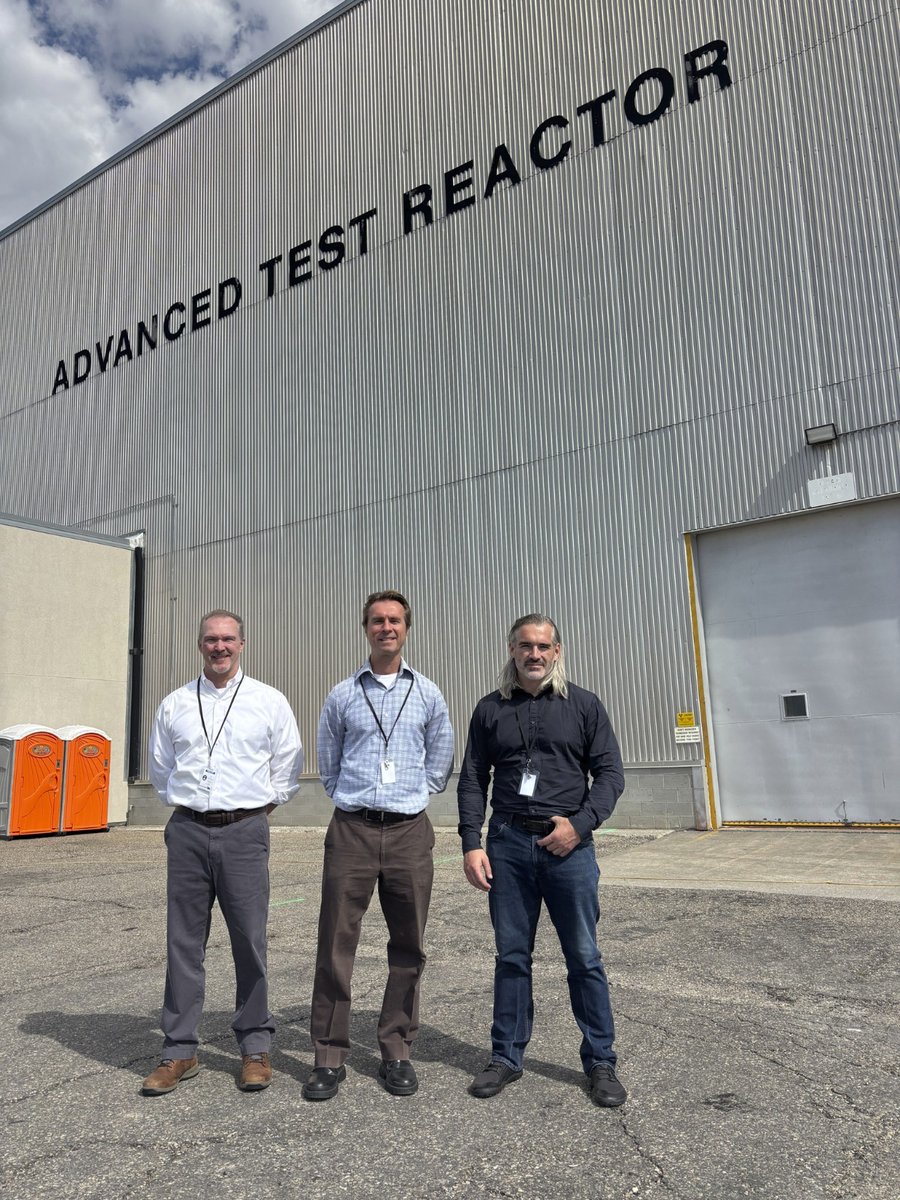
Robert Howe, Chris Dawson and I spent two days at @INL , walking from the birthplace of nuclear power to the place where its future is being proven: the National Reactor Innovation Center NRIC DOME, MARVEL, the Advanced Test Reactor, and the fuel examination and conditioning facilities, HFEF and FCF, that anchor the whole enterprise.
For a company building a helicopter-portable microreactor, this was the most important ground in the country. The capabilities we saw, from HALEU fuel qualification to advanced instrumentation and autonomous controls, are exactly the foundation our system is designed to build on, and the mission we saw everywhere at INL is the one we are chasing: resilient power for forward bases and disaster zones when the grid goes down.
We are deeply grateful to the people who made it happen. To Cayla MacCheyne, P.E. and Joseph Renevitz, who organized two seamless days. To Brady Orchard, who took us inside DOME, a genuine highlight of the visit. To Shelly Norman, who guided us mile after mile and shared her lab with real warmth. To Kevan Weaver at ATR, and to Piyush Sabharwall, whose conversations sharpened our thinking. And to so many others across INL and NRIC who gave us their time and expertise.
We came to Idaho to learn from the best in the world. We left more convinced than ever, and more ready to build.
True Mobile Nuclear, Finally. Tam Fortis Solutions, Inc. LinkedIn post in first comment...
#nuclear #energy #defense #power #ArtificialIntelligence
An AI can find the safe move faster than any human, in places no human can reach. But it never decides what counts as safe. The validated physics does.
We just made that case to the Nuclear Regulatory Commission, and it is now on the formal public record.
The NRC's proposed Part 57 rule will set the terms for how the next generation of microreactors is licensed, including, for the first time, autonomous operation. @TamFortis filed formal comments on that rule, and they are now part of the docket.
Our position is simple, and for a machine like this we think it is non-negotiable. The validated physics codes run, and they make every safety-significant determination. Learned models decide which of those validated computations to run and flag where to look, but they never stand in for the physics. Every consequential action is checked against hard physical limits before it executes, and a qualified human stays on the loop with override and shutdown authority at all times. This is the line the NRC's own October 2024 AI gap assessment drew: well-accepted, physics-based computational methods are not to be replaced by AI. A learned model marketed as "physics-informed" is still a learned model, and it does not run our reactor. The validated solver does. A general-purpose large language model has no place in the decision at all.
This is not a position paper. It is what we are building. Tam Fortis and @microsurgeonbot, the AI company that develops our control system, have demonstrated this approach at U.S. Department of Energy leadership scale on the Frontier and Aurora supercomputers, including a working closed-loop control prototype.
Getting this right is what lets America field mobile, resilient nuclear power for forward operations, disaster response, and remote communities, safely and at the speed this moment calls for.
If you are shaping advanced nuclear policy, deploying it, or investing in it, I would welcome the conversation. The full comment is linked below:
https://t.co/CtGQgC8O6M
#AdvancedNuclear #Microreactor #NuclearRegulation #ArtificialIntelligence #EnergyResilience #NationalSecurity
An AI can find the safe move faster than any human, in places no human can reach. But it never decides what counts as safe. The validated physics does.
We just made that case to the Nuclear Regulatory Commission, and it is now on the formal public record.
The NRC's proposed Part 57 rule will set the terms for how the next generation of microreactors is licensed, including, for the first time, autonomous operation. @TamFortis filed formal comments on that rule, and they are now part of the docket.
Our position is simple, and for a machine like this we think it is non-negotiable. The validated physics codes run, and they make every safety-significant determination. Learned models decide which of those validated computations to run and flag where to look, but they never stand in for the physics. Every consequential action is checked against hard physical limits before it executes, and a qualified human stays on the loop with override and shutdown authority at all times. This is the line the NRC's own October 2024 AI gap assessment drew: well-accepted, physics-based computational methods are not to be replaced by AI. A learned model marketed as "physics-informed" is still a learned model, and it does not run our reactor. The validated solver does. A general-purpose large language model has no place in the decision at all.
This is not a position paper. It is what we are building. Tam Fortis and MSBAI, the AI company that develops our control system, have demonstrated this approach at U.S. Department of Energy leadership scale on the Frontier and Aurora supercomputers, including a working closed-loop control prototype.
Getting this right is what lets America field mobile, resilient nuclear power for forward operations, disaster response, and remote communities, safely and at the speed this moment calls for.
If you are shaping advanced nuclear policy, deploying it, or investing in it, I would welcome the conversation. The full comment is linked below:
https://t.co/dch03Jdh9X
#AdvancedNuclear #Microreactor #NuclearRegulation #ArtificialIntelligence #EnergyResilience #NationalSecurity
A nuclear microreactor small enough to fly in under a Black Hawk, and an AI that can run it with no one on site.
People keep telling us the video below looks like science fiction. It is a working control prototype, and it runs today.
@TamFortis and MSBAI are building this together. Tam Fortis is designing a true mobile reactor: sealed, transportable, sized to fly in from a Black Hawk to a CH-53, and built to deliver power for years on a single fuel load. MSBAI is building the artificial intelligence that operates it.
What you are watching is that AI closing the loop. It runs Model Predictive Control over a physics-faithful digital twin of the reactor core. Every step, it rolls thousands of possible drum-motion futures forward on a GPU, scores each against target power, temperature, and hard safety limits, makes the best move, and replans as conditions change, in near real time.
Here is the part that matters for a machine like this. The AI never decides the physics. Validated physics decides. The learned models only propose and rank which validated computations to run, every consequential action is checked against hard physical limits before it executes, and a human stays on the loop with override and shutdown authority at all times. That is the only kind of autonomy that belongs anywhere near a reactor, and it is exactly where the NRC's new microreactor framework is pointing.
We built and proved this at U.S. Department of Energy leadership scale, on the Frontier and Aurora supercomputers.
Why it matters: clean, resilient power for a forward operating position, a hurricane-isolated hospital, a remote mine, or an off-grid community, with no fuel convoys and no crew on site.
This is an early prototype. We are showing the path, not the finish line. But the path is real, and it is moving fast.
If you are working on resilient power for defense, disaster response, or remote operations, or you just want to see where this goes, follow along. We are glad to talk.
#AdvancedNuclear #Microreactor #ArtificialIntelligence #NationalSecurity #EnergyResilience #DigitalTwin
Tam Fortis launches initiative to develop world's smallest portable nuclear reactors, responding to new executive orders
#nuclear#energy#investmentopportunity#Abundance
https://t.co/ttVDnNL67R
Tam Fortis Launches Initiative to Develop World's Smallest Portable Nuclear Reactors, Directly Responding to New Executive Orders https://t.co/0GFle6Hce3
#energy#opportunity#AI#nuclear