Cofounder at @RaylineAI.
Building ARC, an SLM purpose-trained to choose the best model for every task.
Stanford MBA/MS. RedSox/movies fan, first of his name.
Today, we're incredibly excited to introduce @RaylineAI and launch ARC, a new approach to AI model routing born from a problem we faced ourselves.
If you've built with AI, you've probably experienced some version of this: you use an expensive frontier model for tasks a much smaller model could handle just as well, or you use a cheaper model for something it struggles with, only to watch it spin its wheels, burn tokens, or fail altogether.
And with new models arriving every week, keeping track of which is best for what is nearly impossible.
Either way, you pay in cost, latency, or user experience.
We faced this building Workshop. As we worked to solve it, we realized the problem wasn't unique to us. It's something nearly everyone building AI products or agents faces.
That's what led us to ARC.
Two things matter to us:
𝟭. 𝗠𝗼𝗱𝗲𝗹 𝘀𝗲𝗹𝗲𝗰𝘁𝗶𝗼𝗻 𝗻𝗲𝗲𝗱𝘀 𝘁𝗼 𝗯𝗲 𝗴𝗲𝗻𝘂𝗶𝗻𝗲𝗹𝘆 𝗶𝗻𝘁𝗲𝗹𝗹𝗶𝗴𝗲𝗻𝘁.
Routing isn't just sending easy prompts to cheap models and hard ones to expensive models. The right choice depends on the conversation, the task, available models, reasoning effort, and even cached context.
We trained ARC specifically for multi-turn routing, rather than relying on static rules or simple heuristics. And we keep updating it as new models arrive. Sometimes the latest frontier model is worth it; often, a smaller model works just as well at a fraction of the cost. You shouldn't need to track every release to benefit.
We're publishing our research and benchmarks so you can dig in.
𝟮. 𝗕𝗲𝘁𝘁𝗲𝗿 𝗿𝗼𝘂𝘁𝗶𝗻𝗴 𝘀𝗵𝗼𝘂𝗹𝗱𝗻'𝘁 𝗰𝗼𝗺𝗲 𝘄𝗶𝘁𝗵 𝗹𝗼𝗰𝗸-𝗶𝗻.
Too many routing solutions are tied to a provider, gateway, harness, or application. You shouldn't have to change your stack to get better model decisions.
ARC is an 800M-parameter, open-weight model, and we've made it flexible in how you use it. You can plug it into your existing tools like any other model, tailor its decisions to your priorities and inference economics, and choose whether we handle inference for simplicity or you use your own providers and infrastructure for more control.
The goal is simple: better AI outcomes, lower costs, and more freedom to build your way.
And for those who know Workshop: it's not going anywhere! It's still a great place to build with AI and experiment with ARC firsthand.
If you're building with AI and feeling your margins squeezed, or wish your AI budget went further, let's talk. DMs are open.
I'm incredibly proud of our small but mighty team and excited to share this. We're hiring, too! 🚀
https://t.co/nsWbw1kZma
In 2015, I built an AI that detects early cancer.
Today, we’re introducing ARC by Rayline: the world’s first unified model for routing AI.
> 97.5% of Opus 5.5 quality
> Up to 1/10th of the cost
> Fully open-source
It picks the right model and the right amount of thinking for every step of your agent’s work.
Try it here and read our technical report below:
https://t.co/P7LCZwhMuQ
@TheStalwart In a couple of years:
"Most people think we use Alice as one of the parties in cryptography examples because of the 2026 NVIDIA incident, however...."
Waiting for the Bob player to drop in this story.
In 2015, I built an AI that detects early cancer.
It’s still running across hundreds of hospitals in the US today.
It was the most fulfilling work of my life, and I was building in AI years before everyone called it “AI”.
Building in AI then was a dream.
Now It feels like we’ve taken a turn for the worse.
It started when i was in undergrad.
I built my first company: AI models that made the political data transparent to voters.
At 21, I was offered six figures for it, but the buyers wanted to use it for reasons I couldn't ethically support.
So we turned down the offer and shut down the company instead.
In 2014, I moved into deep learning research on language models, for the Intelligence Community and Goldman Sachs.
Then HCA Healthcare came to us.
They put me in a competition against 10 people from IBM Watson. It was just me and the tools I’d built.
Our job was to build an AI model that can catch the cancer that slips through the cracks in hospitals.
It was the most intense 30 days of my life. Multiple all nighters.
My models won. That turned into a $5M deal, and later its own company, Azra AI.
Then the world caught on.
ChatGPT and Claude arrived, and AI costs exploded.
Building in AI in 2015 felt novel.
We were using it to find cancer tumours and save lives.
Now the biggest tech companies have turned AI into a money extraction machine.
That’s when I decided to make a change.
We raised $8.5M to build a better future for AI.
On Wednesday, we’re launching Rayline.
AI shouldn’t be locked inside a few labs’ models, prices and clouds. It should be open, transparent and decentralized.
More on Wednesday.
@MikeIsaac It was funny walking out and everyone having noticeably loud conversations while everyone adjusted.
So much fun. They heard the decades of criticisms of dark or non-detailed monster fights and went ALL IN.
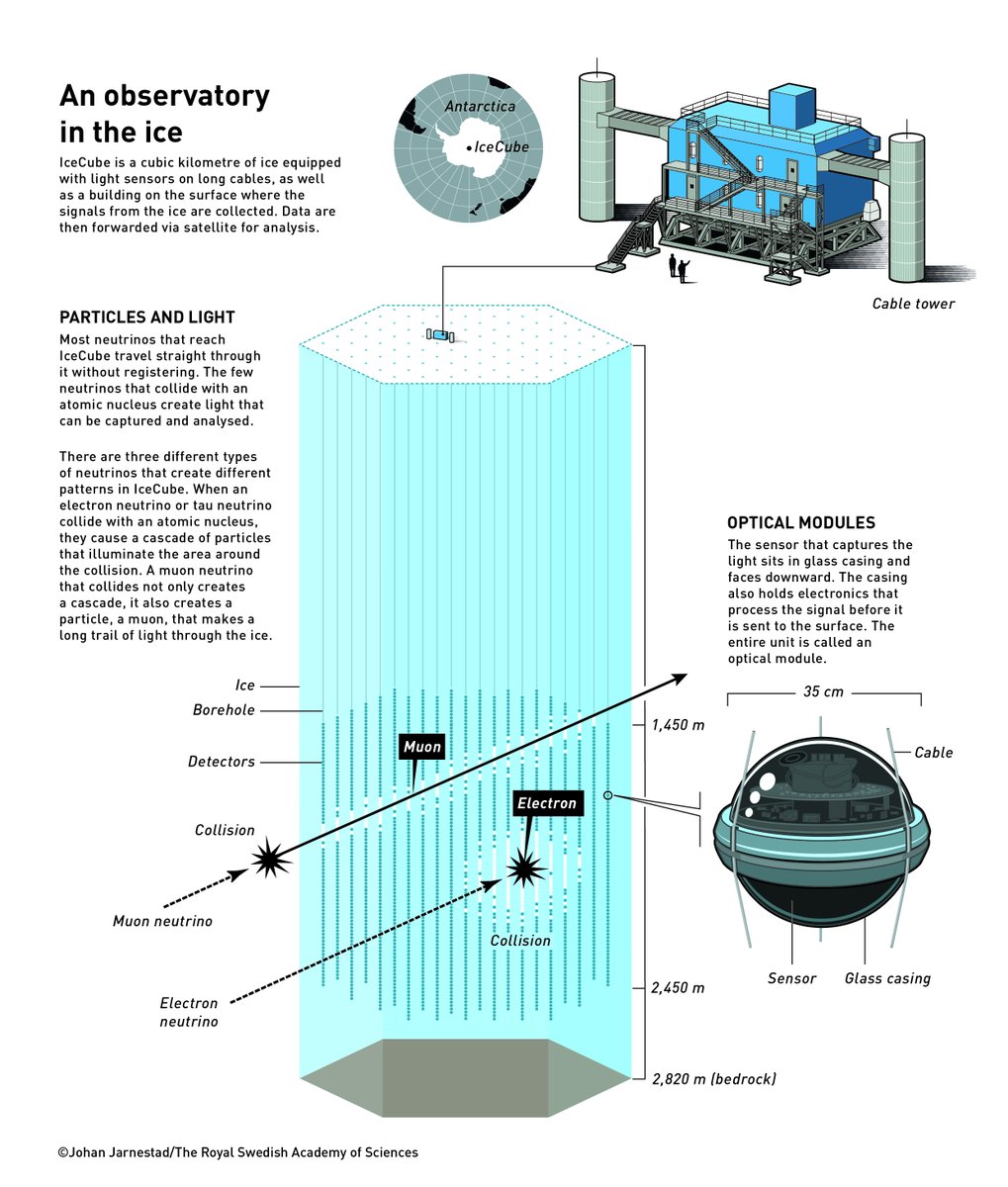
Cosmic neutrinos with extremely high energies are very rare, so an enormous volume of ice is needed to observe an adequate number of collisions. The IceCube Neutrino Observatory covers an entire cubic kilometre and was finished in 2011. Researchers soon discovered the first high-energy neutrinos and, a few years later, could publish their discovery of neutrinos that must originate far outside our solar system. The search for the universe’s neutrino sources could begin in earnest.
Francis Halzen has received the 2026 #NobelPrize in Physics for his decisive contributions to the IceCube Neutrino Observatory and the discovery of high-energy neutrinos of astrophysical origin.
@TheStalwart@Havelock_AI I find /goal in Codex to work pretty well for this type of thing. You define the success criteria, and basically iterates until hitting it.
https://t.co/n1K3RGuUC1
The Dodgers' local-TV deal is a profound competitive advantage. Because of a bankruptcy-court ruling, the team will shield more than $1.3 billion from rev sharing over 25 years. What you might not know: They further monetized it through debt deals with Mark Walter-owned insurers.